To get a mortgage pre-approval in Alberta, you need to show a lender who you are, what you earn, what you owe and what you have saved. In practice that means two pieces of government-issued identification, proof of employment and income, proof of your down payment and closing costs, a list of your debts and assets, and consent for a credit check. This guide walks Calgary, Airdrie and Cochrane buyers through each requirement, the numbers lenders apply and the mistakes that slow files down.
TL;DR
- Expect to provide identification, income documents, proof of down payment and closing funds, and a full list of debts and assets. The Government of Canada lists these as the core items.
- Minimum down payment in Canada is 5% on the first $500,000 of the price, 10% on the portion from $500,000 to $1.5 million, and 20% at $1.5 million or more.
- Budget for closing costs on top of the down payment, and keep your funds traceable in your own account.
- A pre-approval is not a final approval: the property, the appraisal and your finances at closing still matter.
- Self-employed buyers and newcomers usually need extra documents, so start collecting them early.
Table of Contents
- What a pre-approval is, and what it is not
- The documents you need for a pre-approval in Alberta
- The financial requirements lenders assess
- Down payment rules that apply in Alberta
- Extra requirements for self-employed buyers
- Requirements for newcomers to Canada
- How long a pre-approval takes and how long it lasts
- What can still change after you are pre-approved
- Why use a broker for your pre-approval
- Our perspective
- Start your pre-approval with a Calgary broker
- A document checklist you can print
- FAQ
- Sources
What a pre-approval is, and what it is not
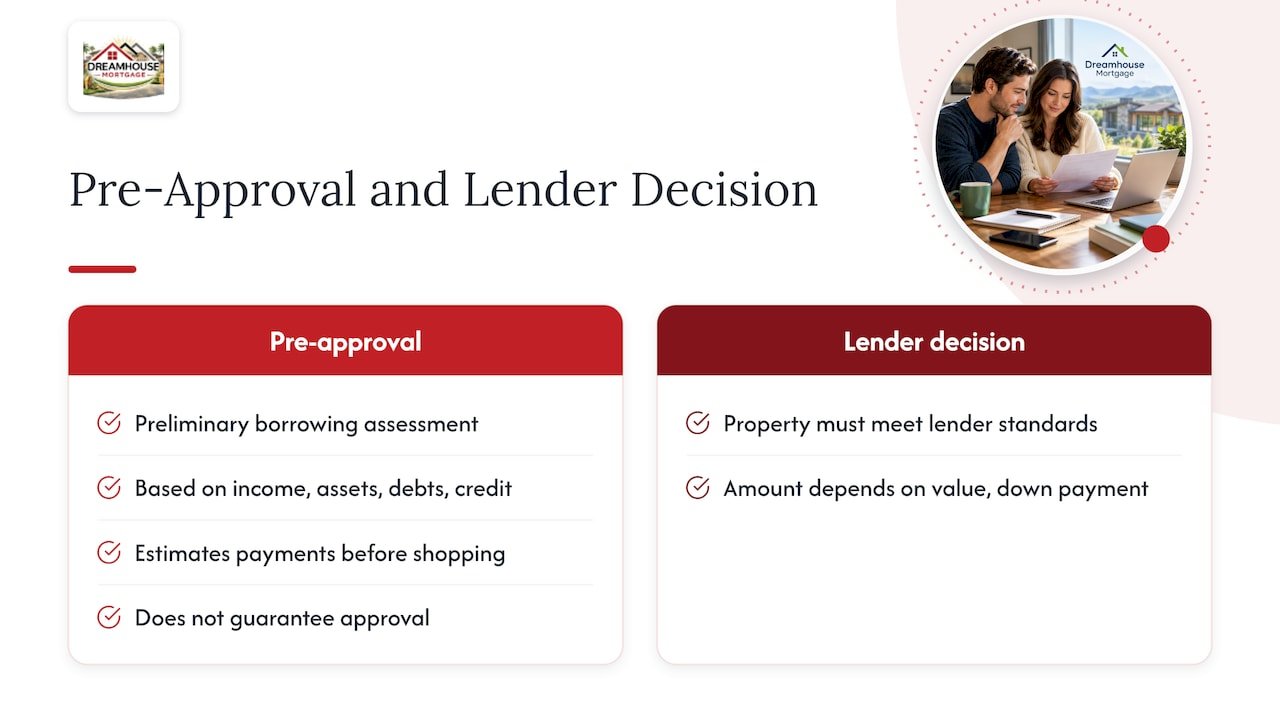
A mortgage pre-approval is a lender’s preliminary assessment of how much you may be able to borrow, based on your assets, income, debts and credit. According to the Financial Consumer Agency of Canada, it can help you learn the maximum mortgage you could qualify for and estimate your payments before you start shopping.
It is not a guarantee. The same federal page states that a pre-approval does not guarantee mortgage approval. The lender will still verify that the property meets its standards, and the final amount depends on the property’s value and your down payment. Different lenders also define and apply each step differently, which is one reason a pre-approval from one lender may not look like another’s.
For Calgary buyers, this last point matters in a market where appraisals can shift a deal. We explain how in our article on preapproval vs approval and why Calgary appraisals can change the deal.
The documents you need for a pre-approval in Alberta
Mortgage rules in Canada are federal and lender-driven, so the document list is largely the same in Alberta as elsewhere in the country. What changes is how you apply it to your own situation. The Government of Canada summarizes the categories as identification, proof of employment, proof of funds for your down payment and closing costs, information on other assets, and details on your debts and financial obligations.
Here is how that looks as a working checklist.
Identification
- Two pieces of valid government-issued photo identification, such as an Alberta driver’s licence and a Canadian passport.
- Your Social Insurance Number, where the lender asks for it for the credit check.
- Your current address and address history, usually for the last two to three years.
Proof of employment and income
If you are salaried, lenders typically ask for:
- A recent pay stub showing year-to-date earnings.
- A letter of employment confirming your position, start date, pay and whether you are permanent, probationary or contract.
- Your most recent Canada Revenue Agency Notices of Assessment, and T4 slips, if the lender wants to compare stated income to filed income.
If you earn commission, bonuses or overtime, expect lenders to average those amounts over a period, often two years, rather than count your best month. Keep your T4s and Notices of Assessment handy.
Pro Tip: Download your Notices of Assessment from your CRA My Account before you contact a broker. It takes a few minutes and avoids a delay later.
Proof of down payment and closing costs
Lenders want to see where your down payment is coming from, and that it has been in your accounts long enough to be traceable. Usually this means 90 days of bank statements, RRSP or TFSA statements if you are using those funds, and a gift letter if a family member is helping.
Closing costs are separate from your down payment. The Canada Mortgage and Housing Corporation (CMHC) notes that borrowers need proof they can cover closing costs, usually between 1.5% and 4% of the cost of the house. On a $450,000 Calgary townhome, that range is $6,750 to $18,000 on top of your down payment.
Debts, assets and obligations
You will be asked to list everything you owe and own:
- Credit card balances and limits
- Car loans or leases
- Student loans and lines of credit
- Child support or spousal support payments
- Other properties and their mortgages
- Savings, investments, RRSPs and TFSAs
Lenders may need a complete accounting of existing debts because your down payment size and current obligations affect how much you can afford. Leaving out a small line of credit is a common cause of trouble later, since it will show up on your credit report anyway.
For a longer version of this list, see our Alberta mortgage documents checklist and our guide to pre-approval documents for Calgary buyers.
The financial requirements lenders assess
Documents only prove the numbers. The lender then tests those numbers against its own rules and federal standards.
Income, debt and the amount you can borrow
Lenders look at your assets, income and debt to determine the maximum they may lend, and the Government of Canada adds that the approved amount also depends on the property’s value and your down payment. In practice, lenders use two ratios:
- Gross Debt Service (GDS): the share of your gross income that goes to housing costs, such as mortgage payments, property taxes and heat, plus condo fees where they apply.
- Total Debt Service (TDS): the share of your gross income that goes to housing costs plus all your other debt payments.
The maximum ratios differ between lenders and between insured and uninsured mortgages, so we do not quote a single universal figure. What matters for you is the direction: every dollar of monthly debt you carry reduces the mortgage you can qualify for. Paying down a credit card balance or closing an unused line of credit before you apply can raise your borrowing power.
The stress test
Canadian lenders qualify you at a rate higher than the rate you will actually pay. For uninsured mortgages, the rule is built around the greater of a fixed minimum rate and your contract rate plus a buffer. We cover the current figure and what it means for your buying power in our guide on pre-approval documents and the OSFI 5.25% rule. A broker will run the numbers at the qualifying rate, not just the rate on the advertisement.
Credit history
Expect a credit check. The Government of Canada notes that a lender may refuse a mortgage if your credit history is poor. CMHC explains that credit history shows how reliably you have paid debts and bills, that people with no history can start building one, and that those with bad credit need to re-establish a good record.
What you can do before applying:
- Pay every bill on time in the months before you apply.
- Keep credit card balances well below your limits.
- Avoid opening new credit cards, car loans or store financing.
- Check your own credit report for errors and correct them.
Pro Tip: Do not finance a vehicle or furniture between pre-approval and closing. A new monthly payment can change your debt ratios and put your approval at risk.
Down payment rules that apply in Alberta
Down payment rules are federal, so they are the same for buyers in Calgary, Cochrane, Airdrie and Edmonton. According to the Government of Canada, the minimum down payment is 5% on the first $500,000 of the purchase price, 10% on the portion above $500,000 up to $1.5 million, and 20% for homes priced at $1.5 million or more.
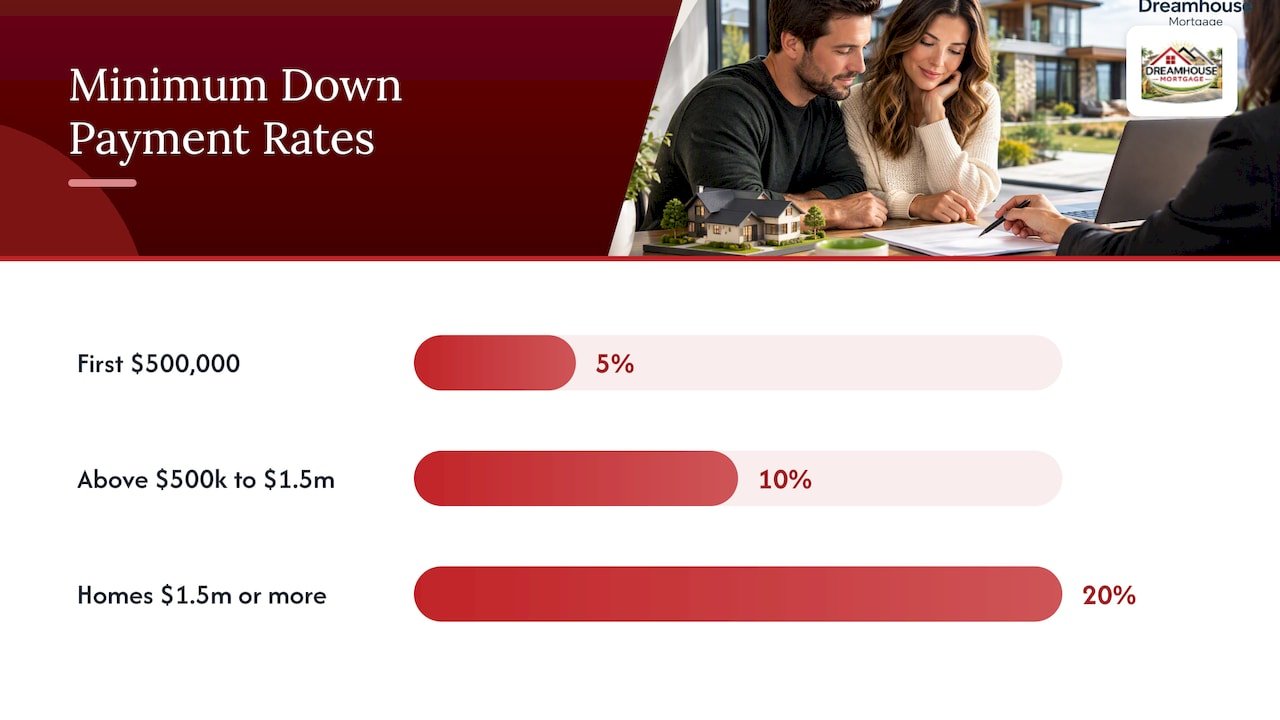
The same page notes that mortgage loan insurance is typically required when your down payment is below 20% of the price, and that it is not available for purchase prices of $1 million or more.
Here are worked examples using those published rules:
| Purchase price | Minimum down payment | How it is calculated |
|---|---|---|
| $400,000 | $20,000 | 5% of $400,000 |
| $500,000 | $25,000 | 5% of $500,000 |
| $650,000 | $40,000 | 5% of $500,000 plus 10% of $150,000 |
| $900,000 | $65,000 | 5% of $500,000 plus 10% of $400,000 |
At $1 million or more, mortgage insurance is unavailable, so a down payment below 20% is not an option through that route. Sources of down payment funds, including savings, RRSP withdrawals under the Home Buyers’ Plan and gifts, each have documentation requirements. Our guide to mortgage down payment types in Canada explains what each requires.
Extra requirements for self-employed buyers
If you own a business or work on commission in Calgary, your income is assessed differently. The Government of Canada says self-employed borrowers may need to provide Canada Revenue Agency Notices of Assessment from the past two years as proof of employment income.
Other items commonly requested include:
- Personal T1 General returns
- Business registration or incorporation documents
- Business bank statements
- Financial statements, where the lender asks for them
Some lenders weigh your net income after write-offs, while others offer programs that look at your income more broadly. Which route fits you depends on your tax filings and how long you have been in business. Our guides on self-employed mortgage income proof in Alberta and self-employed mortgage documents for Calgary break down the options.
Requirements for newcomers to Canada
If you recently arrived, you may not have a Canadian credit history or two years of Canadian income. Lenders with newcomer programs focus on your immigration status, your employment, funds you have transferred and international credit information where available. Expect to show your work permit or permanent resident documents, your employment letter and proof that your down payment is in a Canadian account.
Transferring funds from abroad requires care. Large deposits must be explained, and lenders ask for a paper trail for the source of funds. Our guide for Calgary newcomers seeking a mortgage covers the full process, and our New to Canada mortgage page outlines the programs.
How long a pre-approval takes and how long it lasts
If your documents are ready, a broker can often submit your application quickly, and a lender may return a decision within a few business days. Timelines vary by lender and by how complete your file is. Missing documents are the most common reason for delay.
Rate holds also vary by lender. Many pre-approvals include a rate hold that lasts a set number of months, so ask for the exact length in writing, and ask whether the lender offers a lower rate if market rates fall before you buy. Plan your house hunt around the hold. If you are still looking when it ends, your broker can help you renew the pre-approval with updated documents.
What can still change after you are pre-approved
A pre-approval is conditional. These are the situations that most often alter the outcome:
- The property does not meet lender standards. The lender verifies the home itself, as the Government of Canada notes.
- The appraisal comes in below the price. Your down payment may then need to cover the gap.
- Your finances change. A job change, a new loan or a drop in credit score can alter the decision.
- Your down payment cannot be verified. Unexplained deposits are a common stumbling block.
- Condo documents raise concerns. For condo purchases, lenders review the status certificate and reserve fund information.
Pro Tip: Keep your finances steady from pre-approval until the keys are in your hand. No new debt, no job change without telling your broker, and no large unexplained deposits.
Why use a broker for your pre-approval
A bank can only offer you its own products. A broker can compare many lenders at once, which matters when your file has some feature, such as self-employment, a smaller down payment or a short credit history, that suits some lenders better than others. We work with banks, credit unions, monoline lenders, alternative lenders and private lenders, so we can match your file to the lender most likely to approve it.
You can see how the steps unfold in our mortgage pre-approval process for Alberta buyers and our Calgary pre-approval step-by-step guide.
Our perspective
Most pre-approval problems we see in Calgary, Airdrie and Cochrane are not about eligibility. They come from preparation. A buyer who has two years of Notices of Assessment, 90 days of statements, a gift letter if needed and a clear list of debts is usually in a far stronger position than one who is missing a document and learns about it on the day an offer needs a lender’s answer.
That is why we start every first-time buyer conversation with the documents and the numbers, not the rate. A rate is only useful if you qualify for it. By reviewing your income, debts and down payment against several lenders before you shop, we can tell you what price range is realistic, and which lender suits your file. Because we work with banks, credit unions, monoline, alternative and private lenders, we are not limited to one lender’s rules.
Our goal is a calm, transparent process. You should know what is needed, why it is needed and what happens next. If something in your file is complicated, such as self-employed income, newcomer status or credit that needs repair, we would rather plan for it early than discover it late.
Guriqbal Chahal, MBA, PMP
Start your pre-approval with a Calgary broker
DreamHouse Mortgage is a Calgary-based brokerage, founded in 2013, serving Calgary, Airdrie, Cochrane, Chestermere, Okotoks, High River, Edmonton, Red Deer and surrounding Alberta communities. Our pre-approval service is built for first-time buyers who want clear answers before they make an offer.

We review your documents, compare lenders and tell you what you can realistically borrow. Learn more on our Calgary mortgage pre-approval page, see our first-time buyer guide for Calgary, or visit DreamHouse Mortgage to see our full range of services.
Call Guriqbal Chahal, MBA, PMP, Mortgage Broker, at 403-966-6072. You can also find us on our Google Business Profile.
A document checklist you can print
Before you call, gather the following. Tick off what you have and tell your broker about anything missing.
- [ ] Two pieces of government-issued photo ID
- [ ] Recent pay stub and employment letter (or, if self-employed, two years of Notices of Assessment)
- [ ] T4 slips or T1 General returns for the last two years
- [ ] 90 days of bank statements for your down payment account
- [ ] RRSP, TFSA or investment statements if used for the down payment
- [ ] Gift letter, if family is contributing
- [ ] A list of all debts with balances and monthly payments
- [ ] Information on any other property you own
- [ ] Funds set aside for closing costs
If you want a fuller list tailored to Alberta, our mortgage documents guide goes into more detail.
FAQ
What is needed for a mortgage pre-approval in Alberta?
You need identification, proof of employment and income, proof of your down payment and closing costs, and details of your debts and assets. The lender will also run a credit check. Self-employed buyers typically add two years of CRA Notices of Assessment.
How much mortgage can I get with a $70,000 salary?
It depends on your debts, your down payment, the interest rate and the property. Lenders assess your income against your debt obligations, so someone with no other debts can usually borrow more than someone with a car loan and credit card balances. A broker can run your exact figures through several lenders’ rules.
What are the down payment rules for houses in Alberta?
The rules are federal. The minimum is 5% of the first $500,000, 10% of the portion between $500,000 and $1.5 million, and 20% at $1.5 million or more. Mortgage insurance is typically required below 20% down and is not available at $1 million or more, according to the Government of Canada.
Does a pre-approval guarantee I will get the mortgage?
No. The lender still verifies the property, and the final amount depends on the property’s value and your down payment. Keep your income, debts and credit stable until closing.
Sources
- Getting preapproved for a mortgage, Financial Consumer Agency of Canada
- How much you need for a down payment, Financial Consumer Agency of Canada
- Are You Financially Ready to Buy a Home?, CMHC
Recommended
- Ultimate Guide to Mortgage Documents Required Alberta (2026 Checklist That Gets You Approved Faster)
- Mortgage Pre-Approval Process Explained for Alberta Buyers
- Mortgage Pre-Approval Process Explained for Alberta Buyers
- Mortgage Checklist Calgary: The Ultimate Proven Guide — Everything You Need Before Applying (2026)