In Canada, an “adjustable-rate” mortgage and a “variable-rate” mortgage usually describe the same thing: a rate that moves with the lender’s prime rate during your term. The difference that actually affects your budget is what happens to your payment when the rate moves. Some variable mortgages change your payment each time prime changes. Others keep the payment fixed and shift the split between interest and principal. This guide explains both, compares them against a fixed rate, and shows how a Calgary, Airdrie or Cochrane buyer can decide.
TL;DR
- In everyday Canadian use, “adjustable” and “variable” both mean a rate tied to the lender’s prime rate. Ask your lender how the payment behaves, because that is where products differ.
- Adjustable-payment variable mortgages change your payment when the rate changes. Fixed-payment variable mortgages keep the payment steady, but rising rates can push more of it into interest.
- If rates climb far enough on a fixed-payment variable, none of the payment may reach principal and the balance can grow, according to the Financial Consumer Agency of Canada.
- Before you choose, test your budget against a one and two percentage point rate increase.
- Call Guriqbal Chahal at 403-966-6072 to compare variable and fixed options across multiple lenders.
Table of Contents
- Adjustable vs Variable: Are They Different Products?
- How the Two Variable Payment Structures Work
- Variable vs Fixed: What the Evidence Says
- Stress-Testing Your Budget Before You Choose
- Who Tends to Choose Variable, and Who Chooses Fixed
- First-Time Buyers in Calgary, Airdrie and Cochrane
- Why the Bank of Canada Matters to Variable Mortgages
- Our Perspective: Choose the Structure, Then the Rate
- Questions to Ask Any Lender About a Variable Mortgage
- Work With a Calgary Mortgage Broker on the Decision
- FAQ
- Sources
Adjustable vs Variable: Are They Different Products?
If you search for an adjustable-rate mortgage in Canada, you will find the term used loosely. Many Canadian lenders and websites use “adjustable,” “floating” and “variable” as near-synonyms. The term “adjustable-rate mortgage” is also strongly associated with products from outside Canada, which have different rules and structures. For that reason, we recommend you do not rely on the label alone. Ask the lender or broker these three questions:
- What is the rate quoted against? (Typically the lender’s prime rate, plus or minus a set percentage.)
- Does the payment change when prime changes, or does it stay fixed?
- What are the penalty and conversion terms if I want to leave the product or lock into a fixed rate?
The Financial Consumer Agency of Canada describes a variable interest rate as one that can increase or decrease during the mortgage term, often set at the lender’s prime rate plus a percentage. That is the core definition of what Canadians mean by variable, and by adjustable in most conversations.
Pro Tip: When a lender’s marketing says “adjustable,” confirm in writing whether it means adjustable rate with adjustable payments, or adjustable rate with a fixed payment. The two behave very differently when rates rise.
How the Two Variable Payment Structures Work
The real split inside the variable category is the payment structure. The FCAC explains both versions, and the Bank of Canada has studied the fixed-payment type in detail.
Adjustable-payment variable mortgages
With adjustable payments, your payment changes when the interest rate changes. If prime falls, your payment drops. If prime rises, your payment rises. Your amortization schedule stays on track, because each payment is recalculated to match the new rate. This makes the cost of rate changes visible immediately, which suits borrowers who want their principal paydown to remain steady and who have room in their monthly budget.
Fixed-payment variable mortgages
With fixed payments, your payment stays the same even as your rate moves. According to a Bank of Canada staff analytical note, when prime rises on this type of mortgage, more of the payment goes to interest and less to principal, while the total payment remains fixed. When prime falls, the opposite happens and you pay down principal faster.
That predictability of the cash payment has a limit. The FCAC notes that with fixed payments, rising rates can leave the payment covering only interest and increase the mortgage balance. If rates rise to the trigger point, none of the payment may go toward principal and the amount owed can increase.
If you want to understand that threshold in detail, our guide to trigger rates and negative amortization walks through it using a Calgary-sized loan.
Side by side
| Feature | Adjustable-payment variable | Fixed-payment variable | Fixed rate |
|---|---|---|---|
| Rate moves with lender’s prime | Yes | Yes | No, set for the term |
| Payment when rates rise | Goes up | Stays the same | Stays the same |
| Payment when rates fall | Goes down | Stays the same | Stays the same |
| What changes instead | Nothing; amortization stays on track | Interest vs principal split | Nothing during the term |
| Main risk | Payment shock on a tight budget | Slower paydown, possible balance growth at trigger point | Rate may be higher than variable at the start |
| Best for | Borrowers with a flexible monthly budget | Borrowers who want steady payments and accept paydown risk | Borrowers who want certainty |
The fixed-rate column reflects the general principle in the FCAC and FCC sources: fixed rates provide certainty, while variable rates can rise or fall.
Variable vs Fixed: What the Evidence Says
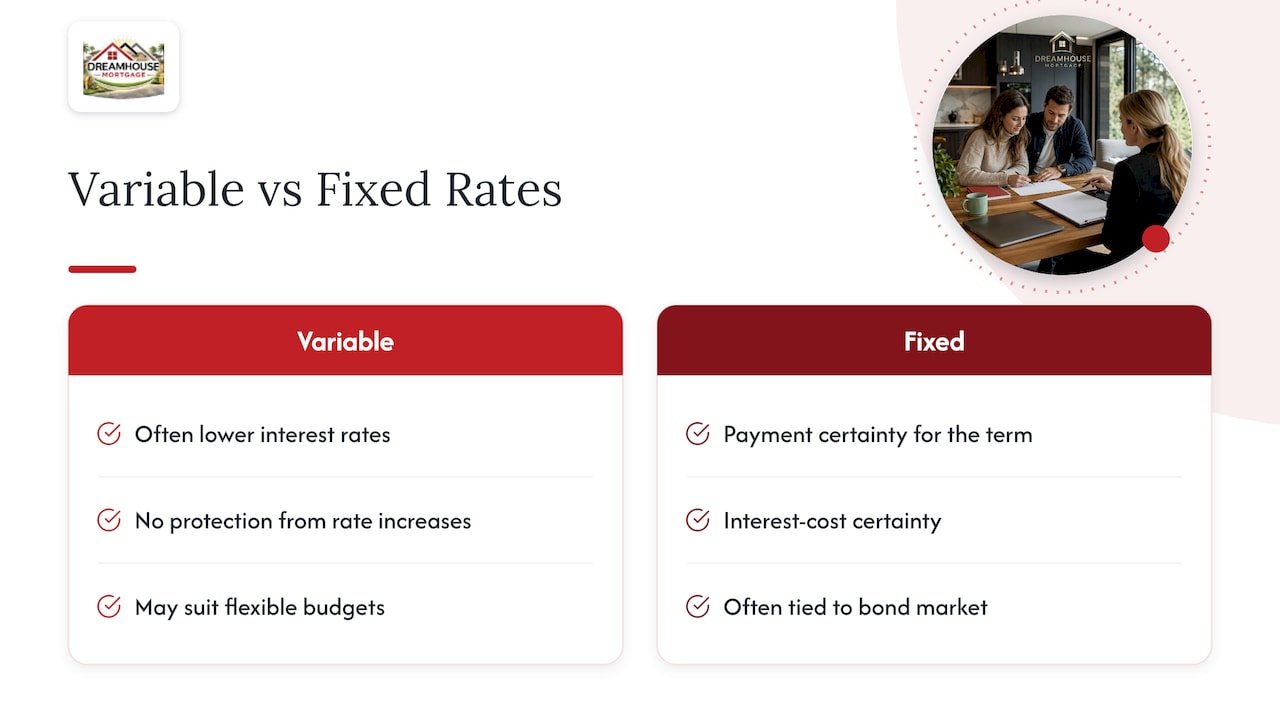
The usual trade-off is cost against certainty. Farm Credit Canada notes that variable-rate mortgages often have lower interest rates than fixed-rate mortgages, but they offer no protection against rate increases. Fixed rates, which are often tied to the bond market, give you certainty over your payment and interest cost for the term.
The FCAC also says variable rates may be lower than fixed rates, but they can rise. It adds that variable-rate mortgages may suit borrowers who are comfortable with uncertainty in rates and payments and who have a flexible budget to absorb increases.
How much can rates move? The FCAC reports that interest rates varied between 0.5% and 4.75% from 2005 to 2015. That range is a useful reminder that a variable rate can look very different at the end of a five-year term than at the start, in either direction.
We cover this decision from an Alberta perspective in our fixed vs variable mortgage Alberta guide, and our page on fixed vs variable for new buyers is written for people buying their first home.
Stress-Testing Your Budget Before You Choose
The most practical step is to price the downside before you sign. Farm Credit Canada advises borrowers on a variable rate to calculate the impact of a one and two percentage point increase on their payments and cash flow. The Quebec regulator, the AMF, likewise recommends using a calculator to estimate payments after an interest-rate change. Quebec rules do not govern an Alberta mortgage, but the exercise is the same anywhere in Canada.
Here is a simple method:
- Take your current or quoted rate and mortgage balance.
- Recalculate the payment at that rate plus 1 percentage point, then plus 2 percentage points.
- Compare each result with your monthly income after tax, property taxes, utilities, child care, vehicle costs and savings.
- Decide whether you could carry the higher payment for at least a year without borrowing elsewhere.
You can run the numbers with our Calgary mortgage calculators and see how the length of the amortization changes the payment in our mortgage amortization calculator guide.
A worked example
Suppose a Calgary couple borrows $400,000 on a 25-year amortization. These figures are illustrative only, not a quote. Using the standard mortgage payment formula with monthly compounding for simplicity, a 4.50% rate gives a payment of roughly $2,220 a month, and a 5.50% rate gives roughly $2,440, a difference of about $220 a month. At 6.50% the payment is roughly $2,690. On an adjustable-payment variable, that is the monthly increase you would feel. On a fixed-payment variable, the payment would not change, but a larger share would go to interest, which is why the trigger point matters.
Canadian fixed-rate mortgages normally compound semi-annually and variable mortgages normally compound monthly, so a lender’s actual payment will differ slightly from this example. Your broker will give you exact figures.
Who Tends to Choose Variable, and Who Chooses Fixed
No option wins for everyone. These are the questions we ask Calgary-area clients.
A variable rate may suit you if
- You have a monthly budget with a real cushion after housing costs.
- You have savings you could use for a lump-sum payment if rates rise.
- You expect to stay flexible about your plans and want to understand your exit terms.
- You are comfortable watching the Bank of Canada’s announcements without losing sleep.
A fixed rate may suit you if
- Your budget is tight, which is common for first-time buyers who have just used their savings on a down payment.
- You rely on a single income, or one of you is self-employed with variable income.
- You are buying in a community such as Airdrie, Cochrane or Chestermere and want to know your cost for the next several years.
- You value certainty over the chance of a lower cost.
Middle paths
Farm Credit Canada and many lenders point to ways to split the difference. A shorter fixed term gives certainty for a defined period without locking you in for as long. Some borrowers also choose a hybrid arrangement that combines a fixed and variable portion. Availability and terms differ by lender, so ask which structures each lender permits.
First-Time Buyers in Calgary, Airdrie and Cochrane
First-time buyers tend to have the least slack in their budgets, so payment structure matters more than a small rate difference. A few practical points:
- Test the higher payment before you make an offer. If a one or two percentage point increase would strain your budget, a fixed rate may be the more comfortable choice.
- Look at the full cost, not just the rate. Property taxes, condo fees, utilities and commuting costs vary between neighbourhoods in Calgary, such as Beltline, Mahogany, Skyview Ranch or Tuscany, and between nearby towns like Airdrie and Cochrane.
- Get pre-approved first. A pre-approval lets you see what each rate type means for your purchase price. Our mortgage pre-approval process guide explains the steps and documents, and our first-time homebuyer mortgage Calgary guide covers the wider purchase process.
- Ask about the rate hold. Many lenders hold a quoted rate for a period while you shop, so ask how long yours applies.
If you are comparing offers, our overview of Calgary mortgage rates shows what to compare beyond the headline number.
Why the Bank of Canada Matters to Variable Mortgages
The Bank of Canada’s policy rate influences lenders’ prime rates, and prime is the benchmark for most variable mortgages. When the policy rate moves, lenders usually adjust prime shortly after. Fixed rates respond more to the bond market, as the Farm Credit Canada source notes, so fixed and variable pricing can move independently.
For a Calgary homeowner, the practical consequence is that a variable mortgage ties your budget to decisions made in Ottawa. Our article on how the Bank of Canada rate affects a Calgary mortgage explains the connection. Because rates change, check current advertised rates with a broker rather than relying on any figure printed in an article.
Our Perspective: Choose the Structure, Then the Rate
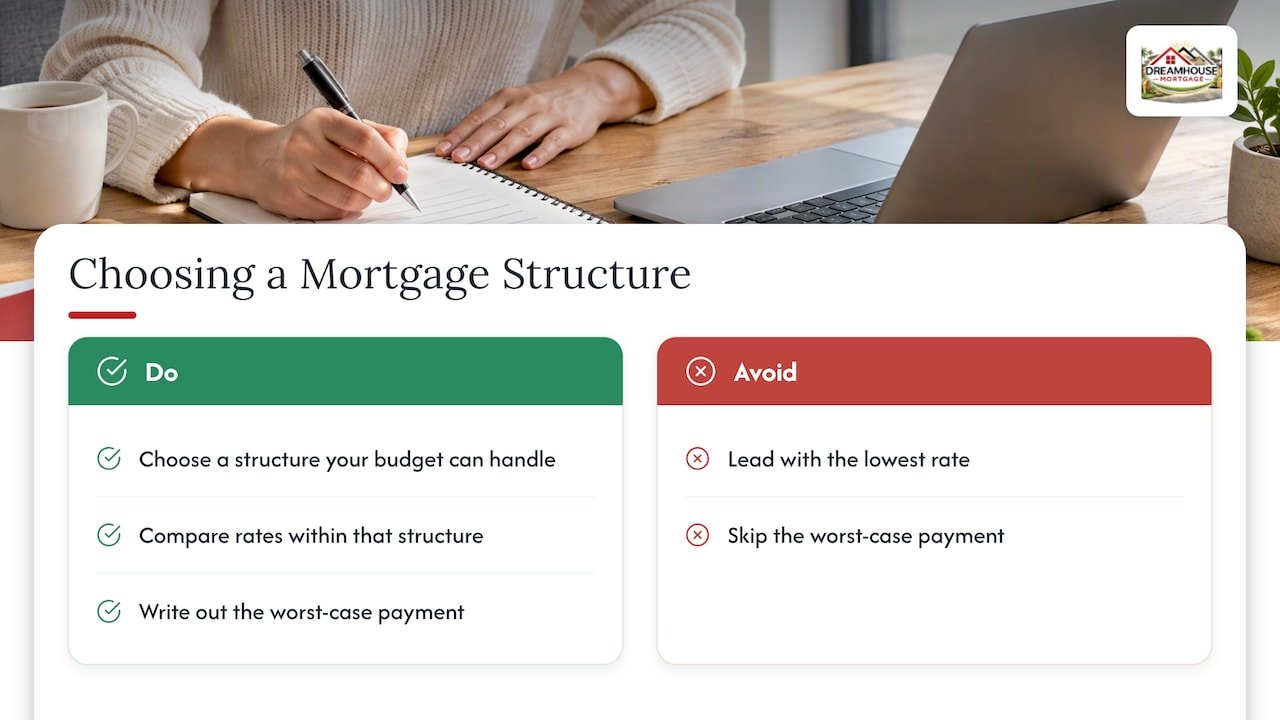
We see many borrowers start with the question “which rate is lowest?” and only later learn how the product behaves. We encourage the reverse order. Choose the payment structure that your budget can survive in a bad year, then compare rates among lenders that offer that structure.
At DreamHouse Mortgage we work with banks, credit unions, monoline lenders, alternative lenders and private lenders. That matters here because variable products differ between lenders: which prime they use, whether payments adjust or stay fixed, what the penalty is for leaving, and whether you can convert to a fixed rate. A broker can lay those terms next to each other. Our Calgary clients, including first-time buyers, tend to appreciate seeing the worst-case payment written out before they commit.
For a first home, our usual advice is simple. Pick the option you could comfortably live with if rates moved against you. If you are comfortable with the higher payment and have a financial buffer, a variable option deserves a serious look. If the higher payment would cause stress, a fixed rate protects your plan.
— Guriqbal Chahal, MBA, PMP
Questions to Ask Any Lender About a Variable Mortgage
Use this checklist when you compare offers:
- Is the payment adjustable or fixed?
- If fixed, what is the trigger rate, and what happens when it is reached?
- How is the rate expressed: prime minus, prime plus, or prime flat?
- How is the penalty calculated if I break the mortgage early?
- Can I convert to a fixed rate during the term, and at what rate?
- What prepayment privileges do I have each year?
- What happens at renewal, and can I switch lenders without penalty?
The last question matters for homeowners in Calgary approaching a term end. Our Renew or Switch service reviews renewal offers alongside other lenders’ rates, and a broker can also help you assess whether a variable or fixed option fits your next term.
Pro Tip: Ask for the answers by email, not just in conversation. Mortgage terms are detailed, and written answers prevent misunderstandings.
Work With a Calgary Mortgage Broker on the Decision
DreamHouse Mortgage is a Calgary brokerage founded in 2013, serving Calgary, Airdrie, Cochrane, Chestermere, Okotoks, High River, Rocky View County, Edmonton, Red Deer and surrounding Alberta communities. We help first-time buyers compare variable and fixed options across multiple lenders, line up pre-approval, and prepare documents so that the offer you make is one you can finance.
Start with our first-time buyer mortgage and pre-approval services, or read our first-time home buyer guide for Alberta before you call.
Call Guriqbal Chahal, MBA, PMP, Mortgage Broker, at 403-966-6072. You can also find us on our Google Business Profile.
FAQ
Is an adjustable-rate mortgage the same as a variable-rate mortgage in Canada?
In most Canadian conversations, yes: both refer to a rate that moves with the lender’s prime rate. What differs between products is how the payment behaves, since some variable mortgages adjust the payment and others hold it fixed. Ask your lender for the exact structure in writing.
Can my balance grow on a variable mortgage?
It can on a fixed-payment variable mortgage. The Financial Consumer Agency of Canada explains that if rates reach the trigger point, none of the payment may go toward principal and the amount owed can increase. An adjustable-payment variable avoids this because the payment rises with the rate.
Are variable rates always cheaper than fixed rates?
No. Farm Credit Canada says variable rates often start lower, but they give no protection against increases. Over a full term, the result depends on where rates go, so compare what each option would cost under different scenarios rather than assuming one will win.
Should a first-time buyer in Calgary choose variable or fixed?
It depends on how much room your monthly budget has. If a payment increase of one or two percentage points would strain your finances, a fixed rate may be the more comfortable choice. If you have a cushion and savings, a variable option is worth comparing. A broker can show you both side by side.
Can I switch from variable to fixed during my term?
Many lenders allow conversion to a fixed rate during the term, but conditions and the rate offered vary. Ask about conversion terms before you sign, and confirm them in writing.
Sources
- Interest on mortgages, Financial Consumer Agency of Canada
- Variable-rate mortgages with fixed payments, Bank of Canada staff analytical note
- Interpreting interest rate fluctuations, Farm Credit Canada
- Mortgage features, Autorité des marchés financiers