The best rental property lender in Canada is not one name. It is the lender whose rules fit your down payment, your income and the property you are buying, and the quickest way to find that lender is through a mortgage broker who can place you with banks, credit unions, monoline lenders, alternative lenders and private lenders. A bank that counts only part of your future rent can decline a deal that a monoline or alternative lender funds on the same day. At DreamHouse Mortgage in Calgary, we compare those lender types for investors in Calgary, Airdrie, Cochrane, Chestermere and across Alberta, and you can reach Guriqbal Chahal, MBA, PMP, directly at 403-966-6072.
This guide shows who the main lenders are, what they publish, how each one counts rental income, and what to compare before you sign.
TL;DR
- A rental property you will not live in needs at least 20% down, and mortgage default insurance is not available for it. A narrow exception exists for owner-occupied 2 to 4 unit homes.
- Lenders differ most in how they count rent: some offset part of your gross rent, some add back a share of net rent, and some require the rent to cover the payment.
- Published rental rates run above owner-occupied rates. Lenders add a premium for rentals, and alternative lenders add more.
- Compare prepayment terms, lender fees and renewal conditions, not just the rate.
- A broker can compare lender categories for you. Call Guriqbal Chahal at 403-966-6072.
Table of Contents
- Types of Canadian rental property lenders
- What specific lenders publish for rental properties
- How lenders count your rental income
- Down payment rules for rental properties
- Rates: what rental mortgages cost
- Fees, prepayment and renewal: the comparison most investors skip
- Choosing a lender by your situation
- A checklist before you apply
- How DreamHouse Mortgage helps rental investors
- Our perspective
- FAQ
- Sources
Types of Canadian rental property lenders
Canadian rental financing falls into five groups. Each suits a different investor, and the order below runs from the lowest rates to the most flexible approvals.
| Lender type | Typical fit | What to expect |
|---|---|---|
| Big banks | Strong income, clean credit, 1 to 4 unit rentals or larger multi-unit buildings | Conservative rental income rules, lowest published rates, tighter exceptions |
| Monoline lenders | Investors who want competitive pricing and clear rental programs | Often sold through brokers, structured rental programs |
| Credit unions | Borrowers who fit a local lender’s rules | Policies differ by institution, sometimes more flexible on rent |
| Alternative (B) lenders | Self-employed investors, bruised credit, larger portfolios | Higher rates and often a lender fee, more flexible qualification |
| Private lenders | Short-term, fast closings, unusual properties | Highest cost, shorter terms, value-based approvals |
The lender type matters more than the brand. A first-time investor with one rental condo in Calgary’s Beltline and a salaried job usually starts at the top of the table. A self-employed investor buying a duplex in Airdrie may be better served by a different row, and our self-employed lender types guide explains how that changes the file.
What specific lenders publish for rental properties
The programs below are examples of what is on the market, taken from each lender’s own pages. Programs, rates and limits change, so use them to understand how lenders differ.
| Lender | Rental program details | Notable terms |
|---|---|---|
| MCAP | Small Rental Program for up to four rental properties: condo, single family, duplex, triplex, fourplex | Flexible payment schedules and prepayment privileges |
| TD Canada Trust | Multi-Unit Residential Mortgage for buildings with 5 or more rental units | Up to 75% of appraised value on purchases, CMHC insurance potentially up to 85% |
| EQ Bank | Rentals up to a fourplex | Up to 30-year amortization, 50%/50% GDS/TDS, 95% add-back on subject rental income, extra 50 bps premium |
| Haventree Bank | Rental property mortgage for growing portfolios | Up to 9 properties in total, 1-, 2-, 3- or 5-year terms, up to 35-year amortization, rate guarantees up to 90 days on purchases |
| Optimum Mortgage | Alt-A rental program | Up to 80% LTV on the first $1.5M, 55% GDS and TDS, 600 minimum Beacon score, 20% minimum down payment on purchases |
| Bridgewater Bank | Gateway Mortgage, lends in Alberta | Up to 80% LTV, loans of $100,000 to $2,000,000, 35-year amortization, rental rate premium of 35 to 50 bps (June 2026 guidelines) |
| Alta West Capital | Express rental first mortgages in Alberta, Ontario and BC | Rentals up to 4 units under one title, 12-month terms, interest-only or up to 35-year amortization, 3 months’ interest prepayment penalty |
Three patterns stand out.
Unit count changes the lender. Programs for one to four units and programs for five or more units are different products with different underwriting. TD’s multi-unit product starts at five units, while MCAP and EQ Bank focus on smaller rentals.
Portfolio caps vary. Haventree allows up to nine properties with any lender, counting a principal residence, while EQ Bank caps its own exposure at four units within a ten-unit portfolio. If you plan to buy a second and third rental, the cap matters on day one.
Credit and ratio rules vary widely. Optimum asks for a 600 Beacon score and permits ratios of 55%, while Alta West’s October 2026 sheet listed minimum scores of 600 at 65% LTV and 620 at 70% LTV. Banks generally want stronger credit and lower ratios. Matching the file to the right row is the broker’s job.
How lenders count your rental income
This is where the best lender for you is decided. Canadian lenders use three common approaches:
- Rental offset: the lender counts a percentage of gross rent, typically 50% to 80%, against the property’s costs.
- Add-back: the lender adds a share of net rental income, often 50%, to your income.
- Debt coverage ratio (DCR): the rent must cover the mortgage payment by roughly 1.10 to 1.20 times.
The percentages differ by lender. EQ Bank states a 95% add-back for subject property rental income, and Optimum states 80% for both offset and add-back. Insured programs are stricter. Under CMHC’s Income Property program, borrowers may use up to 50% of gross rental income or a net rental income approach, with GDS capped at 39% and TDS at 44%.
A worked example
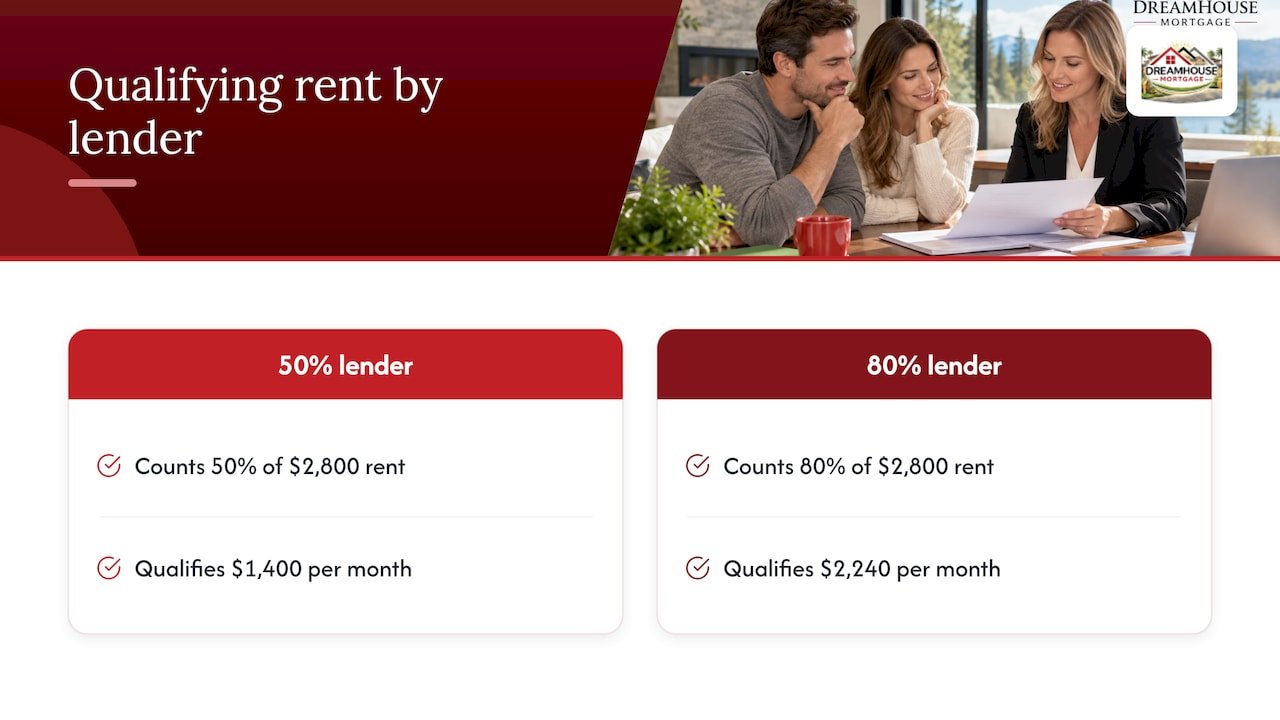
Say a duplex in Calgary’s northwest rents for $2,800 a month in total. A lender that counts 50% of that rent gives you $1,400 a month toward qualifying. A lender that counts 80% gives you $2,240 a month. On the same property and the same income, the second lender’s math allows a larger mortgage. Our Calgary article on when $2,000 of rent counts as $1,000 walks through this logic, and the page on the rental offset mortgage explains the offset method in more detail.
Lenders may also ask for a signed lease or an appraiser’s market rent estimate. A reserve of three to six months of mortgage payments and operating costs is a common recommendation. Plan for it before you make an offer.
Down payment rules for rental properties
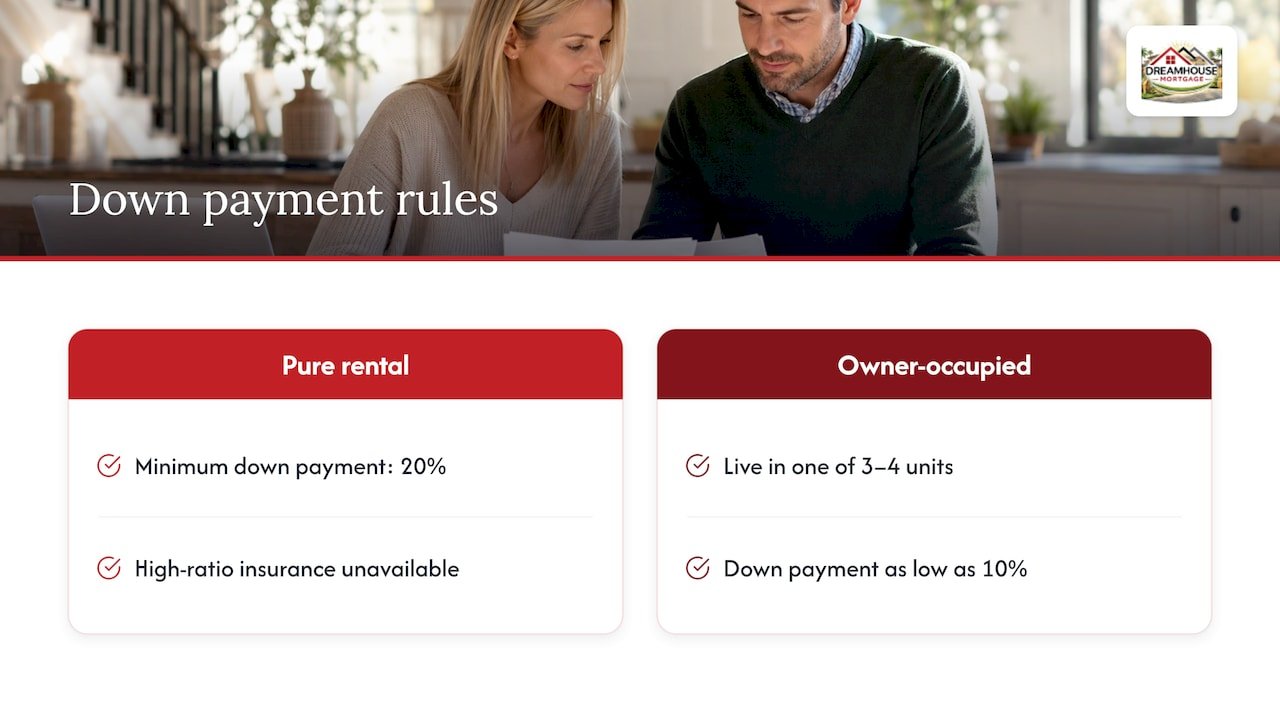
The rule is simple for a pure rental. For a one- to four-unit property you will not live in, the minimum down payment is 20%, and high-ratio insurance is not available. A 3- or 4-unit home where you live in one unit can qualify for as little as 10% down under CMHC’s insured rules. Owner-occupied purchases are the route many first-time investors in Calgary and Cochrane use to start, because you live in one unit and rent the others.
CMHC’s Income Property program insures non-owner-occupied 2 to 4 unit rentals with at least 20% equity, up to 80% LTV, a purchase price or lending value under $1,000,000 and a maximum 25-year amortization. Qualifying is done at the greater of the contract rate plus 2% or 5.25%, per the CMHC fact sheet linked above. Insured rentals can carry lower rates than uninsured ones, which is one reason it pays to compare programs rather than default to a single lender.
For a $700,000 rental, the minimum down payment is $140,000, and closing costs of $15,000 to $25,000 are a typical estimate in Ontario-heavy sources. Alberta has no land transfer tax, only registration fees, so your closing costs on an Alberta purchase will usually be lower than that range. Your broker will give you a figure for your specific purchase.
If you use funds from a gift, a sale or savings built up over time, how lenders view the source of that money matters too. Our guide to mortgage down payment types in Canada covers what documentation lenders ask for.
Rates: what rental mortgages cost
Rental mortgage pricing sits above owner-occupied pricing. Lenders usually add a premium for non-owner-occupied properties, and alternative and private lenders charge more again. Bank of Canada data cited by WealthNorth shows an August 2026 average of 4.58% for uninsured new fixed-rate mortgages of 5 years or more, against 4.12% for insured ones.
A few published reference points, each tied to its period:
- As of November 10 to 11, 2026, the prime rate at the major banks was 4.70%, raised from 4.45% on October 28, 2026 after the Bank of Canada raised its policy rate by 25 bps to 2.50%. TD uses a separate 4.85% prime for its variable-rate mortgage products.
- WealthONE Bank’s 2026 rental page listed investment-property fixed rates from 5.35% for a 1-year closed term to 5.69% for a 5-year closed term.
- Alta West Capital’s October 2026 rental sheet listed 6.49% at 65% LTV and 6.99% at 70% LTV on 12-month terms.
- Bridgewater Bank’s June 2026 guidelines show a rental rate premium of 35 to 50 bps.
These figures move with the prime rate, bond yields and each lender’s rate sheet, and lenders update rates often, sometimes weekly. Your own quote is the number that counts, and you should compare it with a live rate table on the day you apply. Our page on rental property mortgage rates in Calgary is where we keep that conversation Calgary-specific.
A lower advertised rate is not always the lowest cost. A lender that counts more of your rent can let you borrow what you need at a fair rate, while a lender with a slightly lower rate but stricter math may not approve the loan at all.
Fees, prepayment and renewal: the comparison most investors skip
Two mortgages with the same rate can cost very different amounts over five years. Compare these items in writing.
Prepayment privileges. Prepayment rules in the lender’s own documents differ. CIBC’s standard charge terms allow 10% of the original principal per calendar year without charge on a fixed-rate closed mortgage, and 20% with a Variable Flex Mortgage. Those are Ontario documents, so confirm your own province’s terms. Alta West Capital charges three months’ interest as a prepayment penalty. If you plan to sell or refinance within the term, ask how the penalty is calculated.
Lender and broker fees. Alternative lenders often charge a fee on top of the rate, commonly 1% to 2% of the mortgage according to bestrates.ca. Ask for the full cost of borrowing before you decide.
Amortization and term. Haventree offers up to 35-year amortization and Bridgewater up to 35 years, while CMHC-insured rentals are limited to 25. A longer amortization lowers the monthly payment, which helps the rent cover the cost. Interest-only options also exist, and our interest-only investment mortgage guide explains when they make sense.
Renewal. Since November 21, 2024, OSFI no longer requires a set minimum qualifying rate for uninsured straight switches between federally regulated lenders when neither the loan amount nor the amortization period increases. That makes it easier to move your rental mortgage to a better lender at renewal. Our renew or switch service reviews those options.
Rate holds. Some lenders guarantee a rate for a set window. Haventree states up to 90 days on purchases and 60 days on refinances. A rate hold protects you while you shop for the property.
Choosing a lender by your situation
You are buying your first rental
Start with the owner-occupied multi-unit route if it fits, since a 10% down payment on a 3- or 4-unit home you live in changes what you can afford. If you are buying a pure rental, plan for 20% down plus reserves and ask which rental income method each lender uses. The first-time home buyer guide for Calgary covers the ownership side if your rental is also your first home purchase, and our pre-approval requirements checklist for Alberta lists the documents to gather.
You already own and want to buy more
Portfolio limits and the way each lender counts your existing rent are the deciding points. Offset and add-back percentages across lenders can change how many properties you can add. A broker can sequence your purchases so each one fits a lender’s rules. See our overview of the investment property mortgage in Alberta for the Alberta-specific rules.
You are self-employed
If your declared income is lower than your real income because of write-offs, a lender with stated or alternative income programs may fit better than a bank. Our guide to self-employed mortgages in Calgary explains the paperwork.
You are new to Canada
Newcomers can buy rental property, but credit history and income documentation shape which lenders will say yes. The newcomer mortgage guide for Calgary explains the programs.
You plan to renovate the rental
Many investors buy a rental that needs work, then refinance once it is finished. Financing for renovations can come from the purchase mortgage, an equity take-out or a separate loan, and an overview of renovation loan types in Canada shows the range. Our Renovation Financing service builds this into the mortgage plan.
A checklist before you apply
- Decide your target property type and unit count, since it narrows the lender list.
- Confirm your down payment is at least 20% for a pure rental, and that its source can be documented.
- Estimate market rent and ask how each lender counts it.
- Set aside three to six months of payments and operating costs.
- Request the rate, the fee, the prepayment terms and the amortization in writing from each option.
- Ask about rate holds so you are protected during your search.
- Plan the exit: renewal, switch, sale or refinance.
Pro Tip: Tell your broker how many properties you want to own in three years before you pick your first lender. The first mortgage can limit the later ones.
How DreamHouse Mortgage helps rental investors
Our Investment/Rental Mortgage service is built around lender selection. DreamHouse Mortgage is an Alberta brokerage founded in 2013 and headquartered in Calgary, with access to banks, credit unions, monoline, alternative and private lenders. We help with qualification, lender selection, document collection, rate comparisons and funding coordination, for investors in Calgary, Airdrie, Cochrane, Chestermere, Okotoks, High River, Rocky View County, Edmonton and Red Deer. Start with our investment property mortgage page for Calgary, or see the landing page for the full list of services.

Call Guriqbal Chahal, MBA, PMP, Mortgage Broker, at 403-966-6072 to talk through your rental plan. You can also find us on our Google Business Profile.
Our perspective
We built our rental work around one idea: the right lender is the one that counts your rent and your income the way your deal needs them counted. A strong investor can be turned down at one counter and approved at the next, and the only difference is the lender’s rules.
That is why we compare across banks, credit unions, monoline, alternative and private lenders rather than starting from a single rate sheet. For a Calgary investor buying a suite-ready home in Airdrie or a duplex near Cochrane, the useful questions are how much rent is counted, how many properties the lender allows, and what the exit looks like at renewal.
We also think investors deserve a plan, not only an approval: a first purchase, a sequence for the next one, and a clear look at when to renew, switch or refinance. Our goal is a transparent conversation that helps you decide with confidence.
Guriqbal Chahal, MBA, PMP
FAQ
What is the minimum down payment for a rental property in Canada?
For a one- to four-unit property you will not live in, the minimum is 20%, and high-ratio mortgage insurance is not available. If you live in one unit of a 3- or 4-unit home, an insured purchase can require as little as 10% down. Your broker can confirm which rule applies to your property.
Do banks or alternative lenders offer the best rental rates?
Banks and monoline lenders usually publish lower rates, but they have stricter income and credit rules. Alternative lenders approve more varied files at higher rates and often charge a lender fee. The best fit depends on your income, credit and property, which a broker can compare for you.
How many rental properties can I finance?
It depends on the lender. Haventree’s program allows up to nine properties in total, counting a principal residence, while EQ Bank states a ten-unit portfolio maximum with four units held at EQ Bank. Ask about portfolio limits before your first purchase.
Can I use rental income to qualify for the mortgage?
Yes, in most cases. Lenders count rent through offset, add-back or debt coverage methods, and the share of rent they count ranges from about 50% to 95% depending on the lender and the program. A signed lease or an appraiser’s market rent estimate is often requested.
Is a rental property mortgage available in Cochrane and Airdrie?
Yes. Rental financing is available across Alberta, and lenders such as Bridgewater and Alta West list Alberta in their lending areas. DreamHouse Mortgage serves Cochrane, Airdrie, Chestermere and surrounding communities.
Sources
- MCAP Small Rental Program
- TD Canada Trust Multi-Unit Residential Mortgage
- EQ Bank rentals, second homes and investment properties
- Haventree Bank rental property mortgage
- Optimum Mortgage rental solutions
- Bridgewater Bank Gateway Mortgage guidelines, June 2026
- Alta West Capital rental promo
- WealthONE Bank investment property mortgage
- WOWA Canada prime rate history
- WealthNorth rental property mortgages in Canada
- bestrates.ca investment property mortgages guide
- CMHC Income Property program
- CMHC Income Property fact sheet
- CIBC standard charge terms
- OSFI backgrounder on the minimum qualifying rate
Recommended
- Rental Property Mortgage Canada: Avoid Costly Investor Mistakes & Secure Smarter Financing
- Best Rental Property Mortgage Rates Calgary 2026
- Rental Property Mortgage Alberta (2026 Guide) | Expert Advice & Approval Strategies
- Investing in Rental Properties for Long-Term Wealth: The Ultimate Step-by-Step Guide