
Mortgage broker rate negotiation is the process of using competing written lender offers, strategic timing, and borrower profile strengths to secure a lower interest rate and better mortgage terms. The industry term for this practice is rate shopping with negotiation leverage, and it applies whether you work with a bank, credit union, or independent broker. Most borrowers accept the first rate they receive, leaving real money on the table. A 0.25% reduction on a $500,000 mortgage over 25 years translates to thousands of dollars in interest savings. This guide breaks down exactly how mortgage broker rate negotiation works, where the real negotiation room exists, and how to use competing quotes to your advantage.
How mortgage broker rate negotiation actually works
Rate negotiation is not about haggling. It is about presenting documented evidence that a better offer exists and giving your lender the opportunity to match or beat it. Mortgage brokers occupy a unique position in this process because they access wholesale rates from multiple lenders simultaneously, including monoline lenders like First National, MCAP, and Merix Financial, which operate exclusively through the broker channel and do not offer retail banking products.
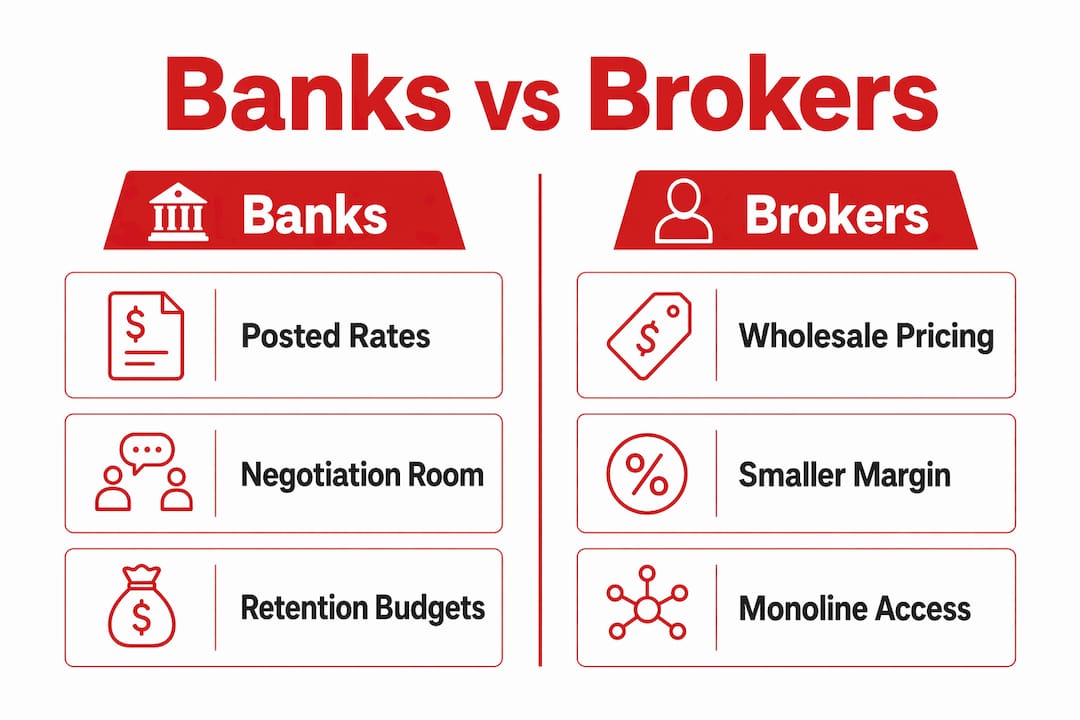
When a broker submits your application to several lenders, those lenders compete for your business. That competition is the foundation of effective rate negotiation. Banks, by contrast, quote from their own posted rate schedule and have internal discretion to discount from there. Understanding this structural difference is the starting point for any borrower who wants to negotiate effectively.

How to shop and compare mortgage quotes before negotiating
Comparing multiple written quotes is the single most effective preparation step before any negotiation conversation. Obtaining written loan estimates from at least three different lender types, including banks, credit unions, and brokers, creates active competition for your mortgage business. That competition gives you documented leverage.
Here is a practical process to follow:
- Request formal written quotes from at least three sources. A bank, a credit union, and a mortgage broker each represent different cost structures and lender panels. Written quotes are legally required to be provided within three business days of application, so you can collect them quickly.
- Compare APR, not just the headline interest rate. APR includes origination fees, closing costs, and other charges, making it the true cost comparison metric. A 4.89% rate with high fees can cost more than a 4.99% rate with no fees.
- Shop within a 14 to 45 day window. Multiple mortgage inquiries within this period count as a single credit inquiry. Your credit score is protected while you gather competing offers.
- Get everything in writing before negotiating. Verbal quotes carry no weight in a negotiation. A written Loan Estimate or lender commitment letter is the document that shifts the conversation.
- Note product features alongside the rate. Prepayment privileges, portability, and penalty structures vary by lender and affect total cost. Record these details for every quote you collect.
Pro Tip: When collecting quotes, ask each lender specifically what their prepayment penalty structure is. This single question often reveals cost differences that the headline rate conceals entirely.
Banks vs. brokers: where is the real negotiation room?
The negotiation range differs significantly depending on whether you are dealing with a bank or a mortgage broker. Understanding this distinction prevents frustration and sets realistic expectations.
| Lender type | Typical posted rate gap | Negotiation room | Access to monoline rates |
|---|---|---|---|
| Big 5 bank | 0.50%–1.50% above wholesale | 0.15%–0.40% reduction possible | No |
| Credit union | 0.25%–0.75% above wholesale | 0.10%–0.25% reduction possible | Rarely |
| Mortgage broker | Starts near wholesale | 0.05%–0.15% reduction possible | Yes |
Big 5 bank posted rates often carry a 0.50% to 1.50% gap from best market rates, which means their first offer has the most room to move. A borrower who walks in with a broker’s written quote and a strong credit profile can realistically negotiate a bank’s initial offer down by 0.15% to 0.40%. That is a meaningful reduction on a large mortgage.
Brokers start closer to wholesale, so the negotiation margin is smaller, typically 0.05% to 0.15%. However, brokers access exclusive monoline lender rates that run 0.15% to 0.20% lower than even a bank’s best discounted offer. Banks cannot match these rates because their cost structures are fundamentally different. So while the negotiation margin with a broker is narrower, the starting point is already lower.
Banks also have retention departments with discretionary budgets, particularly for mortgages over $500,000. High-value mortgages tend to receive stronger negotiation efforts from lenders aiming to retain those clients. Asking to speak with a branch manager or retention specialist, rather than a front-line advisor, often unlocks better offers.
Pro Tip: If you are approaching renewal, contact your lender 4 to 5 months before your term expires. At that point, switching costs are low and lender retention budgets are most accessible. Waiting until the last two weeks eliminates most of your leverage.
How to use competing quotes to negotiate better terms
Presenting a competing offer correctly is more effective than simply asking for a lower rate. The goal is to shift the conversation from “can you do better?” to “here is a written offer I am prepared to accept. Can you match it?”
Key tactics that work:
- Lead with the written quote, not the number. Hand over the actual document. A physical or digital Loan Estimate from a competing lender signals that you are serious and have done the work. Presenting a written broker quote to your bank shifts the dynamic to “beat this number,” which is a much stronger negotiating position.
- Highlight your borrower profile. High credit scores and stable income increase borrowing leverage. If your credit score is above 720 and your income is verifiable and consistent, say so directly. Lenders have more discretion for low-risk borrowers.
- Negotiate fees and credits, not just rate. If a lender cannot move on the rate, ask for lender credits to offset closing costs, reduced origination fees, or waived appraisal fees. These concessions reduce total cost without touching the rate.
- Stay professional and fact-based. Being informed and professional yields better results than adversarial tactics. Lenders respond to documented evidence, not pressure.
- Time your negotiation to rate lock windows. Rates fluctuate. Locking in a rate during a period of market stability, rather than volatility, gives you a cleaner negotiation without the lender citing market conditions as a reason to hold firm.
The main goal is to leverage competing offers to obtain the best overall mortgage package, not just force a single lender to drop their rate. Sometimes the best outcome is a combination of a slightly higher rate with lower fees and better product features.
Why the lowest rate is not always the best deal
Rate is one variable in a multi-variable equation. A mortgage with a 4.79% rate and a restrictive Interest Rate Differential (IRD) penalty can cost far more than a 4.99% mortgage with a simple three-month interest penalty, particularly if you sell, refinance, or break the mortgage early.
Choosing a mortgage with fair penalties versus restrictive IRD penalties can save thousands of dollars if you exit the mortgage before the term ends. IRD penalties at major banks are calculated using posted rates, which inflates the penalty significantly compared to what a monoline lender would charge.
| Product feature | Fair structure | Restrictive structure |
|---|---|---|
| Early exit penalty | 3 months’ interest | Interest Rate Differential (IRD) |
| Prepayment privilege | 20% lump sum annually | 10% or less annually |
| Portability | Full portability | Limited or no portability |
| Total cost impact | Lower if you exit early | Potentially thousands more |
Mortgage brokers are legally required to recommend products aligned with a borrower’s financial situation, not just the lowest rate. This obligation means a good broker will walk you through penalty structures, portability options, and prepayment privileges before recommending a product. Transparency about broker commissions matters here too. A broker who earns a higher commission on a specific product has a potential conflict of interest, and you have every right to ask how they are compensated.
One discount mortgage point costs approximately 1% of the loan amount and reduces the rate by roughly 0.25%. Buying down the rate makes sense only if you plan to hold the mortgage long enough to recoup the upfront cost through monthly savings.
Pro Tip: Ask your broker to calculate the total cost of two or three product options over your expected hold period, not just the term. This single calculation often changes which product looks most attractive.
Key takeaways
Effective mortgage rate negotiation requires written competing quotes, a clear understanding of APR, and realistic expectations about where negotiation room actually exists.
| Point | Details |
|---|---|
| Get written quotes from three sources | Banks, credit unions, and brokers each offer different rates and product structures worth comparing. |
| Banks have more negotiation room | Posted rates carry a 0.50%–1.50% gap from wholesale, giving borrowers 0.15%–0.40% reduction potential. |
| Brokers start near wholesale | Negotiation margin is smaller at 0.05%–0.15%, but the starting rate is already lower than most bank offers. |
| APR is the true cost metric | Headline rate comparisons miss fees, penalties, and product features that affect total mortgage cost. |
| Timing increases leverage | Negotiating 4 to 5 months before renewal maximizes lender retention budgets and switching flexibility. |
What I have learned from years of mortgage negotiations in Alberta
From my perspective, the biggest mistake borrowers make is treating rate negotiation as a one-time event at purchase. Mortgage negotiation is an ongoing practice. Every renewal is a negotiation opportunity, and most borrowers accept their lender’s renewal offer without question, often at rates 0.30% to 0.50% above what the market offers at that moment.
The borrowers who consistently get the best outcomes share three habits. They prepare written competing quotes before any conversation. They understand their own borrower profile, credit score, income stability, and equity position, and they lead with those strengths. And they treat the lender as a business partner, not an adversary.
One thing I tell clients at DreamHouse Mortgage regularly: the broker channel’s real advantage is not just the rate. It is the access to lender panels that banks cannot offer, combined with the obligation to recommend products that fit your actual financial situation. A monoline lender rate through the broker channel, paired with fair penalty terms, will outperform a bank’s “best” discounted rate over the full mortgage lifecycle in most cases.
Investors with multiple properties should pay particular attention to product portability and prepayment privileges. A rate that looks attractive on a single property can become a liability when you want to restructure your portfolio. The total cost calculation, including penalties and product flexibility, matters far more than the rate headline.
— Guriqbal
How DreamHouse Mortgage helps you negotiate better rates

DreamHouse Mortgage gives Calgary and Alberta homebuyers direct access to banks, credit unions, monoline lenders, and alternative lenders through a single broker relationship. That lender panel breadth is what creates genuine negotiation leverage. Guriqbal Chahal and the DreamHouse Mortgage team provide written rate comparisons, explain mortgage broker fees in full, and walk every client through product trade-offs before recommending a mortgage. The broker service carries no direct cost to borrowers in most cases. Whether you are purchasing your first home in Calgary, refinancing an investment property in Edmonton, or approaching renewal in Airdrie or Cochrane, DreamHouse Mortgage provides the competing quotes and negotiation support you need to secure the best available financing.
For expert mortgage advice, competitive rates, and personalized financing solutions, contact Guriqbal Chahal, MBA, PMP, Mortgage Broker, DreamHouse Mortgage at 403-966-6072.
FAQ
What is mortgage broker rate negotiation?
Mortgage broker rate negotiation is the process of using competing written lender quotes to secure a lower interest rate or better mortgage terms. Brokers access wholesale rates from multiple lenders, which creates the competitive foundation for effective negotiation.
How much can you negotiate a mortgage rate down?
Bank initial offers can be negotiated down by 0.15% to 0.40%, while brokers starting near wholesale rates typically have 0.05% to 0.15% of negotiation room. The exact reduction depends on your credit profile, mortgage size, and the competing offers you present.
Does shopping for mortgage rates hurt your credit score?
Multiple mortgage inquiries within a 14 to 45 day window count as a single credit inquiry, so rate shopping does not damage your credit score. Collect all quotes within this window to protect your credit while maximizing your competing offers.
Should I use a mortgage broker or go directly to a bank?
Brokers access exclusive monoline lender rates that run 0.15% to 0.20% below even a bank’s best discounted offer, making the broker channel the stronger starting point for most borrowers. Banks remain worth approaching as a negotiation counterparty once you have a broker’s written quote in hand.
When is the best time to negotiate a mortgage rate?
Negotiating 4 to 5 months before your mortgage renewal gives you maximum leverage because switching costs are low and lender retention budgets are active. Waiting until the final weeks before renewal significantly reduces your negotiating position.
Recommended
- Mortgage Broker Fees Explained for Calgary & Alberta
- How to Get a Lower Mortgage Rate Alberta: Broker vs Bank (Best Strategies to Save Thousands in 2026)
- Bank of Canada Rate Calgary Mortgage: How the Bank of Canada Rate Affects Your Calgary Mortgage | Critical Insights for Homebuyers
- Mortgage Broker vs. Bank Calgary Alberta: The Shocking Truth Nobody Tells You [2026]