
TL;DR:
- Using an experienced mortgage broker at renewal helps homeowners access multiple lenders, negotiate better rates, and navigate regulatory changes. They start early, assess your financial situation, gather competitive offers, and provide strategic advice tailored to your goals. This proactive approach often results in significant savings and smoother refinancing or renewal processes.
A mortgage broker at renewal is a licensed intermediary who shops multiple lenders to secure better rates and terms than your current bank typically offers. The role of mortgage broker at renewal goes far beyond paperwork. Brokers at Dreamhouse Mortgage access banks, credit unions, monoline lenders, and alternative lenders to negotiate on your behalf. For Alberta homeowners in Calgary, Edmonton, Airdrie, Cochrane, and Chestermere, this access translates directly into savings. A 0.25% rate reduction at renewal saves roughly $91 per month and $1,092 per year. That number makes the case for professional broker support before you sign anything.
How does a mortgage broker improve your renewal vs. going to your bank?
Going directly to your bank at renewal means accepting one offer from one lender. A mortgage broker changes that equation entirely. Brokers comparison-shop multiple lenders, including banks, credit unions, and alternative lenders, to find better rates and terms than you can access on your own. That breadth of access is the single most important advantage a broker provides.
Banks negotiate with you as one customer. Brokers negotiate as representatives of hundreds of clients. That volume gives brokers real leverage with lenders who want their business. Dreamhouse Mortgage, for example, works with banks, credit unions, monoline lenders, alternative lenders, and private lenders across Alberta. That network produces competing offers, and competing offers produce better rates.
One important limitation exists. Major Canadian banks vary in their participation with brokers at renewal. BMO, Scotiabank, and TD commonly work with brokers. RBC and CIBC customers often must negotiate directly with their bank. Knowing this upfront helps you plan your renewal strategy with your broker.
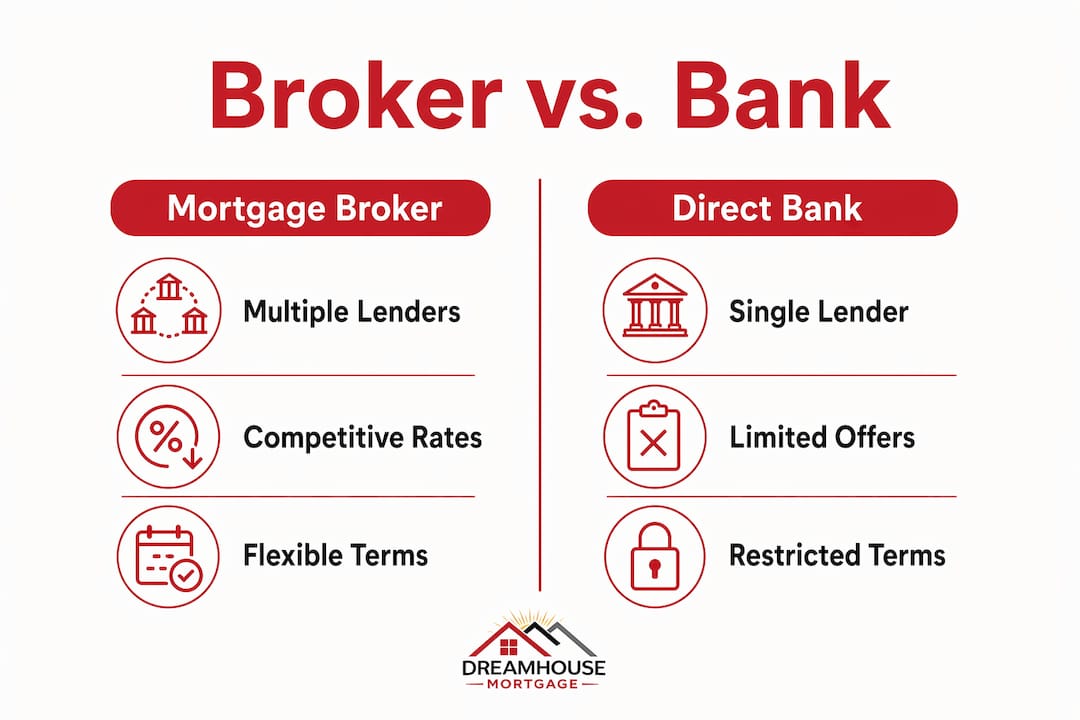
Broker vs. bank renewal: a direct comparison
| Factor | Mortgage Broker | Direct Bank Renewal |
|---|---|---|
| Lender access | Multiple banks, credit unions, alt lenders | Your current bank only |
| Rate negotiation | Competitive quotes from multiple sources | Single offer, limited leverage |
| Switching support | Full logistics and paperwork handled | You manage the process |
| Cost to you | Typically free (broker paid by lender) | No fee, but fewer options |
| Regulatory expertise | Up to date on OSFI changes and stress test rules | General bank advisor |
| Personalized advice | Tailored to your financial goals | Standardized product options |
Pro Tip: Ask your broker to present at least three competing offers before you decide. Seeing the spread between the lowest and highest rate shows you exactly how much negotiation room exists.
Brokers also advise on terms beyond the headline rate. Prepayment privileges, portability, and penalty structures all affect your total cost. A bank renewal letter rarely explains these details. A broker does.
What are a mortgage broker’s key responsibilities at renewal?
The renewing mortgage process managed by a broker follows a clear sequence of tasks, each designed to protect your financial position. Understanding these responsibilities helps you know what to expect and when to act.
-
Early engagement, 120 days before maturity. Starting renewal discussions 120 days out gives your broker time to secure rate holds and gather competing quotes. Waiting for your bank’s renewal letter, which typically arrives 21 days before maturity, eliminates most of your options.
-
Financial assessment. Your broker reviews your current income, credit profile, outstanding debts, and future plans. A homeowner in Okotoks planning a renovation has different renewal needs than one in Red Deer planning to sell in two years. This assessment shapes the product recommendation.
-
Market research and lender comparison. Brokers research current rates, terms, fees, and prepayment privileges across their lender network. This is not a quick rate check. Experienced brokers dig into the market to find personalized solutions that go well beyond the posted rates you see advertised.
-
Rate and term negotiation. Once competing offers are in hand, your broker negotiates directly with lenders. Brokers who send consistent volume to a lender have real pull. That relationship translates into rate discounts and improved terms that individual borrowers rarely achieve alone.
-
Paperwork and switching logistics. If you switch lenders, your broker coordinates paperwork, verifies financial documents, and manages the transition with the new lender. Many lenders cover switching costs to win your business, so the move often costs you nothing out of pocket.
-
Strategic product advice. Should you take a fixed or variable rate? A shorter term for flexibility or a longer term for stability? Should you adjust your amortization? Your broker answers these questions with your specific financial goals in mind, not a product quota.
Pro Tip: Bring your current mortgage statement, a recent pay stub, and your bank’s renewal offer to your first broker meeting. That preparation cuts the process time in half and gives your broker everything needed to start negotiating immediately.
Proactive broker engagement transforms renewal from a stressful deadline into a planned financial decision. Experienced brokers anticipate client needs and market shifts well before the renewal date arrives. That forward planning is where real savings are made.

How did the 2024 OSFI stress test change affect broker value at renewal?
The 2024 OSFI regulatory change is one of the most significant shifts in Canadian mortgage renewal rules in years. Understanding it is now a core part of broker support during renewal.
As of November 21, 2024, OSFI removed the mortgage stress test requirement for uninsured straight switches between federally regulated lenders at renewal. Before this change, switching lenders meant re-qualifying at the stress test rate, which is your contract rate plus 2%, or 5.25%, whichever is higher. That barrier kept many homeowners locked with their current lender even when better rates existed elsewhere.
The removal of this barrier has direct consequences for Alberta homeowners:
- Uninsured borrowers (those with more than 20% equity) can now switch lenders at renewal without re-qualifying under the stress test. This opens the full broker lender network to you.
- Insured borrowers (those with less than 20% equity) were already exempt from the stress test on straight switches. Their switching flexibility has not changed.
- Switching costs are often covered. Many lenders cover switching costs to attract renewal business, reducing the financial friction of moving to a better rate.
- Broker value increased. A knowledgeable broker now has a wider field to work with. More lenders are accessible without qualification barriers, which means more competing offers and more negotiation leverage.
This regulatory change raises the stakes for working with a broker who understands the distinction between insured and uninsured mortgage rules. The wrong advice here can cost you access to better options or create unexpected qualification issues. Dreamhouse Mortgage’s team stays current on OSFI guidelines and applies them directly to your renewal strategy.
The practical implication is straightforward. If you have more than 20% equity in your Calgary, Airdrie, or Cochrane home, you now have more switching options at renewal than you did before November 2024. A broker who knows this regulatory landscape can put those options to work for you.
What steps should you take with your broker to optimize your renewal?
Effective broker support during renewal follows a clear timeline and requires active participation from you as the homeowner. Here is the sequence that produces the best outcomes.
-
Start 120 to 150 days before your maturity date. Homeowners who wait for renewal letters lose their best leverage. Rate holds, competing quotes, and switching windows all require lead time. Mark your calendar and contact your broker well in advance.
-
Gather your financial documents early. Collect your most recent Notice of Assessment from the Canada Revenue Agency, two recent pay stubs, your current mortgage statement, and any renewal offer your lender has sent. Your broker needs these to assess your options accurately.
-
Request multiple competing quotes. Your broker should present offers from at least two or three different lender categories. Comparing a bank offer against a monoline lender and a credit union gives you a real picture of the market. This is the core of the mortgage renewal advice Dreamhouse Mortgage provides to every client.
-
Evaluate all-in costs, not just the rate. A lower rate with a restrictive prepayment penalty can cost more than a slightly higher rate with flexible terms. Your broker calculates the total cost of each option, including penalties, fees, and prepayment privileges, so you compare apples to apples.
-
Discuss your plans for the next term. Are you planning to sell, renovate, or refinance in the next two to five years? These plans affect whether a shorter open term, a longer fixed term, or a variable rate makes more sense. Your broker aligns the product to your life, not just the current rate environment.
Pro Tip: Never sign your bank’s renewal offer on the first day it arrives. You have time to shop. Signing early locks you in before your broker has had a chance to find better options.
Common pitfalls in the renewal process include waiting too long, ignoring alternative lenders, and focusing only on the interest rate. Alberta homeowners in communities like Rocky View County, Chestermere, and High River often have access to credit unions and regional lenders that offer competitive products not available through the major banks. A broker who knows these local options adds real value.
For homeowners considering more than a straight renewal, the renewing or refinancing decision deserves a separate conversation with your broker. Refinancing to access equity or consolidate debt changes the qualification process and the product options available to you.
Key takeaways
A mortgage broker at renewal is your most effective tool for securing better rates, accessing more lenders, and navigating regulatory changes that most homeowners never know exist.
| Point | Details |
|---|---|
| Start 120 days early | Engage your broker before the renewal letter arrives to secure rate holds and competing quotes. |
| Brokers access more lenders | Banks, credit unions, monoline lenders, and alternative lenders all compete for your business through a broker. |
| 2024 OSFI change matters | Uninsured borrowers can now switch lenders at renewal without re-qualifying under the stress test. |
| Rate savings are real | A 0.25% rate reduction saves approximately $1,092 per year on a typical mortgage. |
| Evaluate total cost | Compare prepayment privileges, penalties, and terms alongside the headline rate before deciding. |
What i’ve learned about renewal after years of alberta mortgage work
Most homeowners treat renewal as an administrative task. Sign the letter, move on. That mindset costs real money, and I’ve seen it happen repeatedly across Calgary, Edmonton, Airdrie, and Cochrane.
The most common mistake I see is not acting too late. It’s acting without information. Homeowners accept their bank’s first offer because they don’t know what the broader market looks like. They have no frame of reference. That’s exactly what a broker provides.
The 2024 OSFI stress test change is a perfect example of why local, current knowledge matters. Many homeowners with strong equity positions in Alberta communities still believe they need to re-qualify under the stress test to switch lenders. They don’t. Not anymore. But if no one tells them that, they stay with a lender offering a rate that’s 0.30% or 0.40% higher than what’s available elsewhere. Over a five-year term, that’s thousands of dollars left on the table.
What I’ve found actually works is a structured conversation 120 to 150 days before renewal. We look at the client’s financial position, their plans for the property, and the current lender landscape. Then we build a strategy. Sometimes that means switching lenders. Sometimes it means negotiating hard with the current one. Sometimes it means a short-term product to preserve flexibility. The right answer depends on the person, not the market.
Alberta’s mortgage market has local nuances that matter. Credit unions in communities like Cochrane and Okotoks sometimes offer products that the major banks don’t. Monoline lenders often beat bank rates by a meaningful margin. Private lenders fill gaps for self-employed borrowers or those with non-traditional income. None of these options appear in a bank renewal letter.
My advice is direct: don’t wait for the letter. Call a broker, gather your documents, and give yourself time to make a real decision. The difference between a reactive renewal and a planned one is almost always measured in dollars.
— Guriqbal Chahal, MBA, PMP
Work with dreamhouse mortgage for your alberta renewal
Dreamhouse Mortgage serves homeowners across Calgary, Edmonton, Airdrie, Cochrane, Chestermere, Okotoks, Red Deer, and surrounding Alberta communities. Guriqbal Chahal and the Dreamhouse Mortgage team specialize in mortgage broker rate negotiation to secure competitive renewal rates from banks, credit unions, monoline lenders, and alternative lenders.

Whether you are approaching your first renewal or your fifth, Dreamhouse Mortgage provides a personalized review of your options, a comparison of competing lender offers, and clear advice on the best path forward. The service costs you nothing. Lenders pay the broker fee.
Call Guriqbal Chahal, MBA, PMP, Mortgage Broker at 403-966-6072 for expert mortgage renewal advice and competitive rates across Alberta. Find Dreamhouse Mortgage on Google for reviews and directions.
FAQ
What does a mortgage broker do at renewal?
A mortgage broker shops multiple lenders, including banks, credit unions, and alternative lenders, to find better rates and terms than your current lender offers. The broker negotiates on your behalf, manages paperwork, and advises on the best product for your financial goals.
When should i contact a mortgage broker before renewal?
Contact a broker 120 days before your maturity date to secure rate holds and access the full range of competing offers. Waiting for your bank’s renewal letter reduces your options significantly.
Does the 2024 OSFI stress test change affect my renewal options?
Yes. As of November 21, 2024, uninsured borrowers can switch lenders at renewal without re-qualifying under the mortgage stress test. This makes switching to a better rate easier and increases the value of working with a broker who knows the full lender market.
Does using a mortgage broker at renewal cost me anything?
In most cases, no. Lenders pay the broker’s fee when you take a mortgage through their channel. Some situations, such as private lending, may involve a broker fee paid by the borrower. Your broker discloses all fees upfront before you commit.
Can a broker help if i want to refinance instead of renew?
Yes. Brokers advise on both straight renewals and mortgage refinancing in Calgary and across Alberta. If accessing equity, consolidating debt, or adjusting your amortization makes sense, your broker can model both options and recommend the right path.
Recommended
- Mortgage Renewal Rate Calgary: How to Get a BETTER Rate at Renewal [2026 Guide]
- Mortgage Refinancing Calgary | Mortgage Refinancing Calgary: Renewing or Refinancing Your Mortgage in Calgary? – DreamHouse Mortgage
- Mortgage Renewal Alberta | DreamHouse Mortgage
- Questions to Ask Mortgage Broker in 2026