
Banks decline self-employed mortgages primarily because they measure income using CRA tax returns, not actual cash flow or business deposits. This creates a fundamental problem: the same tax deductions that reduce your annual tax bill also reduce the income lenders use to qualify you. For self-employed professionals in Calgary, Airdrie, Cochrane, Chestermere, and across Alberta, this disconnect between real earnings and “paper income” is the single biggest obstacle to mortgage approval. Understanding exactly how lenders calculate your income, apply stress tests, and review documentation gives you a clear path to fixing a rejection or avoiding one entirely.
Why banks decline self-employed mortgages: the income measurement problem
Banks do not look at your bank account balance or your gross revenue. They look at Line 23600 of your T1 General tax return, which is your net income after all business deductions. Lenders rely on CRA Notices of Assessment (NOAs) to confirm this number, and two consecutive years of NOAs are the standard minimum requirement at most Canadian financial institutions.
The gap between gross revenue and net income is often dramatic. A Calgary contractor who earns $180,000 in gross revenue but claims $90,000 in legitimate business expenses reports only $90,000 in net income. That $90,000 is the number the bank uses to calculate how much mortgage you qualify for, regardless of what your business account shows. Tax deductions lower paper income without reflecting real cash flow, and this is the core disconnect that drives most self-employed mortgage rejections.
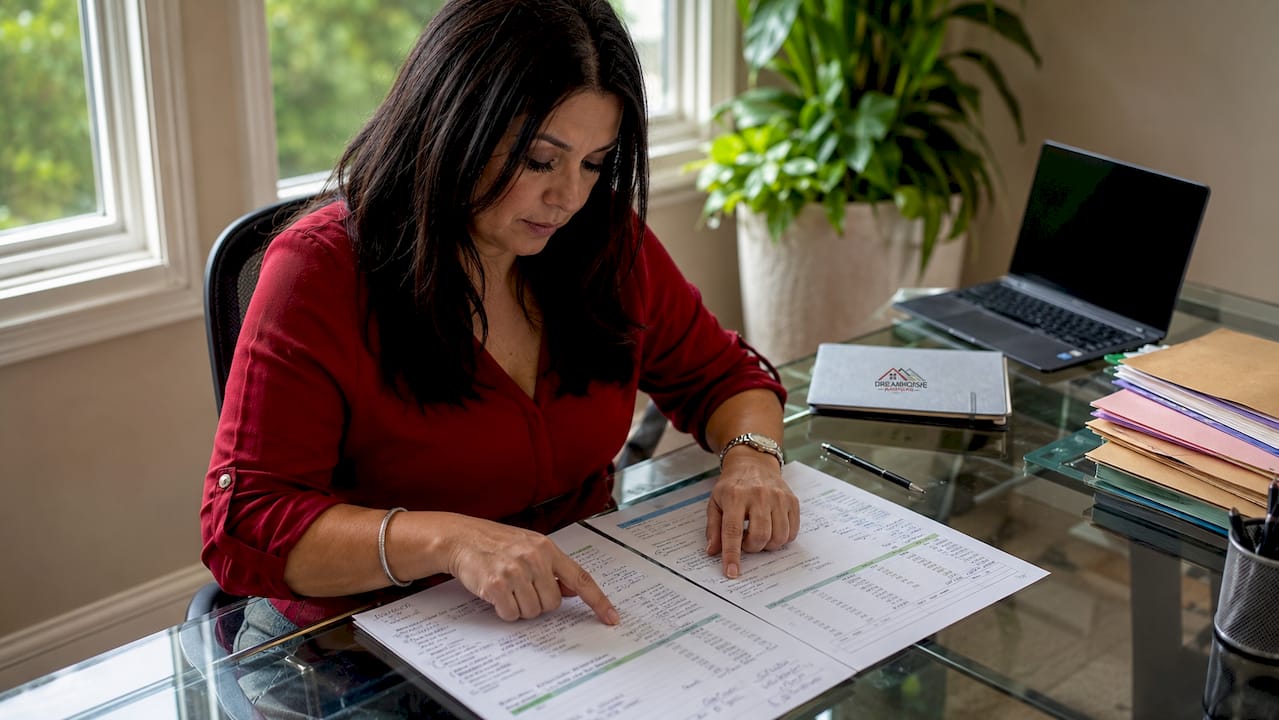
Lenders also average income across two years, which compounds the problem. Income averaging over two years means a borrower who earned $70,000 in year one and $90,000 in year two qualifies on $80,000, not the most recent and higher figure. If your business grew significantly in the past year, that growth is only partially recognized. A salaried employee earning $90,000 qualifies on the full $90,000 with a single pay stub and a letter of employment.
Strong business deposits are not qualifying income without matching tax documentation. This frustrates many self-employed borrowers who see healthy cash flow in their accounts but cannot translate that into mortgage approval. The bank’s underwriting process is built around documented, stable income, not business performance.
- Net income (Line 23600) is the figure lenders use, not gross revenue or total deposits
- Two years of NOAs are required at minimum; some lenders request three if income is inconsistent
- Two-year income averaging reduces qualifying income when recent earnings are higher
- Business deductions that save tax dollars directly reduce the income used for mortgage qualification
- Salaried employees qualify with a single pay stub; self-employed borrowers face a much higher documentation burden
Pro Tip: Plan your tax strategy with your mortgage timeline in mind. If you intend to apply for a mortgage within 24 months, discuss with your accountant how deductions will affect your Line 23600 before filing.
How do stress tests affect self-employed mortgage approval?
The Office of the Superintendent of Financial Institutions (OSFI) mandates a mortgage stress test for all federally regulated lenders in Canada. The stress test qualifying rate is the higher of your contracted mortgage rate plus 2%, or a floor rate of 5.25%. This means you must prove you can afford payments at a rate significantly above what you will actually pay.
For self-employed borrowers, the stress test creates a double penalty. Your qualifying income is already reduced by deductions. The stress test then requires that reduced income to support a higher theoretical payment. The result is a much smaller maximum mortgage amount than your actual cash flow would suggest you can handle.
Gross Debt Service (GDS) and Total Debt Service (TDS) ratios are the two calculations lenders use to measure affordability. GDS and TDS ratios are capped at 39% and 44% respectively. GDS measures housing costs as a percentage of gross qualifying income. TDS adds all other debt payments to that calculation. Both ratios are calculated using the stress test rate, not your actual mortgage rate.
Here is how the math works against a self-employed borrower in practice:
- Gross revenue: $150,000 per year for a freelance consultant in Edmonton
- Net income after deductions (Line 23600): $80,000 after claiming home office, vehicle, and professional expenses
- Two-year average qualifying income: $75,000 after averaging with a lower prior year
- Stress test qualifying rate: 7.2% (if contracted rate is 5.2%, add 2%)
- Maximum mortgage at 39% GDS: Significantly lower than what the same borrower could afford based on actual cash flow
The stress test was designed to protect borrowers from rate increases. For self-employed borrowers with low declared income, it functions as a hard ceiling on borrowing power. A Calgary mortgage broker who specializes in self-employed files can model these ratios before you apply, so you know exactly where you stand.
The stress test applies at all major banks, credit unions regulated federally, and most monoline lenders. Alternative lenders and private lenders are not subject to the same OSFI rules, which is why they represent a viable path for borrowers who cannot pass the standard stress test on declared income alone.
What documentation problems cause self-employed mortgage rejections?
Missing or inconsistent income documentation is the second most common reason banks deny self-employed mortgage applications. Lenders require at least two years of consistent proof of income, and inconsistencies between documents trigger automatic declines in many underwriting systems.
The standard document package for a self-employed borrower in Alberta includes:
- T1 General tax returns for the past two years, signed and filed
- CRA Notices of Assessment for the past two years confirming the filed amounts
- Business registration documents proving the business is active and legitimate
- Financial statements prepared by a CPA for incorporated borrowers
- Bank statements showing business deposits, often three to six months
- HST/GST returns confirming business revenue is consistent with declared income
The most common documentation pitfalls are not missing documents but conflicting numbers. A borrower who declares $85,000 on their T1 but whose GST returns imply $200,000 in revenue creates a red flag for underwriters. Banks want the numbers to tell a consistent story across every document. When they do not, the file is declined or sent back for explanation, which delays approval and sometimes kills it entirely.
The friction in self-employed mortgage qualifying mostly stems from documentation and income interpretation, not from any question about business legitimacy. A Cochrane electrician running a legitimate incorporated business with strong revenue can still be declined if their financial statements, NOAs, and bank statements do not align clearly.
Pro Tip: Before submitting a mortgage application, have your accountant or CPA review all documents side by side. Confirm that the income figures on your T1, NOA, GST returns, and financial statements are consistent and explainable. One phone call to your accountant can prevent a decline.
Incorporated borrowers face an additional layer of complexity. Lenders look at salary drawn from the corporation, not the corporation’s total revenue. If you pay yourself $60,000 in salary but leave $100,000 in the corporation, the bank qualifies you on $60,000. Some lenders will consider retained earnings or dividends, but this requires specific documentation and lender policies vary significantly.
What are the best options for self-employed mortgage approval in Alberta?
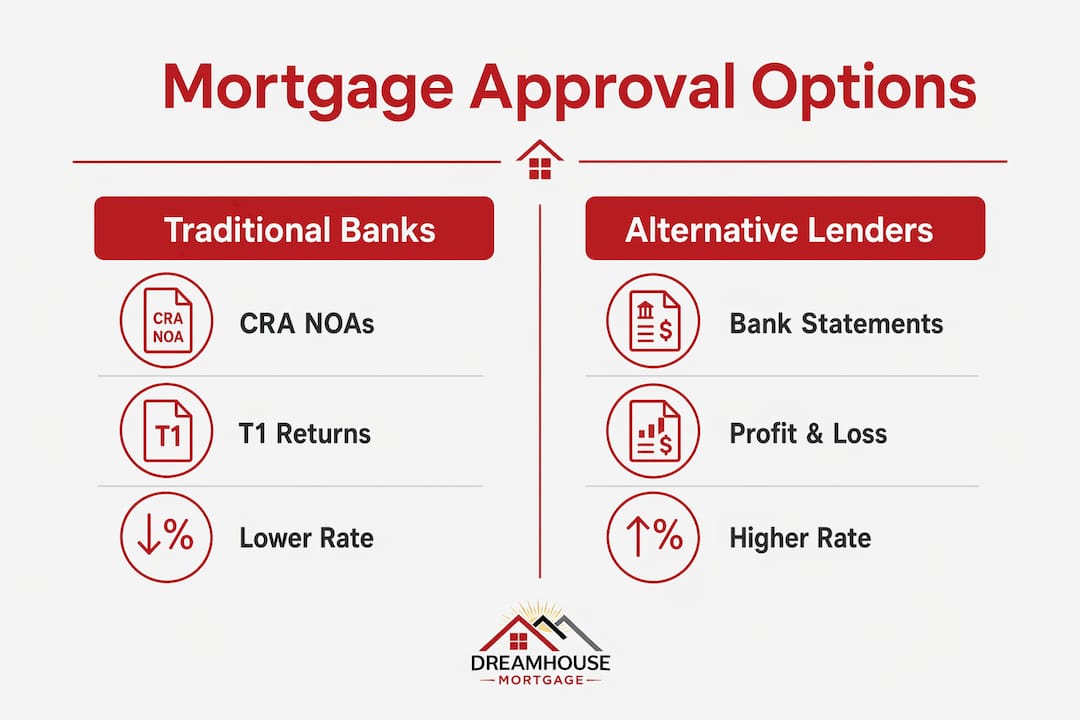
Self-employed borrowers in Alberta have more options than a standard bank rejection suggests. The key is matching your income profile to the right lender type. The self-employed mortgage lender types in Canada fall into three broad categories, each with different income assessment methods and qualification criteria.
| Lender type | Income method | Rate premium | Best for |
|---|---|---|---|
| Major banks (A lenders) | CRA NOAs, T1 General, Line 23600 | None (lowest rates) | Strong declared income, clean docs |
| Alternative lenders (B lenders) | Bank statements, profit and loss | Typically 1–3% higher | Good cash flow, lower declared income |
| Private lenders | Equity and cash flow focused | Highest rates | Short-term bridge, complex situations |
Alternative lenders assess income using bank statements and profit-and-loss statements rather than strictly tax returns. This allows a self-employed borrower with strong deposits but high deductions to qualify based on actual cash flow. The trade-off is a higher interest rate, typically 1–3% above standard bank rates. For many borrowers, this is a temporary solution while they restructure their tax reporting to qualify with an A lender in two to three years.
Several practical strategies improve approval chances regardless of lender type:
Align tax reporting with your mortgage timeline. Tax minimization strategies reduce qualifying income on NOAs, so the timing of deductions and income reporting should be planned 12–24 months before a mortgage application. This does not mean paying more tax than necessary. It means being deliberate about when you claim certain deductions.
Improve your credit score. A credit score above 680 opens more lender options and better rates. Pay down revolving credit balances before applying. Lower balances reduce your TDS ratio and improve your overall application profile. Dreamhouse Mortgage works with borrowers in Red Deer, Okotoks, and High River who have improved their credit profiles specifically to qualify for better mortgage products.
Consider a co-borrower. Adding a spouse or partner with salaried income to the application can bring the combined income above the qualifying threshold. The co-borrower’s income is fully counted, which can offset the reduced qualifying income from the self-employed applicant.
Use an add-back income strategy. Some lenders allow certain business expenses to be added back to declared income for qualification purposes. The add-back income mortgage approach is particularly useful for borrowers who claim large depreciation or amortization expenses that do not represent actual cash outflows.
Work with a mortgage broker who specializes in self-employed files. A broker who understands self-employed mortgage approval in Alberta knows which lenders accept bank statement income, which ones require two versus three years of NOAs, and which alternative lenders offer the best rates for your specific income profile. This knowledge is not available through a single bank’s mortgage specialist.
When you receive a decline, request the specific reason in writing. Identify which income figure and which ratios failed before reapplying. Resubmitting an unchanged file to a different lender wastes time and generates additional credit inquiries. Knowing whether the problem was the two-year average income, the GDS ratio, or a documentation inconsistency tells you exactly what to fix.
For self-employed borrowers considering investment properties in Calgary or Edmonton, the qualification challenge is compounded because rental income is only partially counted and the down payment requirement is higher. The investment property mortgage Alberta qualification process requires a separate income analysis that accounts for both self-employment income and projected rental income.
Key Takeaways
Banks decline self-employed mortgages because they qualify borrowers on CRA net income after deductions, not on actual cash flow, and then apply stress test rates and strict documentation requirements that further reduce borrowing power.
| Point | Details |
|---|---|
| Net income drives qualification | Lenders use Line 23600 from your T1, not gross revenue or bank deposits. |
| Two-year averaging reduces qualifying income | A strong recent year is only partially counted when averaged with a lower prior year. |
| Stress tests compound the problem | OSFI requires qualification at contract rate plus 2% or 5.25%, whichever is higher. |
| Documentation consistency is non-negotiable | Conflicting numbers across T1s, NOAs, and GST returns trigger automatic declines. |
| Alternative lenders offer a real path forward | B lenders use bank statements and profit-and-loss statements, at a rate premium of 1–3%. |
Dreamhouse Mortgage helps self-employed borrowers get approved
Self-employed professionals in Calgary, Airdrie, Cochrane, Chestermere, and Edmonton face real structural barriers in the mortgage approval process. Dreamhouse Mortgage works specifically with self-employed borrowers to analyze their income documentation, identify the right lender type, and build a file that matches the underwriting criteria of that lender.

Guriqbal Chahal, MBA, PMP, Mortgage Broker and Broker of Record at Dreamhouse Mortgage, has worked with incorporated business owners, freelancers, and contractors across Alberta since 2013. The brokerage accesses major banks, credit unions, alternative lenders, and private lenders to find the best available option for each client’s income profile. Before your next application, get a free mortgage broker consultation to understand exactly where your file stands and which lender is the right fit. Contact Guriqbal Chahal directly at 403-966-6072 or visit the Dreamhouse Mortgage Google Business Profile to book your consultation.
FAQ
Why do banks use tax returns instead of bank statements for income?
Canadian federally regulated lenders are required to verify income through CRA-filed documents, specifically T1 General returns and Notices of Assessment, because these are the most reliable and tamper-resistant proof of income available.
How many years of tax returns do I need for a self-employed mortgage in Alberta?
Most lenders require two consecutive years of filed T1 returns and matching NOAs. Some lenders request three years if income is inconsistent or has declined in recent years.
Can I get a mortgage if my declared income is low but my cash flow is strong?
Yes. Alternative lenders and some credit unions assess income using bank statements and profit-and-loss statements rather than CRA net income, though rates are typically 1–3% higher than standard bank rates.
What is the mortgage stress test and how does it affect self-employed borrowers?
The OSFI stress test requires borrowers to qualify at their contracted rate plus 2%, or 5.25%, whichever is higher. For self-employed borrowers with reduced declared income, this higher qualifying rate further limits the maximum mortgage amount they can access. More detail on how this applies in Alberta is available through the mortgage stress test Alberta guide.
What should I do after a self-employed mortgage rejection?
Request the specific reason for the decline in writing, identify whether the issue was income averaging, GDS or TDS ratios, or documentation inconsistencies, then correct the exact problem before reapplying to a lender whose criteria match your income profile.
Recommended
- Self Employed Mortgage Lender Types in Canada: Complete 2026 Guide
- Self Employed Mortgage Lender Types in Canada: Complete 2026 Guide
- Self-Employed Mortgage Calgary: The Ultimate 2026 Guide to Getting APPROVED
- Self Employed Mortgage Alberta | DreamHouse Mortgage
- Get Your Investment Property Professionally Managed