
What is an interest-only mortgage for investment property in Canada?
An interest-only mortgage for investment property lets you pay only the interest portion of your loan for a set term, keeping monthly payments lower while the principal balance stays unchanged. During that period, no equity builds through repayment. The full principal remains due when the term ends or when you sell.
In Canada, these loans are not available through federally regulated banks because CMHC mortgage insurance requires principal amortization. That restriction pushes investors toward alternative lenders, credit unions, B-lenders, and private lenders. A minimum 20% down payment is required since the loan cannot be insured.
Key mechanics at a glance:
- Interest-only periods generally last several years before principal repayment begins
- Monthly payments cover interest only; the principal balance does not decrease
- Mortgage interest is fully tax-deductible against rental income under CRA guidelines
- A significant down payment applies to all interest-only investment loans
- Lenders include credit unions, B-lenders, monoline lenders, and private lenders
Key benefits of interest-only mortgages for Canadian investment property investors
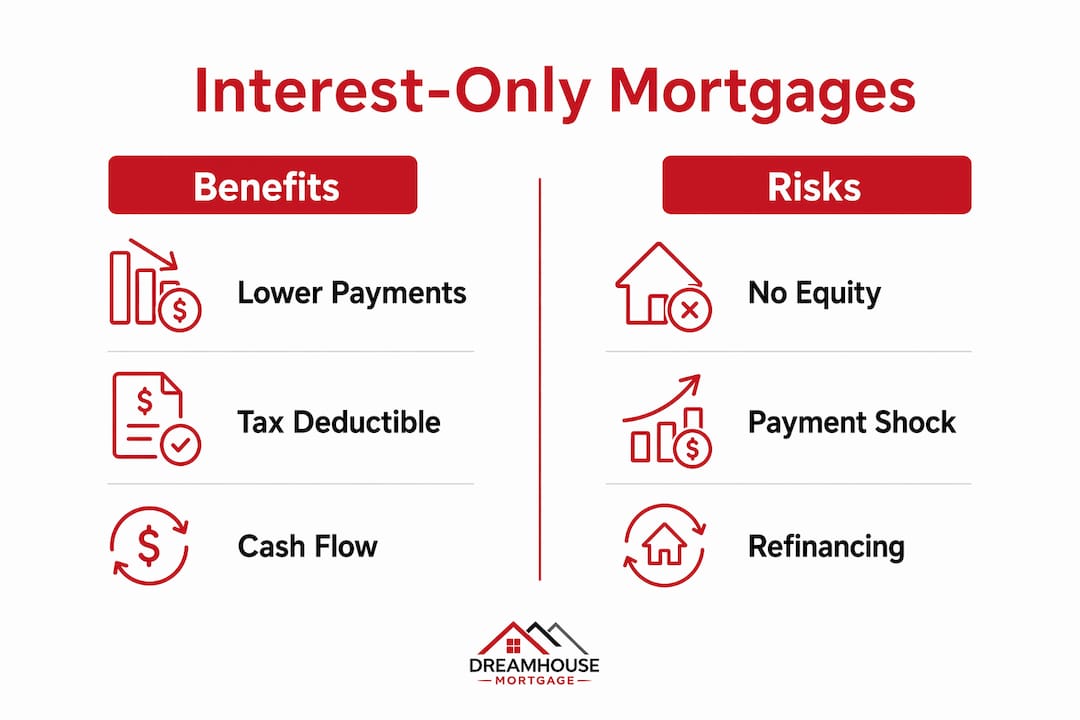
Lower monthly payments are the most direct advantage. Paying interest only on a typical loan costs less per month than a conventional mortgage at the same interest rate over a standard amortization period. That monthly savings can cover maintenance, property taxes, or fund a second investment.

The tax treatment adds another layer. Under CRA’s Income Tax Act paragraph 20(1)©, interest on borrowed money used to earn rental income is fully deductible. Because you pay no principal during the interest-only term, your deductible interest expense stays higher for longer, reducing taxable rental income more than a conventional loan would.
Capital preservation is a third benefit. Freed-up cash can fund renovations that increase a property’s rental value, or go toward a down payment on a second property in Calgary, Airdrie, or Edmonton.
| Loan Type | Monthly Payment (est.) | Principal Paid | Monthly Cash Freed |
|---|---|---|---|
| Interest-only | lower monthly interest payment | — | additional monthly cash flow |
| Conventional principal + interest | higher monthly payment including principal | principal portion steadily paid | no additional cash flow |
Estimates based on a $500,000 loan. Actual rates vary by lender and borrower profile.
Additional benefits:
- Flexibility for property flippers who plan to sell before the interest-only term ends
- Lower carrying costs during renovation periods when rental income is interrupted
- Ability to redirect capital toward portfolio expansion rather than debt reduction
Risks and drawbacks of interest-only mortgages on investment properties
No principal repayment means no automatic equity growth. Your equity position only improves if the property’s market value rises. In a flat or declining market, you could hold a property for years and owe the same amount you borrowed on day one.

Payment shock is the most common problem investors face. Once the interest-only period ends, payments jump to cover both principal and interest on the remaining balance, compressed into a shorter amortization window. That increase can be sharp enough to turn a cash-flow-positive property into a liability.
Higher interest rates compound the issue. Because interest-only loans carry no CMHC insurance, lenders price in more risk. Rates typically run higher than insured conventional mortgages, which partially offsets the cash flow benefit.
Additional risks to plan for:
- Rental income alone may not cover the higher payments after the interest-only term
- Mortgage brokers note these products suit flippers and experienced investors, not those relying solely on rent to service the debt
- Cash reserves must be strong enough to absorb rate increases or vacancy periods
- Refinancing at term end is not guaranteed, especially if property values have not risen
How interest-only mortgage payment structures and terms work in Canada
Most interest-only terms last several years. After that, the loan either converts to a fully amortizing mortgage or must be refinanced. The amortization clock starts fresh on the remaining principal, which means payments in the repayment phase are higher than they would have been on a conventional loan from the start.
Hybrid structures offer a middle path. Meridian Credit Union’s Hybrid Mortgage, for example, splits the loan so that a minimum of 20% amortizes conventionally while up to 60% remains interest-only. The combined facility can fund up to 80% of the property’s value. Investors are advised to gradually convert the interest-only portion into the amortizing segment over time.
Under OSFI Guideline B-20 and CMHC rules, federally insured mortgages have maximum amortization periods. Interest-only loans fall outside that framework entirely, so amortization schedules are set by the alternative lender rather than a federal standard.
| Structure | Interest-Only Period | Amortization After | Best For |
|---|---|---|---|
| Full interest-only | several years | Full balance, shorter window | Flippers, short-hold investors |
| Hybrid (e.g., Meridian) | Ongoing on IO portion | 20%+ amortizes from start | Buy-and-hold investors |
| Private lender IO | Negotiable | Varies by lender | Investors needing flexibility |
Canadian market specifics: eligibility, tax rules, and Alberta context
Alternative and private lenders dominate this space in Canada. Federally regulated financial institutions cannot offer interest-only residential mortgages because CMHC insurance rules require principal amortization. Credit unions, B-lenders, and private lenders operate outside OSFI’s direct oversight, giving them flexibility to structure these products.
OSFI’s Guideline B-20 still shapes the broader environment. Under OSFI’s rental income guidance, mortgages where repayment depends materially on rental cash flows are classified as Income-Producing Residential Real Estate, which carries higher capital requirements for lenders. That classification affects pricing and availability, even at alternative lenders who reference B-20 as a benchmark.
In Alberta, investors face minimum 20% down payments, stress tests at many lenders, and rates that run higher than owner-occupied mortgages. These conditions make interest-only products most practical for investors with solid cash reserves and prior real estate experience, whether they are buying in Calgary, Cochrane, Chestermere, or Edmonton.
For tax purposes, CRA allows full deduction of mortgage interest on rental property expenses under Form T776. Because interest-only payments carry no principal component, the deductible amount stays maximized throughout the interest-only term.
Strategies for refinancing or transitioning after the interest-only period ends
Planning the exit before the interest-only term expires is the most important step. Waiting until the final months limits your options and your negotiating position with lenders.
Three practical paths exist. First, refinance into a conventional amortizing mortgage with a new lender. If the property has appreciated and your income profile is strong, you may qualify for better terms than you had originally. Mortgage refinancing in Calgary and across Alberta is most effective when you approach lenders six to twelve months before your term ends.
Second, sell the property before the interest-only period closes. This works well for flippers who bought below market value, renovated, and can exit with a profit that covers the higher interest cost of the loan. Third, convert to a hybrid structure if your lender offers it, gradually shifting the interest-only balance into an amortizing segment to smooth the payment transition.
Pro Tip: Start building a cash reserve in year three of a five-year interest-only term. Having three to six months of the projected post-term payment set aside gives you negotiating room and protects against vacancy or rate increases at renewal.
How interest rate changes affect your interest-only mortgage payments
Interest-only loans are more sensitive to rate changes than conventional mortgages. On a conventional loan, a portion of each payment reduces principal, so the outstanding balance shrinks over time. On an interest-only loan, the full principal stays exposed to rate movements for the entire interest-only term.
A 1% rate increase on a $500,000 interest-only loan adds roughly $417 per month to your carrying cost. On a conventional mortgage, the same increase has a smaller effect because the balance has been partially paid down. Variable-rate interest-only products amplify this exposure further.
Locking into a fixed rate for the interest-only term provides predictability. It costs more upfront than a variable rate but removes the risk of payment increases during the period when you are not building equity.
What lenders look for when qualifying you for an interest-only investment loan in Canada
Qualification standards at alternative and private lenders are stricter than many investors expect. Lenders want to see that you can handle not just the current interest-only payment but also the projected payment once principal repayment begins.
Core criteria typically include:
- Substantial down payment on the investment property
- Strong credit profile, depending on the lender’s criteria
- Documented rental income or a credible rental income projection
- Debt service coverage that accounts for the post-term amortizing payment
- Cash reserves sufficient to cover several months of payments
Under OSFI’s B-20 framework, rental income can be used to qualify, but lenders must apply rigorous due diligence. Mortgages where repayment depends heavily on rental cash flows carry higher capital requirements, which lenders factor into their approval criteria and pricing. For Alberta investment property financing, working with a broker who knows which lenders are actively placing these deals in 2026 saves time and avoids unnecessary credit inquiries.
How the interest-only term affects equity buildup and property resale value
Equity does not build through repayment during the interest-only period. The only equity gain comes from market appreciation. In strong markets like Calgary’s inner-city neighborhoods or Edmonton’s growing suburbs, that appreciation can be meaningful. In flat or softening markets, an investor can hold a property for a full five-year interest-only term and exit with the same loan balance they started with.
This has direct implications for resale. If you sell during the interest-only term, your net proceeds depend entirely on how much the property has appreciated above your purchase price plus transaction costs. There is no amortization cushion. Investors who finance rental properties with interest-only structures need a realistic view of local price trends before committing to the product.
One practical upside: because you are not paying down principal, your monthly cash flow stays higher, which can fund property improvements that directly increase resale value. A well-timed renovation during the interest-only period can produce appreciation that exceeds what principal repayment would have built.
Dreamhouse Mortgage connects Alberta investors with the right lenders

Dreamhouse Mortgage gives Alberta real estate investors direct access to the alternative lenders, credit unions, and private lenders that actually offer interest-only investment loans in 2026. Guriqbal Chahal, MBA, PMP, Broker of Record, has structured investment property financing across Calgary, Airdrie, Cochrane, Chestermere, Edmonton, and Red Deer. The brokerage compares lenders, negotiates rates, and walks investors through qualification so there are no surprises at term end.
For investors weighing an interest-only structure against a conventional investment property mortgage, Dreamhouse Mortgage provides a clear side-by-side analysis of total cost, cash flow impact, and tax treatment specific to your property and income profile.
Call Guriqbal Chahal at 403-966-6072 or connect via Google Business Profile to discuss your investment property financing options.
Key Takeaways
Interest-only mortgages for Canadian investment properties are available exclusively through alternative lenders, require a substantial down payment, and deliver maximum cash flow benefit when paired with a clear exit or refinancing strategy before the term ends.
| Point | Details |
|---|---|
| Lender type | Only alternative, private, and B-lenders offer interest-only investment loans in Canada; federally regulated banks cannot. |
| Down payment | A minimum 20% down payment is required because CMHC will not insure interest-only mortgages. |
| Tax advantage | Mortgage interest on rental properties is fully deductible against rental income under CRA’s Form T776. |
| Rate sensitivity | A 1% rate increase on a $500,000 interest-only loan adds roughly $417 per month, making rate management critical. |
| Dreamhouse Mortgage | Guriqbal Chahal connects Alberta investors with lenders actively placing interest-only investment loans across Calgary, Edmonton, and surrounding communities. |
FAQ
Can you get an interest-only mortgage on an investment property in Canada?
Yes, but only through alternative lenders, credit unions, B-lenders, or private lenders. Federally regulated banks cannot offer them because CMHC insurance requires principal amortization, and a minimum 20% down payment applies.
How much does an interest-only mortgage cost on a $200,000 loan?
No principal is repaid during the interest-only term, so the full principal remains due when the term ends.
Is interest on an investment property mortgage tax-deductible in Canada?
Yes. Under CRA guidelines, mortgage interest on a property used to earn rental income is fully deductible against that income. Interest-only loans maximize this deduction because the entire payment is interest with no principal component.
What happens when the interest-only period ends?
Payments increase to cover both principal and interest on the remaining balance, compressed into a shorter amortization period. Investors should plan to refinance, sell, or convert to a hybrid structure well before the term expires to avoid payment shock.
Who qualifies for an interest-only investment loan in Alberta?
Lenders typically require a minimum 20% down payment, documented or projected rental income, and cash reserves to cover projected post-term payments. Experienced investors with strong financials are the primary candidates.