A Calgary homeowner can qualify for a HELOC if they have more than 35% equity for a standalone line of credit, or 20% equity when combining it with an existing mortgage, since federal rules cap standalone HELOCs at 65% of home value and combined borrowing at 80%. You’ll also need to pass the mortgage stress test and meet typical lender expectations around credit score and income. Those numbers are ceilings, not promises. Call Guriqbal Chahal at 403-966-6072 to find out exactly where your file stands.
TL;DR:
- A Calgary homeowner’s maximum HELOC borrowing capacity depends on the lower of 65% of home value minus existing mortgage or 80% minus mortgage, with appraisals heavily impacting limits.
- Qualification requires passing the federal stress test, maintaining credit scores around 680, and having over 20% equity when combined with a mortgage or more than 35% as a standalone.
- The primary underwriting challenge is demonstrating repayment ability, which can be affected by debt ratios, income stability, and proper documentation, especially for self-employed applicants.
- Delivery and legal costs, including appraisal fees and collateral registration, typically total 10 to 15 business days from complete documentation.
- Working with a broker greatly improves chances of approval by matching your file to the most fitting lender, especially if you have unique income sources or property types.
Table of Contents
- How Much Can You Borrow With a HELOC in Calgary?
- What Do Lenders Actually Check Before Approving a HELOC?
- What Documents and Fees Should You Expect?
- Why Do Lenders Cap HELOCs the Way They Do?
- How DreamHouse Mortgage Helps Calgary Homeowners Get a HELOC
- What Can You Actually Use a HELOC For, and What’s Off Limits?
- Primary Residence vs. Investment Property HELOCs in Calgary
- How Is Calgary’s Housing Market Affecting HELOC Approvals Right Now?
- Do All Calgary Lenders Follow the Same HELOC Rules?
- The Editorial Take: What Calgary Homeowners Get Wrong About HELOCs
- Ready to Find Out What You Actually Qualify For in Calgary?
- Where This Article’s Numbers Come From
- Sources
- FAQ
How Much Can You Borrow With a HELOC in Calgary?
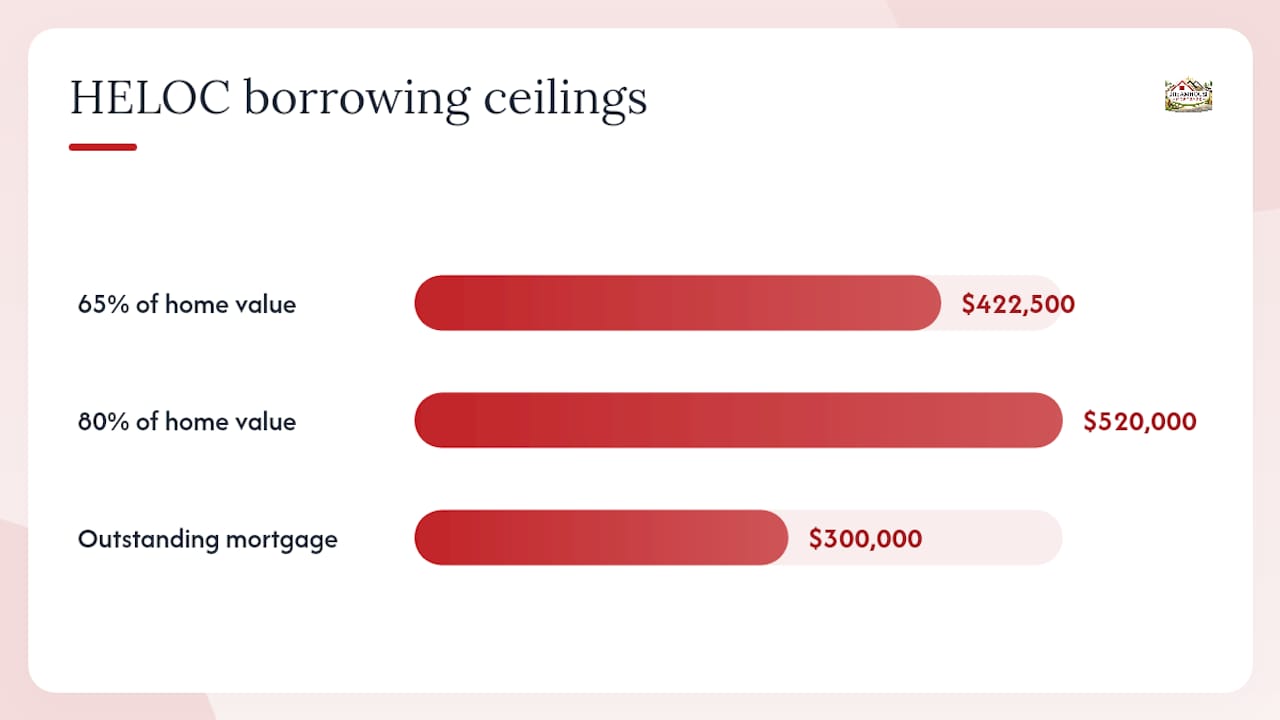
Federal limits control every HELOC application in Canada. The revolving, standalone portion of a HELOC cannot exceed 65% of your home’s appraised value. When combined with your existing mortgage balance, the total secured debt against your property cannot exceed 80% of appraised value, with federally regulated lenders required to structure anything above 65% as an amortizing loan rather than a revolving line.
Here’s the math you can run yourself before calling a broker:
- Standalone HELOC ceiling = home value × 0.65 − outstanding mortgage balance
- Combined ceiling (mortgage + HELOC) = home value × 0.80 − outstanding mortgage balance
- Your practical borrowing cap is whichever number comes out lower
Say your bungalow in Renfrew or a two-story in Evanston appraises at $650,000, and you have $300,000 left on your mortgage. The standalone formula gives you $422,500 minus $300,000, or $122,500. The combined formula gives you $520,000 minus $300,000, or $220,000. Since $122,500 is lower, that’s your realistic ceiling as a revolving HELOC, unless you restructure part of it as an amortizing loan to reach closer to the $220,000 figure.
That appraisal number carries more weight than most applicants expect. A worked HELOC calculation from Financial Canadian confirms lenders use the same 65%/80% split, and if a Calgary appraiser comes in $30,000 to $40,000 below your own estimate, which happens often in neighborhoods with wide price variance like Killarney or Bridgeland, your entire ceiling shifts downward with it. Homeowners in older communities with unique renovations or non-standard layouts should expect more appraisal variability than those in newer builds in Cranston or Mahogany, where recent comparable sales make valuation more predictable.
What Do Lenders Actually Check Before Approving a HELOC?
The 65%/80% loan-to-value limits set your maximum. Whether you actually qualify for that maximum depends on a separate set of underwriting checks, and this is where most Calgary applications either sail through or stall.
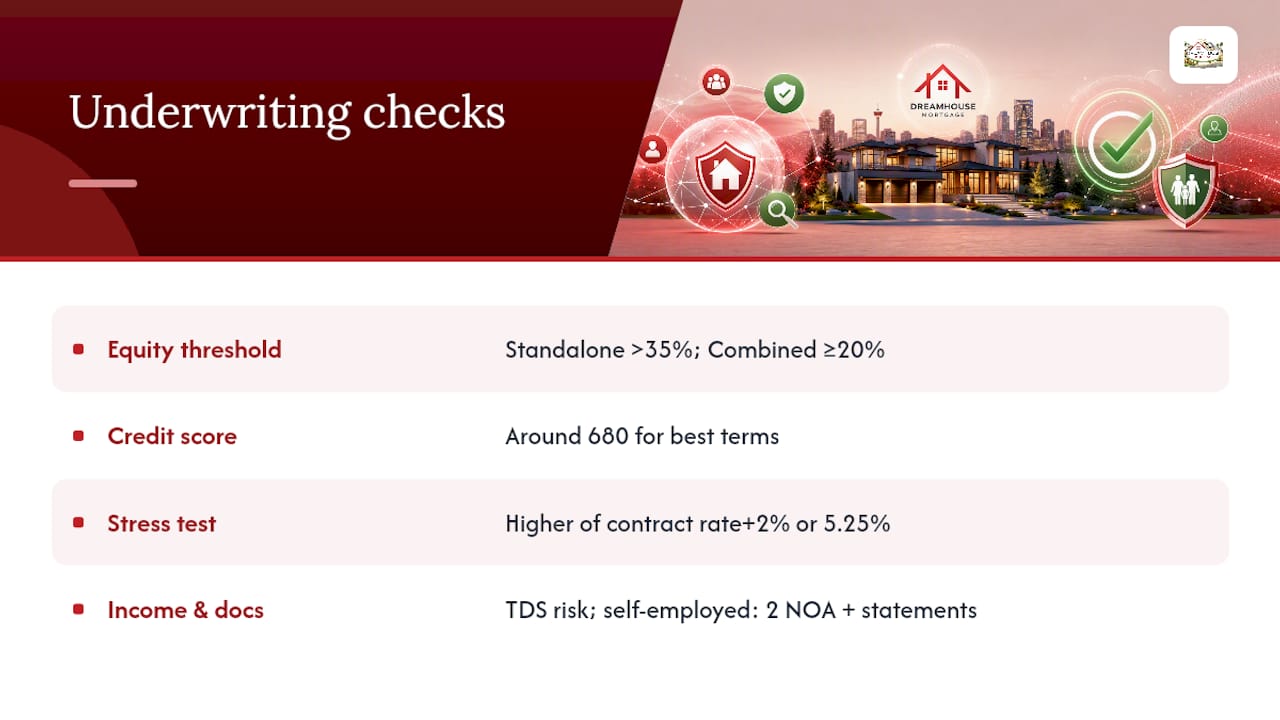
1. Equity threshold. Canada.ca’s guidance confirms you generally need more than 35% equity in your home to access a standalone HELOC, or at least 20% equity when it’s combined with your mortgage. Below those thresholds, you’re simply not eligible regardless of income or credit.
2. Credit score. Most Calgary lenders prefer to see a credit score around 680 or higher for the best rates and terms. Lower scores don’t always disqualify you but may affect the rate or direct you to alternative lenders, where a broker’s help can be valuable.
3. The stress test. Every applicant must qualify at the greater of their contract rate plus 2% or 5.25%. This single rule trips up more Calgary homeowners than any other requirement.
**4.
If your household income is $95,000 and you’re already carrying a car loan and a mortgage payment, that extra $250 phantom payment can push your TDS from a comfortable 38% to a rejected 46%, based purely on the stress test’s qualifying rate mechanics.
Self-employed applicants face an added documentation layer. Expect to provide two years of Notices of Assessment, business financial statements, and sometimes a letter from your accountant explaining income deductions. A broker who regularly places self-employed files with monoline and alternative lenders can often smooth over what a single bank might flag as inconsistent income.
What Documents and Fees Should You Expect?
A complete application moves fast in Calgary. An incomplete one can stall for weeks. Here’s what to have ready before you call:
- Proof of property ownership (title or recent property tax statement)
- Current mortgage statement showing outstanding balance
- Government-issued photo ID
- Recent pay stubs and a letter of employment, or two years of tax returns and Notices of Assessment if self-employed
- Details of any other secured debt against the property
Once your documents are in, the lender orders an appraisal. Expect to pay between $300 and $500 out of pocket, with a turnaround of roughly 5 to 10 business days depending on how busy Calgary appraisers are that month. In Alberta, you’ll also need a lawyer or notary to handle the collateral charge registration on title, which carries its own legal fee separate from the appraisal cost.
With a complete file and a straightforward appraisal, total processing typically runs 10 to 15 business days. The most common causes of delay aren’t the lender, they’re missing pay stubs, an outdated mortgage statement, or a self-employed applicant who hasn’t pulled their last two NOAs yet.
Knowing your realistic ceiling in advance means you’re negotiating from a position of information, not guessing what a lender will offer you.*
Why Do Lenders Cap HELOCs the Way They Do?
They come from OSFI’s Guideline B-20, the federal underwriting framework that governs how federally regulated banks assess residential secured lending, HELOCs included.
The reasoning behind this matters for how you present your file. Lenders underwrite for repayment ability first, not collateral value. Foreclosing on a property is slow, expensive, and something no lender wants to do, so your income, your debt ratios, and your documented capacity to make payments carry more weight than how much equity sits in your Calgary home.
This also explains why switching lenders to add a HELOC is more complicated than adding one at mortgage renewal. Moving to a new lender requires fresh collateral charge registration on title, which adds legal steps and cost that simply don’t apply if you stay put and add the HELOC through your existing lender at renewal.
If you want a stronger underwriting outcome, focus your energy here:
- Pay down existing consumer debt before applying, since it directly improves your TDS ratio
- Document self-employed income clearly with two years of NOAs rather than relying on gross business revenue
- Get an independent sense of your home’s value before the official appraisal
- Work with a broker who can package your file for the lender most likely to approve it the first time
How DreamHouse Mortgage Helps Calgary Homeowners Get a HELOC
Getting a HELOC approved involves matching your specific file to the lender whose underwriting appetite fits your situation. A mortgage broker can assist clients through this process.
A broker-led HELOC application typically includes:
- Comparing multiple banks, credit unions, and monoline lenders to find better rate and structure options than a single branch visit would surface
- Running your stress-test numbers before you apply, so there are no surprises about your usable limit
- Coordinating the appraisal and document collection so nothing sits waiting in an inbox
- Structuring the borrowing split between revolving and amortizing portions in a way that keeps you under both LTV ceilings
- Advising on whether adding a HELOC at renewal or through a new lender makes more sense for your file
| What you’re wondering | How a Calgary broker helps |
|---|---|
| “Do I even qualify?” | Quick equity and stress-test check before you apply anywhere |
| “Which lender fits my file?” | Comparison across banks, credit unions, and monoline lenders |
| “What if I’m self-employed?” | Guidance on NOA documentation and lender flexibility |
| “How do I avoid delays?” | Document checklist prepared before appraisal is ordered |
Guriqbal Chahal’s MBA and PMP credentials inform how DreamHouse Mortgage structures these applications, treating a HELOC not as a single transaction but as part of a longer-term financing plan for Calgary homeowners.
What Can You Actually Use a HELOC For, and What’s Off Limits?
A HELOC is flexible by design, which is exactly why so many Calgary homeowners reach for one instead of refinancing or taking a second mortgage. Common uses include home renovations, consolidating higher-interest debt, funding a down payment on an investment property, covering education costs, or bridging cash flow for a self-employed business owner. Because it’s revolving credit secured against your home, you draw only what you need and pay interest on the outstanding balance, not the full approved limit.
There aren’t hard federal restrictions on what you spend HELOC funds on, but lenders and your own financial plan should still shape how you use it. Using a HELOC to cover recurring living expenses or non-essential spending is a common way homeowners end up carrying revolving debt against their home longer than intended, since there’s no forced repayment schedule the way there is with an amortizing loan.
One use case worth flagging for Calgary investors: pulling equity from a primary residence to fund a rental property down payment is common and generally accepted by lenders, provided your debt ratios still hold up under the stress test. What most homeowners overlook is that borrowing against credit utilization in this way affects your broader credit profile even before you draw the funds, since the approved limit itself can factor into how future lenders view your available versus used credit.
Primary Residence vs. Investment Property HELOCs in Calgary
Income qualification also shifts. On a primary residence, your personal employment or self-employment income carries the application. That means an investment property HELOC application in Calgary often needs a stronger overall income profile to clear the same TDS thresholds as a primary residence file.
Rate pricing tends to run higher on investment property HELOCs too, and fewer lenders offer them compared to owner-occupied products. Some monoline and alternative lenders that are flexible on primary residences pull back significantly on rental properties, narrowing your options. This is one area where working with a broker pays off directly, since investment property financing requires matching your file to the smaller pool of lenders actually willing to extend a HELOC against a non-owner-occupied Calgary property.
How Is Calgary’s Housing Market Affecting HELOC Approvals Right Now?
Appraised value drives your borrowing ceiling directly, so local price trends matter more to your HELOC application than almost anything else in the process. Calgary’s housing market has seen substantial price appreciation over recent years compared to many other major Canadian cities, which has meaningfully increased the equity many homeowners are sitting on, particularly those who purchased before 2020 in communities like Signal Hill, Tuscany, or Auburn Bay.
That equity growth is good news for borrowing capacity, but it comes with a catch. Appraisers work off recent comparable sales, and in neighborhoods where price growth has been uneven or where inventory is thin, valuations can lag behind what homeowners believe their property is worth. A HELOC applicant in a fast-appreciating area like Mahogany might get an appraisal that matches expectations, while someone in a slower-moving pocket could see a more conservative number that trims their borrowing ceiling.
Rising home values across Calgary have also pushed more homeowners toward HELOCs as an alternative to selling and moving up, since tapping equity to renovate or add a secondary suite is often cheaper than a full move in the current market.
Do All Calgary Lenders Follow the Same HELOC Rules?
Banks tend to be the most conservative, sticking closely to the 680+ credit score guidance and standard TDS caps. Credit unions, which fall under provincial rather than strictly federal oversight in some respects, occasionally show more flexibility on credit score or documentation for local Alberta members.
Monoline lenders, which specialize purely in mortgage and HELOC products without offering day-to-day banking, often compete aggressively on rate for straightforward, well-documented files. Alternative and private lenders exist specifically for homeowners who don’t fit standard underwriting boxes, whether that’s inconsistent self-employed income, a lower credit score, or a non-standard property type common in some of Calgary’s older or acreage-adjacent communities.
This is exactly where working through a broker rather than a single institution changes the outcome. Guriqbal Chahal at DreamHouse Mortgage places HELOC applications across this full spectrum of lenders, matching a Calgary homeowner’s specific file, credit profile, income structure, and property type, to whichever institution’s guidelines actually fit, rather than forcing every applicant through one bank’s fixed criteria.
The Editorial Take: What Calgary Homeowners Get Wrong About HELOCs
It isn’t. The stress test and debt ratios do more damage to Calgary applications than loan-to-value ever does, and I’d argue homeowners spend too much time obsessing over their home’s appraised value and not enough time cleaning up their debt profile before applying.
Conventional wisdom treats a HELOC like a straightforward math problem. It’s not. It’s an underwriting decision built around repayment capacity, and OSFI’s B-20 framework makes that explicit. A homeowner sitting on $200,000 of equity with a maxed-out credit card and an unstable self-employed income will lose to a homeowner with less equity but a clean, documented, low-debt file every time.
If there’s one thing Calgary homeowners should prioritize first, it’s running the stress-test math honestly, using the higher qualifying rate, before assuming their equity guarantees approval. The second priority is talking to someone who places files across multiple lenders rather than betting everything on one bank’s answer.
— Guriqbal Chahal, MBA, PMP
Ready to Find Out What You Actually Qualify For in Calgary?
Running the equity math yourself only gets you so far. What actually determines your HELOC approval is which lender’s specific underwriting fits your income, credit, and property, and that’s the piece a single bank visit won’t tell you. Mortgage brokers compare banks, credit unions, monoline, and alternative lenders side by side, helping homeowners get matched to the option most likely to approve them the first time.

There’s no cost and no obligation to that conversation.
Call Guriqbal Chahal, MBA, PMP, Mortgage Broker at 403-966-6072, check the Google Business Profile for reviews and details, or book a mortgage broker consultation online if a call isn’t convenient right now. If you’re weighing a HELOC against negotiating better terms on your existing mortgage, DreamHouse Mortgage’s rate negotiation guidance is worth a look before you decide which route fits your Calgary property best.
Where This Article’s Numbers Come From
- Canada.ca’s Financial Consumer Agency guidance governs the 65%/80% loan-to-value limits, minimum equity thresholds, and the federal stress test that every Calgary HELOC applicant must pass.
- OSFI’s Guideline B-20 sets the underwriting expectations federally regulated lenders follow, including the requirement that HELOC amounts above 65% LTV be structured as amortizing debt.
- Financial Canadian’s HELOC guide supplied the practical calculation formulas, appraisal cost and timeline figures, and stress-test payment examples used throughout this article.
This article is general information, not a substitute for advice from a qualified financial advisor. Consult a qualified financial professional about your own circumstances before acting on anything here.
FAQ
How Do You Qualify for a HELOC in Canada?
You need more than 20% equity if combining with a mortgage or 35% for a standalone HELOC, a credit score generally around 680 or higher, and you must pass the federal stress test at the greater of your contract rate plus 2% or 5.25%.
What Are the Newest HELOC Rules in Canada?
OSFI’s Guideline B-20 still caps the revolving portion at 65% LTV and combined borrowing at 80% LTV, and adding or increasing a HELOC at mortgage renewal is treated as a new application requiring full requalification under current stress-test standards.
Can a Calgary Broker Help if My Bank Declines My HELOC?
Yes. A broker like Guriqbal Chahal at DreamHouse Mortgage can place your file with credit unions, monoline, or alternative lenders whose underwriting criteria may fit your situation better than the bank that declined you.