
For a large, one time expense like a renovation or debt payoff, a cash out refinance usually makes more financial sense; for flexible, ongoing draws, a HELOC usually wins. Second mortgages and home equity loans stay useful for edge cases where credit or income don’t fit standard lender boxes. Every route runs into the same wall: OSFI’s stress test and an 80% combined loan to value ceiling on your home’s equity.
TL;DR:
- A refinance replaces your entire mortgage with a new fixed or variable loan, suitable for large, one-time expenses and debt consolidation, but requires full re-qualification at OSFI stress test rates.
- A HELOC offers a revolving, interest-only credit line with variable prime-linked rates, best for staged renovations or emergency funds, but has higher rates and callable exposure risks.
- Second mortgages and home equity loans are more flexible options for borrowers with poor credit or unconventional income, often involving private lenders with higher costs and shorter terms.
- Fully understanding prepayment penalties and how stress tests impact qualification is vital before choosing between refinancing and a HELOC, with written estimates recommended for accurate comparison.
- Borrowing discipline and timing are more critical than just rates, as Canadians tend to underestimate how debt costs compound over time, influencing the overall affordability and effectiveness of either product.
Table of Contents
- Refinance vs HELOC: Comparing Structure, Rates, and Costs
- What Is a Cash-Out Refinance and When Does It Make Sense?
- How Does a HELOC Work and Who Should Use One?
- Second Mortgage vs Home Equity Loan: When Do They Fit?
- How to Choose Between Refinance, HELOC, and Second Mortgage
- What Do Refinancing and HELOC Costs Actually Look Like?
- Local Perspective: Broker Support for Calgary-Area Homeowners
- The Real Trade-Off Nobody Explains Clearly Enough
- Get a Free Rate and Penalty Check for Your Calgary Property
- Sources
- FAQ
Refinance vs HELOC: Comparing Structure, Rates, and Costs
The two products solve the same problem, access to home equity, in almost opposite ways. A refinance replaces your entire mortgage with a new one and hands you a lump sum. A HELOC sits alongside your mortgage as a separate, revolving line you draw from as needed.
| Feature | Refinance | HELOC | Second Mortgage | Home Equity Loan |
|---|---|---|---|---|
| Structure | Lump sum, replaces mortgage | Revolving line of credit | Separate lump-sum loan behind first mortgage | Lump sum, fixed term |
| Typical rates | Fixed or variable, close to standard mortgage rates | Variable, prime-linked | Higher than first mortgage rates | Fixed, moderate to high |
| Max LTV | Up to 80% combined | 65% standalone, 80% combined with a readvanceable mortgage | Varies by lender, often up to 80% combined | Similar to second mortgage limits |
| Repayment | Principal and interest | Interest-only minimum | Principal and interest, shorter term | Principal and interest |
| Best for | Large one-time needs, debt consolidation | Flexible, staged access to funds | Borrowers who don’t qualify elsewhere | Fixed-amount projects with a set payoff date |
| Upfront costs | Appraisal, legal fees, possible penalty | Setup fee, appraisal, possible inactivity fee | Higher lender/broker fees | Appraisal and legal fees |
| Qualification | Full re-qualification, stress test applies | Stress test applies, income verification | More flexible, often alternative lenders | More flexible, alternative lenders common |
| Risk profile | Prepayment penalty if breaking a term | Variable rate, callable limit | Higher cost, shorter runway | Fixed cost but locked term |
The takeaway that trips up most homeowners: refinancing means full re-qualification at today’s OSFI stress test rate, even if you’re staying with your current lender. A HELOC application faces the same stress test, but the underwriting can feel less rigid for borrowers whose income has shifted since their original purchase.
What Is a Cash-Out Refinance and When Does It Make Sense?
A cash out refinance replaces your existing mortgage with a new, larger one and pays you the difference in a lump sum, which can help fund major projects like roof financing options through trusted partners. You’re not adding debt on top of your mortgage, you’re restructuring the whole thing.
Rate options split between fixed and variable, and the choice affects both your monthly payment and your exposure if you break the term early. TD Canada Trust’s refinancing guidance notes that timing a refinance to your renewal date is one of the simplest ways to sidestep a prepayment penalty entirely.
Breaking a fixed-rate mortgage mid-term is where refinance costs bite hardest. Lenders typically charge the greater of three months’ interest or an interest rate differential (IRD) calculation, and on a $400,000 mortgage that IRD penalty can run into the thousands.
Refinances that pull equity are classified as uninsured, conventional transactions, capped at 80% combined loan to value, and subject to full mortgage qualification at the OSFI minimum qualifying rate even if you never change lenders.
A refinance tends to fit best when you need:
- One large sum for debt consolidation or a major renovation
- A locked, predictable payment for budgeting certainty
- To combine a high-interest HELOC balance into a single, lower-rate mortgage
How Does a HELOC Work and Who Should Use One?
A home equity line of credit gives you a revolving pool of credit secured against your property, and you only pay interest on what you actually draw. Rates are variable, tied to prime, and most lenders only require interest-only payments each month, which keeps the minimum obligation low but doesn’t reduce the balance unless you choose to pay more.
Standalone HELOCs are typically capped at 65% of your home’s value. Pair one with a readvanceable mortgage structure and the combined limit can stretch to 80%, with your available HELOC room growing automatically as you pay down the mortgage portion.
The risk that catches people off guard is callable exposure. Because a HELOC is a demand product, lenders can reduce your limit or, in rare stress scenarios, call the balance due. The Government of Canada’s research on HELOC trends flags variable-rate exposure and affordability as the two issues that trip up borrowers most often.
On cost, HELOC rates often run 0.75 to 1.15 percentage points higher than comparable mortgage rates. That rate gap can lead to significantly higher annual interest costs on large balances when compared to refinancing options.
A HELOC generally fits best for:
- Staged renovation projects where you draw funds as invoices come due
- Bridge financing between selling one property and closing on another
- An emergency backstop you’d rather not carry as a lump-sum loan
Pro Tip: Ask your broker whether a readvanceable mortgage makes sense for your situation. It lets your HELOC limit grow automatically as you pay down principal, without a new application every time you need more room.
Second Mortgage vs Home Equity Loan: When Do They Fit?
A second mortgage and a home equity loan both sit behind your first mortgage in the lender’s repayment order, and both deliver a lump sum rather than a revolving line. The distinction is mostly about who lends: second mortgages frequently come from private or alternative lenders, while home equity loans can come from either traditional or alternative sources.
Both carry higher rates and shorter terms than a standard refinance, reflecting the added risk lenders take on in second position. They tend to show up when a borrower doesn’t qualify for a traditional refinance or HELOC, often because of bruised credit, non-traditional income, or a lender needing funds quickly.
- Second mortgage: private or alternative lender, higher rate, fast approval
- Home equity loan: fixed sum, fixed term, moderate rate
- Both: useful stopgaps, rarely a long-term hold
How to Choose Between Refinance, HELOC, and Second Mortgage
Start with four numbers: how much you need, how soon, how much rate movement you can tolerate, and how far you are from your current mortgage’s renewal date.
- Calculate your remaining prepayment penalty exposure if you’d need to break your term early.
- Gather income documents, recent pay stubs, and two years of tax returns if you’re self-employed.
- Ask your lender or broker for a written prepayment penalty estimate, not a verbal ballpark.
- Confirm whether adding a HELOC resets or extends your existing mortgage term.
- Ask specifically how the stress test applies to your file and at what qualifying rate.
Watch for vague fee estimates or a lender who can’t explain the stress test math on the spot. That’s a sign to get a second opinion before signing anything.
Pro Tip: Always request your prepayment penalty quote in writing before deciding between refinancing and a HELOC. A verbal estimate over the phone is often lower than what actually shows up on your discharge statement.
What Do Refinancing and HELOC Costs Actually Look Like?
On a $100,000 draw, a HELOC at prime plus a typical margin can carry noticeably higher monthly interest than a fixed-rate refinance on the same amount, largely because of that 0.75 to 1.15 point rate gap noted earlier. Run both scenarios with real numbers before deciding, since even a small rate difference compounds fast on a six-figure balance.
On taxes: the Canada Revenue Agency generally allows interest deductibility only when borrowed funds are used to earn investment or business income, not for personal use like a kitchen renovation. Speak with a tax professional before assuming any interest is deductible.
Local Perspective: Broker Support for Calgary-Area Homeowners
Guriqbal Chahal, MBA, PMP, Broker of Record at Dreamhouse Mortgage, works with homeowners across Calgary, Airdrie, and Cochrane on exactly this decision. The brokerage runs prepayment penalty estimates, compares lender rate sheets, and maps out readvanceable mortgage options so you’re choosing with real numbers, not guesswork. A no-cost consultation gets you a calculation built around your actual mortgage rather than a generic rule of thumb.
The Real Trade-Off Nobody Explains Clearly Enough
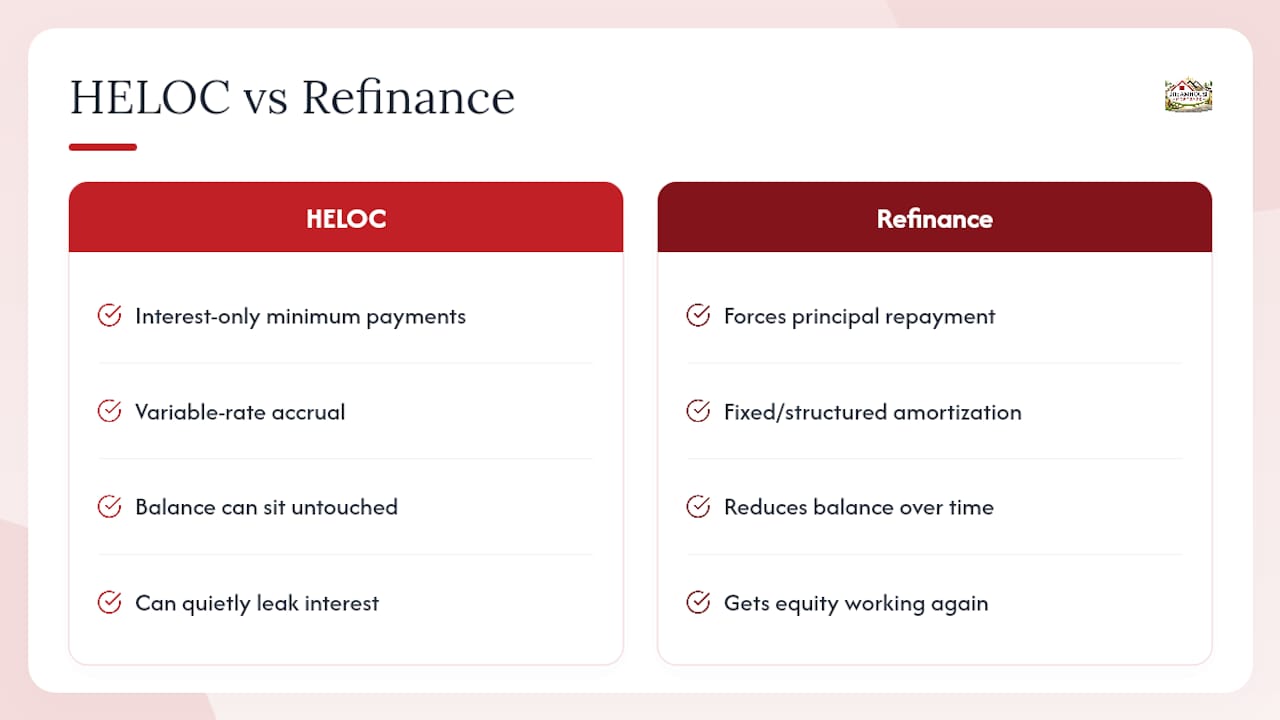
Most articles on this topic treat refinance and HELOC as a simple rate comparison, and that’s where they mislead readers. The bigger factor is discipline. A HELOC’s interest-only minimum payment feels friendly right up until the balance sits untouched for three years, still accruing at a variable rate that can climb without warning. A refinance forces principal repayment whether you like it or not, which sounds restrictive until you realize that’s exactly the structure that gets your equity working for you again instead of quietly leaking interest.
The conventional advice, “compare the rates and pick the lower one,” skips the part that actually matters for Calgary homeowners: how the CMHC’s mortgage consumer survey data consistently shows Canadians underestimate how borrowing behavior compounds over a five-year term. Prioritize your repayment discipline and your renewal timing before you even look at a rate sheet. Get those two right, and either product works. Get them wrong, and the “cheaper” option ends up costing more.
— Guriqbal Chahal, MBA, PMP
Get a Free Rate and Penalty Check for Your Calgary Property
Mortgage brokers can provide a side-by-side comparison across multiple lenders, credit unions, and alternative options, run by one broker familiar with the Calgary, Airdrie, and Cochrane markets. Instead of calling three institutions and piecing together three different penalty quotes yourself, you get one clear picture of what a refinance versus a HELOC actually costs on your specific mortgage.

Guriqbal Chahal, MBA, PMP walks you through your mortgage broker rate negotiation options, checks whether refinancing now or at renewal saves you more, and gives you a written prepayment penalty estimate before you commit to anything. Call 403-966-6072 or book through the Google Business Profile to set up your free consultation today.
This article is general information, not a substitute for advice from a qualified financial advisor. Consult a qualified financial professional about your own circumstances before acting on anything here.
Sources
FAQ
Is a HELOC Better Than Refinancing?
Neither is universally better. A HELOC suits flexible, staged draws, while refinancing usually suits a single large lump sum with a locked payment.
How Much Would a $100,000 HELOC Cost Per Month?
Interest-only payments on a $100,000 HELOC vary with the prime rate, and because HELOC rates typically run 0.75 to 1.15 points higher than comparable mortgage rates, the monthly cost is usually higher than an equivalent refinance amount. Get a current quote from a broker for an exact figure tied to today’s prime rate.
What Is the “2% Rule” for Refinancing Mortgages?
This isn’t a formal Canadian lending rule. The 2% often referenced elsewhere relates to the OSFI stress test buffer added to your contract rate, not a refinancing threshold.
Is a HELOC a Good Idea in Canada?
A HELOC can be a smart tool for staged projects or emergency access to funds, but it carries variable-rate and callable-limit risk that the Government of Canada’s consumer research flags as a common source of borrower difficulty.
Should Calgary Homeowners Talk to a Broker Before Choosing?
Yes. A broker like Dreamhouse Mortgage can run penalty estimates and lender comparisons specific to your mortgage, which a single bank branch typically won’t offer across competing lenders.