
Keep your low first-mortgage rate and add a second mortgage for a short-term cash need. Refinance when you want one loan, a lower blended rate, or a longer amortization. That is the core of the second mortgage vs. refinance difference for most Alberta homeowners, and the right choice usually becomes clear once you run four numbers: your current mortgage balance, your home’s estimated value, the cash you need, and any prepayment penalty on your existing mortgage.
Quick decision guide:
- Keep your first mortgage intact (take a second mortgage) if you have a low fixed rate you do not want to break, need funds quickly, or carry bruised credit that a prime lender would decline.
- Replace your first mortgage (refinance) if you want one monthly payment, a lower blended interest rate, or a longer amortization to reduce monthly costs.
- Wait until renewal if your prepayment penalty is large enough to wipe out the savings from refinancing, then reassess with a broker like Guriqbal Chahal at Dreamhouse Mortgage.
Canada’s mortgage rules, administered under the Financial Consumer Agency of Canada, shape both options. The sections below walk through each one in detail.
Key Takeaways
The core of the second mortgage vs. refinance difference is this: a second mortgage preserves your existing first mortgage while adding a separate loan, whereas refinancing replaces the first mortgage entirely, resetting your rate, term, and potentially your amortization.
| Point | Details |
|---|---|
| Keep vs. replace | A second mortgage keeps your first mortgage; a refinance replaces it with a new single loan. |
| Combined LTV cap | Both options are commonly capped at about 80% of the home’s appraised value in Canada. |
| Rate and cost tradeoff | Second mortgages carry higher rates but avoid prepayment penalties; refinances offer lower rates but incur penalty and setup costs. |
| Qualification gap | Second mortgages through alternative or private lenders accept weaker files; prime refinances require full income verification and a stress test. |
| Dreamhouse Mortgage | Guriqbal Chahal at Dreamhouse Mortgage models both scenarios for Alberta homeowners and matches borrowers to the right lender pool. |
Table of Contents
- How a second mortgage and a refinance compare at a glance
- What is a second mortgage in Canada?
- Advantages and disadvantages of a second mortgage
- What does refinancing a mortgage mean in Canada?
- Advantages and disadvantages of refinancing
- How much can you borrow, and what does each option cost?
- How lenders evaluate your application and what to expect in Canada
- How to decide: a step-by-step checklist for Alberta homeowners
- How Dreamhouse Mortgage helps Alberta homeowners compare options
- A broker’s perspective on this decision
- Dreamhouse Mortgage: personalized equity borrowing advice for Alberta homeowners
- Sources
- FAQ
How a second mortgage and a refinance compare at a glance
The table below covers the dimensions that matter most when weighing these two options side by side.
| Dimension | Second Mortgage | Refinance |
|---|---|---|
| Effect on first mortgage | Kept in place | Replaced entirely |
| Number of loans / payments | Two | One |
| Typical interest rate | Higher than first mortgage | Potentially lower (prime lenders) |
| Access to funds | Lump sum or revolving (HELOC) | Lump sum (cash-out) or rate/term reset |
| Combined LTV limit (Canada) | Up to ~80% of appraised value | Up to ~80% of appraised value |
| Fees and closing costs | Lower upfront; no penalty on first | Prepayment penalty + appraisal + legal |
| Best use case | Short-term cash, keep low rate, weaker credit | Consolidation, lower blended rate, amortization reset |
According to Matrix Mortgage Global, the four-number test (balance, value, cash needed, penalty) is the fastest way to reveal which option costs less, both upfront and over a two-to-five-year horizon.
Pro Tip: Before calling a lender, get a written payout statement from your current lender. The prepayment penalty on a fixed-rate mortgage can be several months’ interest or an interest rate differential (IRD) calculation, and that single number often decides the refinance vs. second mortgage question on its own.
What is a second mortgage in Canada?
A second mortgage is a separate loan registered against your home that sits behind your existing first mortgage on title. Because the second lender is in a subordinate lien position, they absorb more risk if the property goes into power of sale. That risk is why second mortgages carry higher rates than first mortgages and why second lenders, including alternative and private lenders, often accept files that a bank’s prime desk would decline.
The two main forms
Home equity loan: A fixed lump sum, repaid on a set schedule. The rate is fixed or variable, and you receive all funds at once. This suits one-time needs like a renovation or debt payoff.
HELOC (Home Equity Line of Credit): A revolving credit facility, typically at a variable rate. You draw and repay as needed, up to your approved limit. Canada that HELOCs are commonly structured so total access is roughly 65% of the home’s appraised value, while a home equity loan or second mortgage can reach a combined LTV of about 80%.
Reverse mortgage: Available to homeowners aged 55 and older. This is a specialized product, not a standard second mortgage.
How the math works
A Calgary homeowner with a home appraised at a certain value and a first mortgage balance has a combined LTV of 60%. At a common combined LTV cap near 80%, total borrowing capacity is limited accordingly, leaving some amount available through a second mortgage or HELOC, subject to income qualification and lender approval.
Key mechanics to know:
- Two separate registrations sit on title simultaneously.
- Two monthly payments are required while the second mortgage is active.
- Second lenders include banks, credit unions, alternative lenders, and private lenders, each with different rate and qualification standards.
- The second mortgage term is often shorter (six months to two years for private lenders; one to five years for institutional lenders).
Advantages and disadvantages of a second mortgage
Second mortgages suit homeowners who need cash without disturbing a favorable first mortgage, or who cannot qualify for a prime refinance at the moment.
Advantages
- No prepayment penalty on the first mortgage. The first mortgage stays untouched, so no IRD or three-month interest penalty applies.
- Faster funding. Private and alternative lenders can fund a second mortgage in days rather than the weeks a full refinance typically requires.
- Credit flexibility. NerdWallet Canada notes that second lenders may accept files banks would not, making this path workable for self-employed borrowers or those with recent credit events.
- Preserves a low first-mortgage rate. If your first mortgage carries a rate well below current market rates, a second mortgage lets you keep that advantage.
- Shorter commitment. A private second mortgage can be repaid when the first mortgage comes up for renewal, then consolidated at that point.
Disadvantages
- Higher interest rate. MoneySense confirms that second-lien lending commands higher rates because of subordinate risk, often several percentage points above prime first-mortgage rates.
- Two monthly payments. Managing two obligations adds cash-flow pressure.
- Short-term solution risk. A private second mortgage with a one-year term requires a clear exit plan, whether that is renewal, sale, or refinance.
- Higher total interest cost over time. The rate premium compounds; a second mortgage held for years costs more than a refinance would have.
- Foreclosure priority. If you default, the first lender is paid first. The second lender recovers only what remains, which is why they price the risk into the rate.
Red flags: when a second mortgage is a risky choice
- Monthly income is already stretched across the first mortgage payment.
- The property is near power of sale or already in arrears.
- The lender is a private individual or unlicensed entity with no clear terms.
- The funds are intended to cover recurring living expenses rather than a one-time need.
What does refinancing a mortgage mean in Canada?
Refinancing replaces your existing mortgage with a new mortgage, resetting the rate, term, and, if you choose, the amortization. The new mortgage pays out the old one, and you end up with a single loan registered on title. NerdWallet Canada explains that refinancing can involve prepayment penalties, appraisal fees, and legal costs, all of which must be factored into the economics.
Rate-and-term refinance
You replace the mortgage to get a better interest rate or to change the amortization period. No additional cash is taken out. This is common at renewal or when rates drop significantly mid-term.
Cash-out refinance
You replace the mortgage for a higher amount than the current balance and receive the difference as cash. This is the refinance path most comparable to a second mortgage when the goal is accessing equity.
Prepayment penalties
Breaking a fixed-rate mortgage mid-term triggers a prepayment penalty. Lenders calculate this as either three months’ interest or the IRD, whichever is greater. On a mortgage with a low rate and several years remaining, the IRD prepayment penalty can be substantial. That figure is often the most important variable in the refinance vs. second mortgage decision.
Refinancing options at a glance:
- Rate-and-term: lower rate or different amortization, no cash out.
- Cash-out: access equity as a lump sum, combined LTV up to ~80%.
- Debt consolidation refinance: roll high-interest debt into the mortgage at a lower blended rate.
- Amortization reset: extend repayment period to reduce monthly payment, though total interest paid increases.
Advantages and disadvantages of refinancing
Refinancing usually makes the most financial sense when you can lower your overall borrowing cost, consolidate high-interest debt into a lower mortgage rate, or want a single payment and a fresh amortization schedule.
Advantages
- Lower blended interest rate. Rolling credit card or car loan debt into a mortgage rate can reduce the effective rate on that debt substantially.
- One monthly payment. A single obligation simplifies budgeting and reduces the risk of missed payments.
- Amortization reset. Extending to a 25-year or 30-year amortization lowers the monthly payment, freeing cash flow. Dreamhouse Mortgage’s mortgage amortization guide explains how this affects total interest paid over the loan life.
- Access to prime lender rates. Qualifying borrowers get the lowest available rates, which second-mortgage lenders cannot match.
Disadvantages
- Prepayment penalty. Breaking mid-term can cost prepayment penalties and fees that may eliminate the savings from a lower rate.
- Higher upfront costs. Appraisal fees, legal fees, and lender administration charges add to the cost of refinancing.
- Stricter qualification. Prime lenders apply the federal mortgage stress test (qualifying at the contract rate plus 2%, or 5.25%, whichever is higher). Borrowers with irregular income or recent credit events may not pass.
- Longer total interest if amortization resets. Stretching a 15-year remaining amortization back to 25 years reduces the monthly payment but increases total interest paid over the life of the loan.
Typical refinance cost items to add to your math:
- Prepayment penalty (IRD or three months’ interest, whichever is greater)
- Appraisal fee (roughly $300–$500 in Alberta)
- Legal / notary fees (roughly $1,000–$1,500)
- Lender administration or discharge fee
How much can you borrow, and what does each option cost?
Canada’s Financial Consumer Agency confirms that combined borrowing is commonly capped near that threshold.
Typical LTV limits by product
| Product | Maximum LTV / Access |
|---|---|
| HELOC | ~65% of appraised value |
| Home equity loan / second mortgage | ~80% combined (first + second) |
| Cash-out refinance | ~80% of appraised value |
| Reverse mortgage (55+) | ~55% minus existing mortgage balance |
Worked example: Calgary homeowner
Assume a home appraised at $750,000 and a first mortgage balance of $450,000.
- Current LTV: $450,000 / $750,000 = 60%.
- Maximum combined borrowing at 80%: $750,000 x 0.80 = $600,000.
- Available equity: $600,000 minus $450,000 = $150,000.
- Cash-out refinance vs. second mortgage: Both options can access up to $150,000 in this scenario. The difference is cost and speed.
If the first mortgage carries a prepayment penalty of $12,000, the refinance costs at least $12,000 plus appraisal and legal before a single dollar of savings materializes. A second mortgage at a higher rate but with no penalty may cost less over a one-to-two-year horizon, depending on the rate spread.
Pro Tip: Run this four-number test first: (1) current mortgage balance, (2) estimated home value, (3) cash needed, (4) prepayment penalty. Divide the penalty by the monthly savings a refinance would generate to get your break-even month. If the break-even is beyond your planned hold period, a second mortgage is likely the cheaper path.
For a detailed look at home equity refinancing options in Alberta, Dreamhouse Mortgage’s resource page walks through lender comparisons and current rate ranges.
How lenders evaluate your application and what to expect in Canada
Second mortgages and refinances follow different underwriting paths, and the qualification gap between them is one of the most practical factors in the decision.
Key qualification differences:
- Income verification. A prime refinance lender requires full income documentation: T4s or Notices of Assessment, recent pay stubs, and business financials for self-employed borrowers. A private second-mortgage lender often focuses primarily on the equity position and property value.
- Credit score. Prime refinance lenders generally want a score of 680 or higher. Alternative second-mortgage lenders may work with scores in the 550–650 range; private lenders may not set a minimum score at all.
- Stress test. Federally regulated lenders apply the mortgage stress test to refinances. Most private second-mortgage lenders are not federally regulated and do not apply it.
- Debt service ratios. Prime lenders cap gross debt service (GDS) and total debt service (TDS) ratios. Second-mortgage lenders, particularly private ones, may use looser or different ratio thresholds.
- Property appraisal. Both options typically require an appraisal or automated valuation model (AVM). A full appraisal is more common for refinances; some second-mortgage lenders accept AVMs for lower-risk files.
Documents lenders typically request
- Government-issued photo ID
- Most recent mortgage statement (showing balance and lender)
- Two years of T4s or Notices of Assessment (prime lenders)
- Recent pay stubs or proof of income
- Property tax statement
- Appraisal or AVM report
Typical timelines
A private second mortgage can fund in as few as five to ten business days when the file is straightforward. A full refinance with a prime lender typically takes three to six weeks, accounting for payout statement requests, legal work, and appraisal scheduling.

Credit report impact: Both options generate a hard inquiry on your credit report. A new mortgage or second mortgage also changes your total debt load, which affects your credit utilization and debt-to-income profile. The impact is generally temporary, and on-time payments on either product support credit recovery over time.
A relevant policy note: as of December 15, 2024, Canada raised the insured mortgage cap to $1.5 million and adjusted down-payment tiers, which affects some refinance and purchase scenarios for higher-value properties in Calgary and Edmonton.
How to decide: a step-by-step checklist for Alberta homeowners
The right choice between a second mortgage and a refinance depends on your numbers, not a general rule.
- Calculate your four numbers. Write down your current mortgage balance, your home’s estimated market value, the cash you need, and your prepayment penalty (call your lender for a written payout statement).
- Estimate your refinance penalty. If you are mid-term on a fixed-rate mortgage, the IRD penalty can be substantial. If you are on a variable rate or near renewal, the penalty is usually much smaller.
- Run the blended-rate scenario. Compare the all-in monthly payment of a refinanced mortgage (new rate, new amortization) against the combined payments of your existing first mortgage plus a second mortgage. Include the penalty and fees in the refinance total.
- Assess your documentation readiness. If you are self-employed, recently changed jobs, or carry a credit score below 680, a prime refinance may not be available. A second mortgage through an alternative or private lender may be the only near-term path.
- Consider your timeline. If your first mortgage renews within 12–18 months, waiting and consolidating at renewal often costs less than breaking now.
- Choose based on priority:
- Speed or qualification is the constraint: second mortgage.
- Lower blended rate, debt consolidation, or amortization reset is the goal: refinance.
Edge cases worth noting
- Self-employed borrowers in Calgary or Airdrie with two or fewer years of business history often find second mortgages more accessible than prime refinances.
- Investors holding rental properties in Red Deer or Edmonton may use a second mortgage on one property to fund a down payment on another, preserving the first mortgage’s rate and avoiding a full refinance.
- Recent credit events (consumer proposal, late payments) typically disqualify borrowers from prime refinance for one to two years; a second mortgage through a private lender can bridge that gap.
- Near power of sale: A second mortgage is not a solution if the property is already in arrears without a clear repayment plan. Seek legal and broker advice immediately.
How Dreamhouse Mortgage helps Alberta homeowners compare options
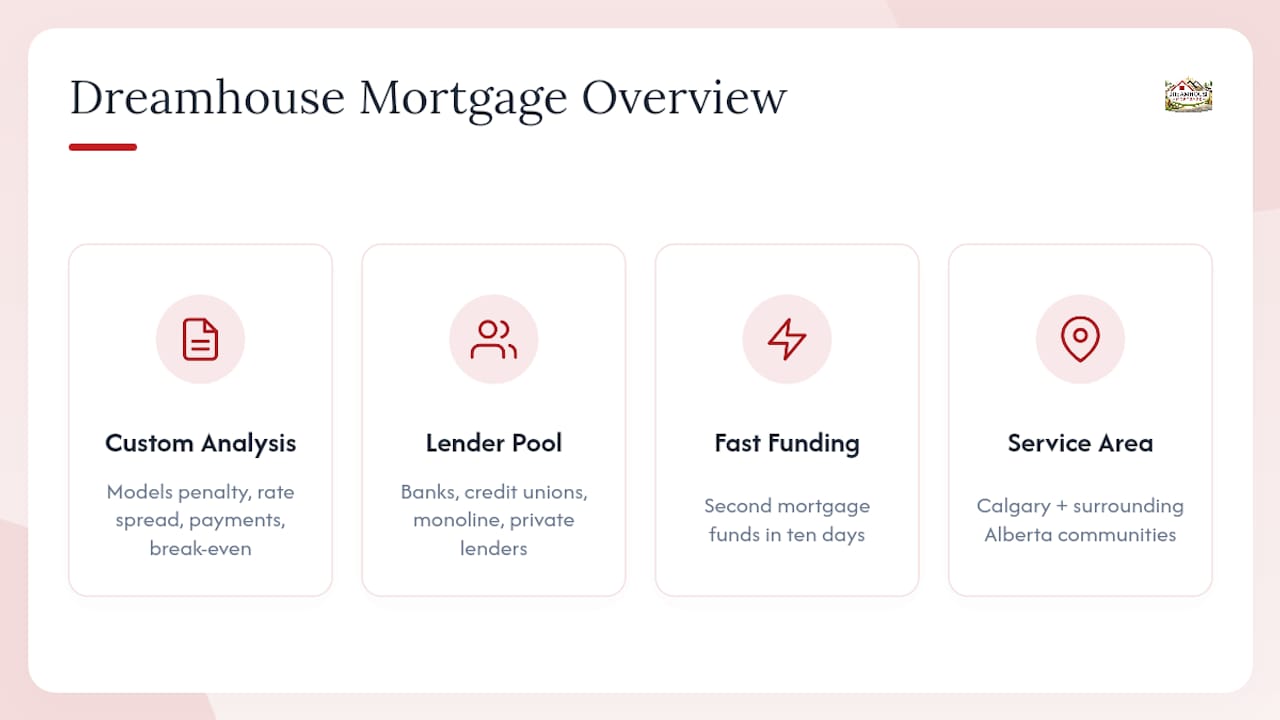
A mortgage broker shops the full lender pool, calculates your prepayment penalty, and models both scenarios side by side before you commit to either path. That analysis, done in one conversation, is the practical advantage of working with a broker rather than approaching a single lender directly.
Dreamhouse Mortgage, led by Guriqbal Chahal, MBA, PMP, Broker of Record, provides this comparison service for homeowners across Calgary, Airdrie, Cochrane, Chestermere, Okotoks, High River, Rocky View County, Edmonton, Red Deer, and surrounding Alberta communities.
Broker services relevant to this decision:
- Prepayment penalty calculation and break-even analysis
- Lender matching across banks, credit unions, monoline lenders, alternative lenders, and private lenders
- Fast second-mortgage sourcing for urgent funding needs
- Refinance negotiation and rate comparison across multiple lenders
- Qualification assessment for self-employed, new-to-Canada, and credit-challenged borrowers
- Home equity loan and HELOC options in Alberta explained and compared
Guriqbal Chahal, MBA, PMP, Broker of Record at Dreamhouse Mortgage: “The second mortgage vs. refinance decision comes down to four numbers and one question: can you absorb the penalty? Alberta homeowners who run that math with a broker before signing anything consistently make the choice that costs them less over their actual hold period.”
Call Guriqbal Chahal, MBA, PMP, Mortgage Broker at 403-966-6072 or view the Dreamhouse Mortgage Google Business Profile to book a free consultation.
A broker’s perspective on this decision
The four-number test is the starting point for every client conversation at Dreamhouse Mortgage. Current balance, home value, cash needed, prepayment penalty. Those four figures tell most of the story before a single lender is contacted. In Alberta’s market, where fixed-rate mortgages locked in during 2020–2022 still carry rates well below current levels, the penalty calculation is especially consequential. A short-term second mortgage, bridged to renewal, is often the cleaner path. That said, borrowers consolidating significant high-interest debt into a single mortgage payment at renewal can generate real monthly savings that justify the upfront cost.
Call Guriqbal Chahal, MBA, PMP, Mortgage Broker at 403-966-6072 or connect via the Dreamhouse Mortgage Google Business Profile for a free, no-obligation analysis of your specific situation.
Dreamhouse Mortgage: personalized equity borrowing advice for Alberta homeowners

Alberta homeowners comparing a second mortgage and a refinance need more than a general explanation. They need their specific numbers modeled: the penalty, the rate spread, the monthly payment difference, and the break-even timeline. Dreamhouse Mortgage does exactly that, at no cost to the borrower.
Founded in 2013 and serving Calgary, Airdrie, Cochrane, Chestermere, Red Deer, Edmonton, and surrounding Alberta communities, Dreamhouse Mortgage works with banks, credit unions, monoline lenders, alternative lenders, and private lenders. That lender pool means Guriqbal Chahal can source a fast second mortgage for a borrower who needs funds in ten days and a competitive refinance for a borrower who qualifies for prime rates and wants to consolidate debt.
Whether you are a first-time buyer in Cochrane weighing your equity options, a Calgary investor looking at a debt consolidation mortgage, or a self-employed homeowner in Airdrie who cannot pass a bank’s stress test, Dreamhouse Mortgage has a lender match for your file.
Call Guriqbal Chahal, MBA, PMP, Mortgage Broker at 403-966-6072, visit the Dreamhouse Mortgage Google Business Profile, or book a free consultation to get your second-mortgage vs. refinance analysis started today.
This article provides general information about Canadian mortgage options and is not a substitute for professional mortgage or financial advice. Confirm current rules, rates, and qualification criteria with a licensed mortgage broker or your lender.
Sources
- Canada
- Getting a Second Mortgage – NerdWallet Canada
- Second mortgages in Canada: What are the rules? – MoneySense
- Second Mortgage vs Refinance: Which Fits? – Matrix Mortgage Global
FAQ
What is the main difference between a second mortgage and a refinance?
A second mortgage adds a new loan behind your existing first mortgage, leaving the first mortgage in place. A refinance replaces the first mortgage entirely with a new loan, resetting the rate and term.
What is the downside to a second mortgage?
The primary downsides are a higher interest rate than a first mortgage and the obligation to carry two monthly payments simultaneously. Over a longer term, the rate premium results in higher total interest paid compared to a refinance at a prime rate.
How much can you borrow with a second mortgage in Canada?
Most Canadian lenders cap total borrowing (first mortgage plus second mortgage) at roughly 80% of the home’s appraised value, as confirmed by Canada.ca. The exact amount available depends on your current mortgage balance and the lender’s specific criteria.
Is a second mortgage a good idea for Alberta homeowners?
A second mortgage is a practical option when your first mortgage carries a low fixed rate you do not want to break, when you need funds quickly, or when your credit or income documentation does not meet prime refinance standards. It is less suitable as a long-term solution because of the higher rate.
When does refinancing make more sense than a second mortgage?
Refinancing is the stronger choice when you can qualify for a prime rate, your prepayment penalty is small or near zero (at renewal), and your goal is to consolidate debt, lower your blended interest rate, or reset your amortization for a lower monthly payment.