
A holding company mortgage can protect your personal assets and simplify estate planning, but in Alberta it almost always makes financing harder and pricier. Expect a personal guarantee, a bigger down payment, and the loss of the Principal Residence Exemption. For most Calgary investors, the decision hinges on whether retained corporate earnings and multi-property plans outweigh those added costs, and DreamHouse Mortgage can model the numbers before you commit.
TL;DR:
- Most lenders for corporate-owned properties require a larger down payment of 25% to 35% and a personal guarantee from the borrower.
- Transferring an existing property into a holding company can trigger significant tax consequences unless a rollover defers the gain, making pre-structuring more cost-effective.
- A holding company provides liability protection and estate planning advantages but results in higher accounting costs and the loss of the Principal Residence Exemption.
- Financing options are limited in Alberta, with credit unions and B-lenders treating corporate mortgages as specialty files, often with rates 25 to 100 basis points above standard residential loans.
- For portfolios with multiple properties, retained earnings, or estate-freeze goals, a holding company can be worthwhile, but single-property owners and those intending to live in the property typically benefit more from personal ownership.
Table of Contents
- Pros and Cons of Buying or Holding Property in a Holding Company
- How Alberta Lenders Underwrite a Mortgage for Holding Companies
- Tax and Legal Consequences of Corporate Property Ownership
- Structuring Before Purchase vs. Transferring Property Later
- When a Holding Company Actually Makes Sense
- How DreamHouse Mortgage Supports Alberta Holdco Buyers
- What Calgary Investors Get Wrong About Holdco Mortgages
- Talk to DreamHouse Mortgage Before You Structure Your Purchase
- Sources
- FAQ
Pros and Cons of Buying or Holding Property in a Holding Company
A holding company mortgage puts a legal wall between your operating business risks and your real estate. If a tenant sues or a business venture goes sideways, the property sitting in a separate holdco is generally shielded from that liability. That structure also opens the door to an estate freeze, letting you lock in today’s value for tax purposes while future growth accrues to the next generation, and it lets a corporate group keep retained earnings working inside the business rather than pulling money out and paying personal tax first.
The trade-offs are real. Running a holdco means a second set of financial statements, a corporate tax return, and ongoing legal and accounting fees that a personally held rental never generates. Corporations cannot claim the Principal Residence Exemption, so any personal-use property held corporately loses that shelter entirely. Passive rental income inside a corporation is also taxed at a steep rate, and most lenders will still ask you to personally guarantee the mortgage anyway.
- Pro: Liability isolation between business operations and real estate holdings
- Pro: Estate-freeze flexibility for succession planning across a family group
- Pro: Retained earnings can fund purchases without a personal tax hit first
- Con: Added yearly accounting, legal, and corporate filing costs
- Con: Loss of the Principal Residence Exemption on corporate-owned property
- Con: Higher passive-income tax rates inside the corporation
- Con: Lenders typically still require a personal guarantee
How Alberta Lenders Underwrite a Mortgage for Holding Companies
Most major banks avoid lending directly to a holding company for a single residential property. That gap gets filled by credit unions, monoline lenders, and B-lenders, who treat a corporate-owned 1-to-4 unit property as a specialty file rather than a standard residential approval. Larger, 5-plus unit buildings shift into fully commercial mortgage territory, where underwriting leans on the building’s own cash flow rather than your personal income.
Lenders evaluating a corporate borrower look at loan-to-value and debt service coverage ratio against the rental income the property can generate, then request incorporation documents, corporate financial statements, and a rent roll before they will even quote a rate. Expect a bigger down payment too. Corporate and commercial mortgages typically ask for 25% to 35% down, against rates that often run 25 to 100 basis points wider than a comparable residential mortgage in your own name.
Here is the practical sequence Calgary investors usually work through:
- Decide your ownership structure before you shop for a mortgage. Buying personally then moving the property into a holdco later triggers tax consequences worth avoiding.
- Gather corporate documents early. Articles of incorporation, a corporate organization chart, and two years of financial statements speed up underwriting significantly.
- Prepare for a personal guarantee. Nearly every lender extending a corporate mortgage will ask a director or shareholder to personally guarantee the debt.
- Budget for a larger down payment. Corporate files rarely qualify for the same minimum down payment as an owner-occupied purchase.
- Line up a refinance plan. Many investors start with a B-lender and plan to move to better pricing once the file seasons.
A word of caution on financing programs: the Canada Small Business Financing Program excludes holding companies and rental property entirely, so don’t waste time chasing that route for a rental purchase. A conventional commercial mortgage, underwritten on property value and income, is the correct path.
Pro Tip: Ask your broker to pre-qualify the corporate file against two or three lender types at once. B-lender, credit union, and monoline underwriting guidelines differ enough that the same file can qualify at one and get declined at another.
Tax and Legal Consequences of Corporate Property Ownership
Passive rental income earned inside a holding company gets taxed at a high combined rate, close to the top marginal bracket most years, before you ever touch a dividend. The Refundable Dividend Tax on Hand mechanism returns some of that tax once you pay dividends out to shareholders, but the timing lag means cash sits taxed at a high rate before it gets refunded.
The number that surprises most first-time holdco buyers: corporations get zero access to the Principal Residence Exemption. If you later live in the property or hoped to shelter appreciation the way an individual homeowner would, that option simply does not exist for corporate title.
A few other consequences worth flagging before you sign anything:
- Deemed disposition on transfer: moving a property you already own into a corporation is treated as a sale for tax purposes unless you use a section 85 rollover to defer the gain.
- TOSI and income splitting: the Tax on Split Income rules limit how easily you can pay dividends to a lower-income spouse or adult child from the holdco.
- Small business deduction grind-down: passive investment income above certain thresholds can reduce the small business deduction available to associated operating companies.
- Corporate filing obligations: annual T2 returns follow the CRA’s corporation income tax guide, separate from your personal return.
None of this is a reason to avoid a holdco outright, but it is a strong reason to get a corporate lawyer and an accountant involved before restructuring anything, not after.
Structuring Before Purchase vs. Transferring Property Later
Setting up the holding company before you buy is almost always cheaper than transferring an existing property in later. Buy first in your own name, and moving it into a corporation afterward risks a deemed disposition and a capital gains bill on top of legal and land transfer costs you would have avoided by structuring correctly from day one.
If a transfer is unavoidable, here is the checklist to work through:
- Talk to your accountant first about whether a section 85 rollover can defer the gain.
- Confirm lender consent. Your existing mortgage lender must approve any change in title before the transfer proceeds.
- Budget for Alberta land transfer and registration fees, plus legal fees to draft the transfer and rollover election.
- Re-qualify the mortgage under the corporation’s name, which often means a fresh underwriting review.
For Calgary, Cochrane, and Airdrie buyers, timing this around a mortgage renewal date can save you from paying a penalty to break your current term mid-transfer.
When a Holding Company Actually Makes Sense
A holdco tends to earn its cost when you already have multiple rental properties, meaningful retained earnings sitting in an operating company, or a clear estate-freeze goal for passing wealth to the next generation. Advisers generally steer single-property buyers toward personal ownership instead, since the accounting and legal overhead rarely pays for itself on one door.
- Good fit: investors holding three or more rental properties or planning to scale a portfolio
- Good fit: business owners with retained earnings already inside a corporation
- Good fit: families planning a succession or estate freeze
- Poor fit: a first rental property purchased without existing corporate income
- Poor fit: anyone who might live in the property and want the Principal Residence Exemption later
- Poor fit: early-stage landlords still building toward a second or third door
Pro Tip: If your expected passive rental income is modest and you plan to sell within five to seven years, run the numbers both ways. The tax savings inside a corporation rarely outweigh the accounting fees at that scale.
How DreamHouse Mortgage Supports Alberta Holdco Buyers
The brokerage works with multiple lenders to help place corporate mortgage files. A consultation reviews your corporate structure, realistic lender appetite, guarantee implications, and a timeline you can plan around. Bring your incorporation documents, personal financial statements, a rent roll if the property is already tenanted, and the purchase agreement or property details. The team has experience guiding investors through corporate financing decisions.
What Calgary Investors Get Wrong About Holdco Mortgages
Most of the advice circulating online treats a holding company like a tax shelter that also happens to buy real estate. That framing is backwards. A holdco’s real value is liability isolation and estate flexibility, not a way to dodge tax on rental income, and the personal guarantee nearly every lender requires quietly undoes the liability protection people think they are buying.
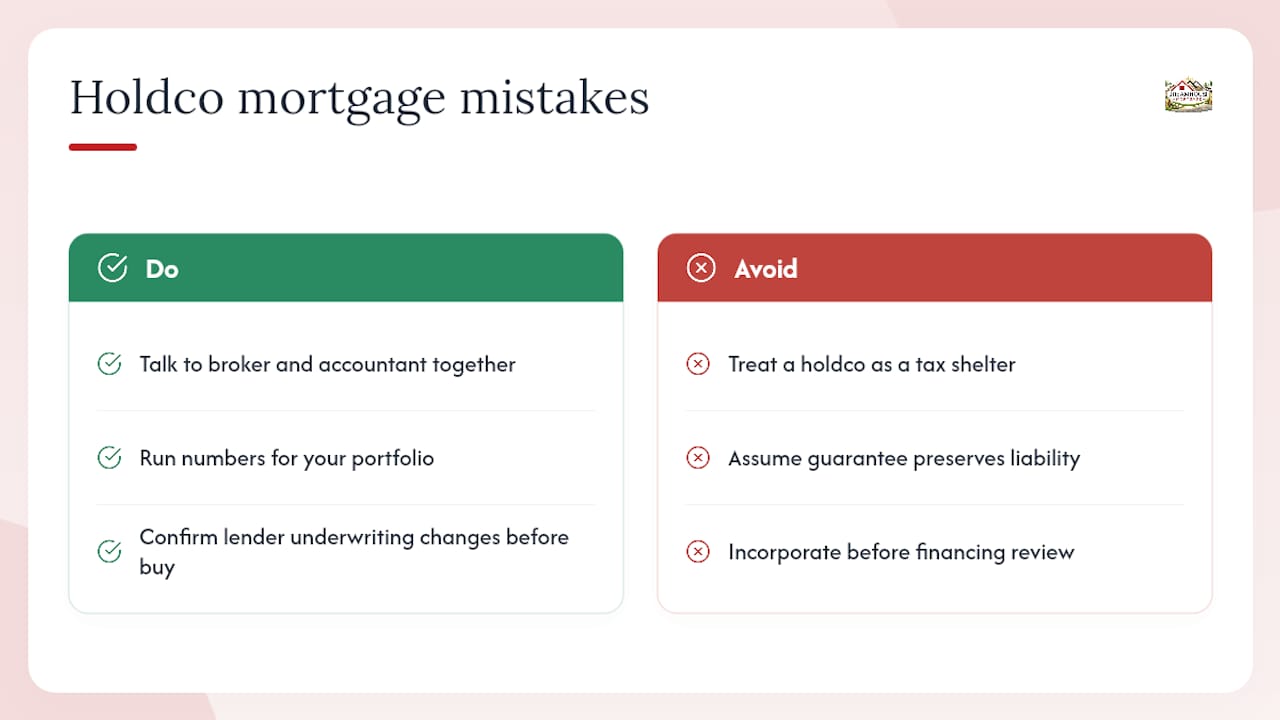
The conventional advice also underweights how much the financing side changes the math. What actually matters is running the numbers on your specific portfolio size, retained earnings, and sale horizon before you incorporate anything.
If you take one thing from this: talk to a mortgage broker and an accountant together, before you buy, not after your lawyer has already drafted the transfer. Calgary’s lender landscape for corporate files shifts often enough that what worked for a colleague’s holdco two years ago may not clear underwriting today.
— Guriqbal Chahal, MBA, PMP
Talk to DreamHouse Mortgage Before You Structure Your Purchase
DreamHouse Mortgage gives Calgary, Cochrane, and Airdrie investors something a single bank branch can’t: access to multiple lender types in one conversation, so a corporate file gets shopped across credit unions, monolines, and alternative lenders instead of stalling at one institution’s answer.

A free consultation walks through your down payment options, expected rate range, and a realistic pre-approval timeline before you make an offer, whether you’re buying personally or through a corporation. If you’re weighing a holding company mortgage against a straightforward investment property purchase, it helps to see both numbers side by side, and our investment property mortgage guide for Calgary breaks down current down payment and qualification expectations. Call Call Guriqbal Chahal, MBA, PMP, Mortgage Broker, at 403-966-6072 to book a consultation, or find DreamHouse Mortgage on Google Business Profile to see local reviews and get directions.
This article is general information, not a substitute for advice from a qualified financial advisor. Consult a qualified financial professional about your own circumstances before acting on anything here.
Sources
- What is a real estate holding company in Canada? | Multitax Services
- Purchasing Real Estate With Holding Company: Costs, Pros & Cons | Insight Law Firm
- Can you use the CSBFP for a rental or real-estate holding company? (BridgeNote)
- T2 Corporation Income Tax Guide — CRA
FAQ
What are the tax benefits of a holding company in Canada?
The main benefit isn’t a tax break on rental income. It’s the ability to keep retained earnings inside a corporate structure and use estate-freeze planning for succession, while passive rental income still gets taxed at a high corporate rate with RDTOH recovered only when dividends are paid out.
Can I buy a house with my holding company?
Yes, but expect a lender to underwrite it as a corporate or commercial file rather than a standard residential mortgage, which usually means a 25% to 35% down payment and a personal guarantee from a director or shareholder.
What are the disadvantages of a holding company for real estate?
The property loses access to the Principal Residence Exemption, you take on ongoing accounting and legal costs, and most lenders still require a personal guarantee that offsets much of the liability protection you were seeking.
Do holding companies pay taxes in Canada?
Yes. Holding companies file a T2 corporate return and pay tax on passive rental income at a high combined rate, with the RDTOH mechanism refunding a portion of that tax once dividends are distributed to shareholders.
Recommended
- Minimum Down Payment Calgary 2026: Lowest Amount You Need to Buy a Home
- Mortgage Checklist Calgary: The Ultimate Proven Guide — Everything You Need Before Applying (2026)
- Alberta Construction Mortgages: Plan for 20 to 35% Down, 3 to 5 Draws
- Investment Property Mortgage Calgary 2026: Best Rates, Down Payment & Qualification Guide