
Lenders reviewing your file for pre-approval generally need five document groups: government-issued ID, proof of income, proof of your down payment, a full list of your assets and debts, and property information once you have an accepted offer. Exact requirements vary by lender, and a missing item is the most common reason files stall according to CMHC’s guidance for mortgage professionals. A mortgage broker can build you a checklist tailored to your situation before you apply.
TL;DR:
- Missing or incomplete documentation related to income, down payment, or assets is the most common reason mortgage files stall during pre-approval.
- Self-employed applicants need two years of CRA Notices of Assessment and detailed business financial statements to prove income stability.
- Applying for pre-approval before gathering aged funds or final CRA documents can delay the process or cause rejection due to sequencing issues.
- The stress test uses a minimum rate of 5.25% or your rate plus 2%, with GDS and TDS ratios capped at 39% and 44% respectively.
- Organizing and verifying all required documents early, including credit reports and proof of funds, significantly speeds up the approval process.
Table of Contents
- What documents do Canadian lenders typically ask for?
- Extra paperwork for self-employed buyers, newcomers, and co-signers
- How the stress test and debt ratios shape your pre-approval
- Getting your file organized before you apply
- What happens between pre-approval and final approval
- A broker’s view on what actually slows Calgary files down
- The checklist matters less than the sequence you follow
- Let DreamHouse Mortgage review your file before you apply
- Where to verify these rules yourself
- Sources
- FAQ
What documents do Canadian lenders typically ask for?
Most Calgary and Alberta lenders build their pre-approval file around the same core categories. According to the Financial Consumer Agency of Canada, lenders typically require identification, proof of employment, proof you can cover the down payment and closing costs and a clear picture of your assets and debts. Here is what that generally includes.
- Identification and address: a Canadian passport, driver’s license, or provincial photo card, plus a recent utility bill or bank statement showing your current address.
- Proof of income: your recent pay stubs, T4 slips covering the past couple of years, and an employment letter stating your position, salary, and pay frequency, with commission details added if part of your pay is variable.
- Down payment proof: bank statements showing the funds have been in your account long enough to qualify as seasoned, RRSP Home Buyers’ Plan paperwork if you are drawing from retirement savings, and a signed gift letter confirming the money is a non-repayable gift if family is helping.
- Assets and liabilities: three months of bank statements, investment or registered account statements, and a list of current debts including credit cards, car loans, lines of credit, and student loans with balances and minimum monthly payments.
- Credit report: pulling your own Equifax or TransUnion report ahead of time lets you fix errors before a lender sees them.
- Property documents, once you have an offer: the MLS listing, signed Offer to Purchase, deposit confirmation and condo documents such as fees and a status certificate if you are buying a condo.
Our mortgage checklist for Calgary and Alberta buyers walks through each of these with local examples, and if part of your down payment is a gift, our gift letter mortgage checklist covers the exact wording lenders expect.
Extra paperwork for self-employed buyers, newcomers, and co-signers
Some applicants face a longer list, and knowing this ahead of time prevents a frustrating back-and-forth with your lender.
- Self-employed borrowers need two years of Canada Revenue Agency Notices of Assessment, T1 tax returns, statements of business income and expenses, and corporate financial statements if incorporated. Lenders look closely at line 15000 (total income) and line 23600 (net income) on your NOA to judge how stable your earnings really are.
- Newcomers to Canada typically supply employment letters, any newcomer mortgage program paperwork their lender offers, and alternative income proof such as foreign pay records or bank statements, translated where needed. Expect some lenders to apply extra conditions or a slightly longer review while your Canadian credit history is still thin.
- Co-signers and guarantors provide the same core package as the primary applicant: ID, income proof, and a full list of liabilities. Their debts get added into the household’s GDS and TDS calculations, which can shift the maximum mortgage amount the file supports.
Pro Tip: If your income comes from a mix of sources, self-employment plus rental income, for example, bring documentation for each stream rather than assuming a single T4 will cover it.
Our self-employed mortgage income proof guide for Alberta goes deeper into what business owners specifically need to prepare.
How the stress test and debt ratios shape your pre-approval
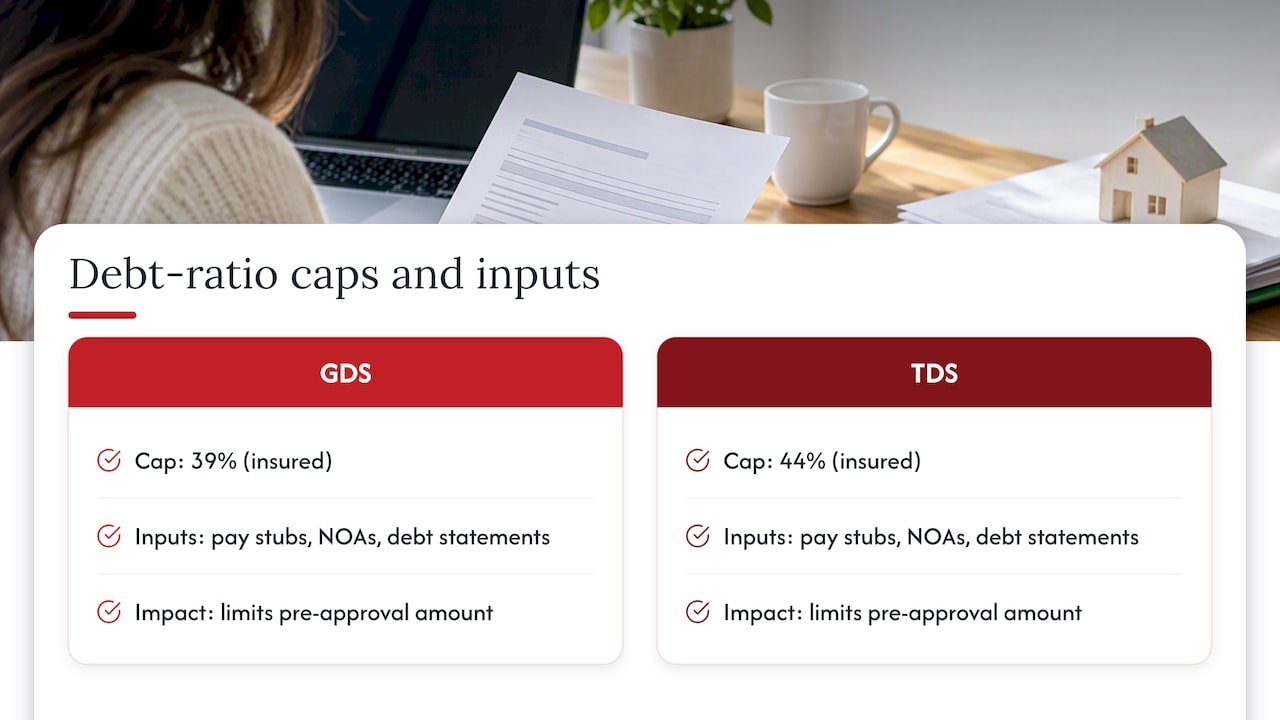
Every document you submit feeds into two calculations that decide how much you can actually borrow. Federally regulated lenders must qualify you using a stress test set by the Office of the Superintendent of Financial Institutions: the greater of your contract rate plus 2%, or a floor of 5.25%.
The stress test floor is 5.25%, and it means your pre-approval amount is based on a higher rate than what you will actually pay, which protects you against future payment shocks according to OSFI.
Lenders use your pay stubs, NOAs, and debt list to calculate two ratios: gross debt service and total debt service. For insured mortgages, these are commonly capped at 39% (GDS) and 44% (TDS). Every pay stub and debt statement you hand over exists to make these numbers accurate, since an incomplete debt list understates your obligations and can lead to a pre-approval that does not survive final underwriting.
Getting your file organized before you apply
A little organization ahead of your appointment saves real time once your file is with a lender.
- Build one labeled digital folder, PDFs rather than photos, and keep three months of recent bank statements ready to upload.
- Pull your credit report early and dispute any errors before a lender sees the file.
- Request your CRA Notices of Assessment ahead of time, since retrieval through your CRA My Account or by phone can take a few business days if you have not registered yet.
- For down payment funds, show at least 90 days of account history to prove the money has been sitting long enough, or attach a signed gift letter with proof of the giver’s own funds.
- Before your appointment, ask your broker which documents apply to your specific income type and whether any recent large deposits need an explanation.
Pro Tip: Name your files clearly, “Smith_T4_2024.pdf” rather than “scan001.pdf”, so nothing gets missed when your broker assembles the package for a lender.
Our pre-approval process guide for Alberta buyers covers what happens after submission, including typical rate-hold timelines.
What happens between pre-approval and final approval
Pre-approval is not the finish line. Once you have a signed offer, a few more steps typically follow before funding.
- A property appraisal confirms the home’s value supports the mortgage amount, and proof of home insurance is required before closing.
- Your lender may ask for updated bank statements closer to your closing date, or proof of sale if you are relying on funds from an existing property.
- New debt or a fresh credit inquiry after pre-approval can change your approved amount or void it entirely, so hold off on financing a car or opening new credit until after closing.
- Rate holds from pre-approval typically last 90 to 120 days, so timing your house search around that window matters.
A broker’s view on what actually slows Calgary files down
In more than a decade guiding Calgary-area buyers through this process, I have seen the same gaps repeat: seasonal or commission income without enough supporting months, and down payment funds that were moved between accounts too recently to look “aged” to a lender. Both are fixable with the right paperwork gathered early.
A mortgage brokerage can sit down with clients for a document review before anything goes to a lender, catching these issues while there is still time to fix them. Whether you are self-employed, new to Canada, or buying your first home in Calgary, Airdrie, or Cochrane, a checklist specific to your income and down payment source can be built, then coordination is done with the lender on your behalf.
The checklist matters less than the sequence you follow
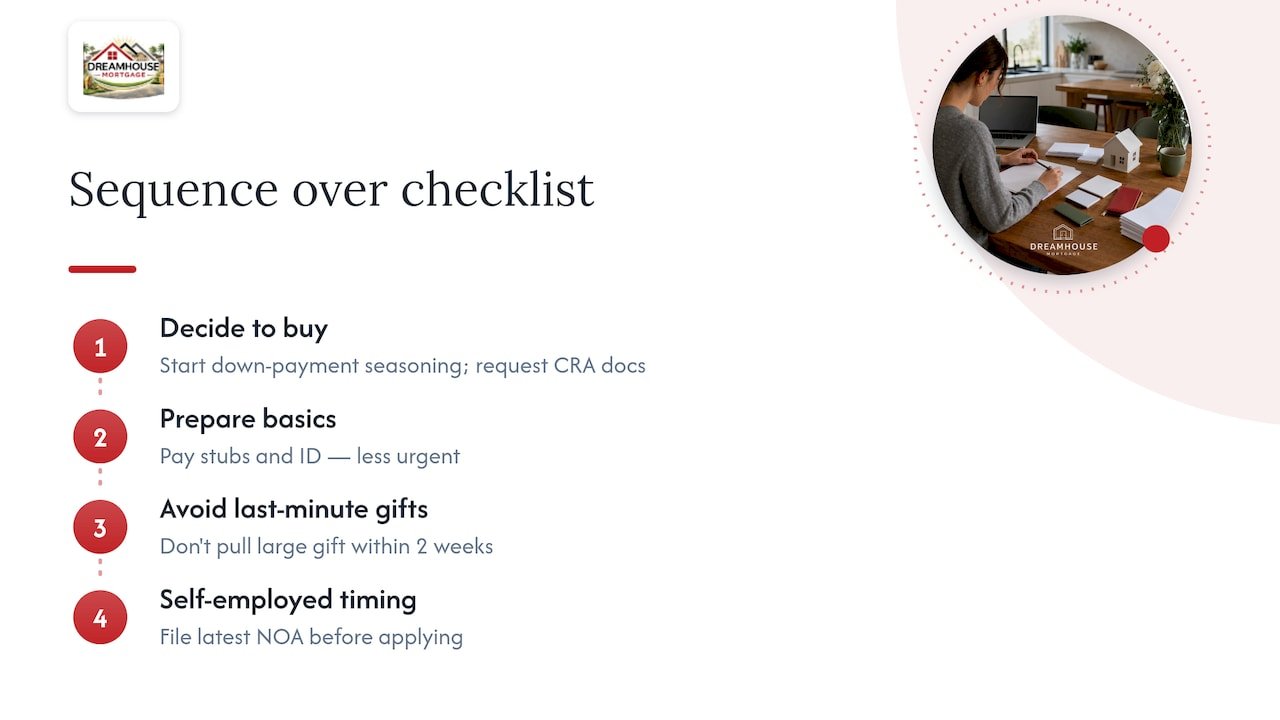
The real lesson from watching hundreds of Calgary files move through underwriting is that most rejection scares have nothing to do with income or credit. They come from sequencing: buyers pull a large gift deposit two weeks before applying, or a self-employed buyer applies for pre-approval before their latest NOA is even filed. The documents themselves rarely surprise anyone; the timing does.
Generic online checklists treat every document as equally urgent, but aged funds and CRA paperwork need a head start that pay stubs and ID do not. If you take one thing from this article, let it be this: start your down payment seasoning and your CRA document requests the moment you decide to buy, not the week you find a house.
— Guriqbal Chahal, MBA, PMP
Let DreamHouse Mortgage review your file before you apply
Gathering the right documents is easier with a broker who knows what your specific lender will ask for, and such services are offered for buyers across Calgary, Airdrie, Cochrane, and the surrounding Alberta communities.

Whether you need help with a Mortgage Pre-Approval, a First Time Buyer Mortgage, a Self Employed Mortgage, or a New To Canada Mortgage program, we review your documents ahead of submission so nothing holds up your file. Call Guriqbal Chahal, MBA, PMP, Mortgage Broker at DreamHouse Mortgage at 403-966-6072, or check our Google Business Profile to see how we have helped local buyers. Start with our mortgage pre-approval page to book your document review today.
Where to verify these rules yourself
A few official sources are worth bookmarking as you gather your paperwork.
- Financial Consumer Agency of Canada for guidance on preparing to get a mortgage and checking your credit early.
- OSFI for details on the B-20 guideline behind GDS and TDS limits.
- CRA for information on requesting Notices of Assessment and income verification.
This article is general information, not a substitute for advice from a qualified financial advisor. Consult a qualified financial professional about your own circumstances before acting on anything here.
Sources
- Getting preapproved for a mortgage — Financial Consumer Agency of Canada
- Minimum qualifying rate for uninsured mortgages — OSFI
- Mortgage application tips — CMHC
- Mortgage industry consultation — CRA
FAQ
What documents do I need for pre-approval for a mortgage?
You will typically need government-issued ID, proof of income such as pay stubs and T4 slips, proof of your down payment funds, and a list of your assets and debts. Self-employed applicants also need two years of Notices of Assessment and business financial statements.
How much income do you need to qualify for a $500,000 mortgage in Canada?
There is no single income figure, since it depends on your interest rate, other debts, and the stress test floor of 5.25% that lenders apply. A mortgage broker can run your specific numbers against current GDS and TDS limits to give you an accurate figure.
What are the new mortgage rules in Canada for 2026?
Federally regulated lenders continue to apply the OSFI stress test, qualifying borrowers at the greater of their contract rate plus 2% or a 5.25% floor. Rules can shift, so confirming current details with a licensed Alberta mortgage broker before you apply is the safest approach.
How to get pre-approved for a $200,000 mortgage?
The process is the same regardless of loan size: gather your ID, income proof, down payment documentation, and debt list, then have a lender or broker calculate your GDS and TDS ratios against that amount. DreamHouse Mortgage can confirm whether your documents support that pre-approval amount before you submit anything to a lender.
Recommended
- Ultimate Guide to Mortgage Documents Required Alberta (2026 Checklist That Gets You Approved Faster)
- Mortgage Checklist Calgary: The Ultimate Proven Guide — Everything You Need Before Applying (2026)
- Mortgage Pre-Approval Process Explained for Alberta Buyers
- Mortgage Pre‑Approval Calgary AB (2026 Guide) – Smart, Simple Steps