
Yes, Canadian lenders can use rental income to help you qualify for a mortgage, but the amount they accept and the paperwork they require vary by lender and by the rules set out through CMHC and OSFI. Before you make an offer on a property with rental potential, gather your tax documents and talk to a mortgage broker who can match your file to the right lender.
TL;DR:
- Lenders use either an offset or an income addition method, then usually discount rent for vacancies, maintenance, and management; compare both calculations before making an offer.
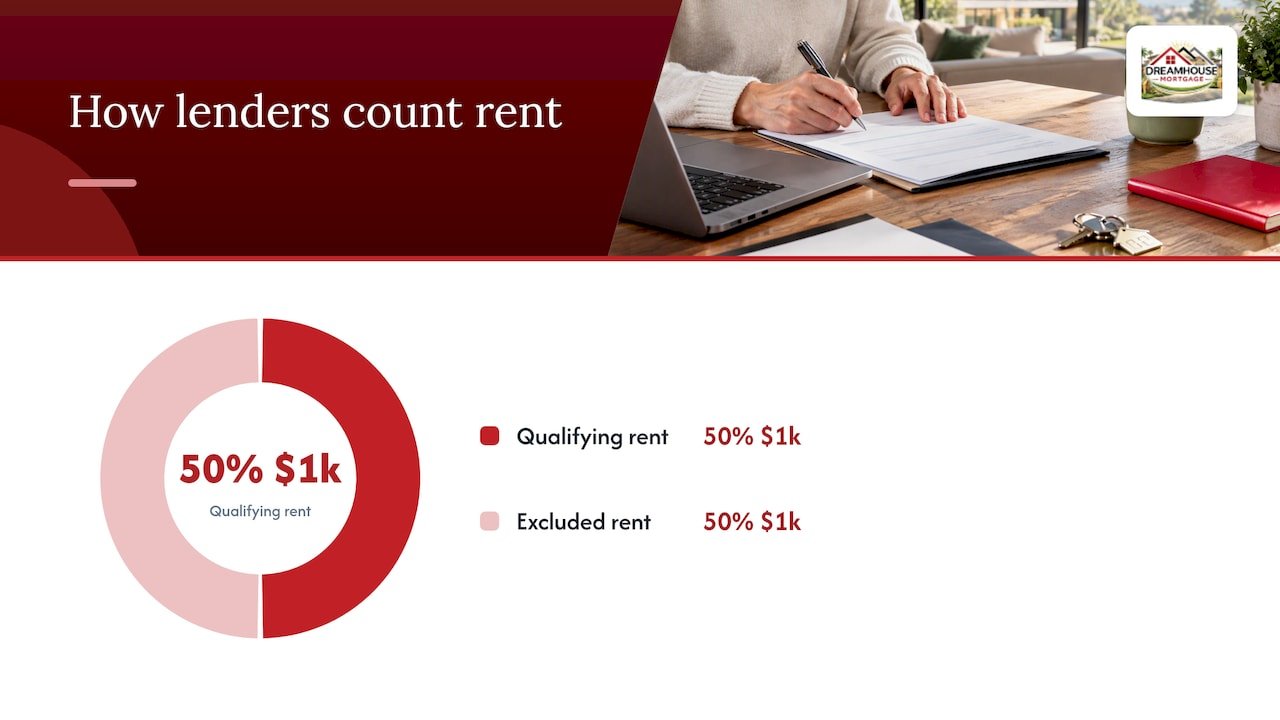
- For a unit renting $2,000 monthly, a lender using a 50% gross rent approach counts $1,000 and includes the full mortgage payment in debt ratios.
- For insured two to four unit homes you occupy, CMHC allows gross or net rental income and may exclude property taxes or heating costs.
- Prepare two years of T1 returns and matching Notices of Assessment, plus leases and bank or platform statements; projected rent appraisals rank last.
- Short term rental income faces tighter review because bookings fluctuate and leases may be absent; verify municipal rules, and expect some lenders to reject it.
Table of Contents
- How lenders count rental income: offsets, add-backs and net approaches
- CMHC’s approach to qualifying rental income on 2 to 4 unit properties
- OSFI, Guideline B-20 and what the 2025 clarification actually changes
- Documents lenders want, and two worked examples
- How a mortgage broker packages rental income to strengthen your approval
- Why rental income stability and vacancy rates matter to lenders
- Self-managed versus professionally managed rental properties
- How rental income affects your loan-to-value ratio and borrowing limits
- Tax implications to plan for alongside your mortgage qualification
- Calgary and Alberta perspective: what local buyers should watch for
- We assist buyers who want rental income to count toward their mortgage, and our value is in matching your documentation to the lender most likely to accept it on good terms rather than leaving you to guess which bank’s policy fits your file.
- FAQ
- Sources
How lenders count rental income: offsets, add-backs and net approaches
Lenders generally use one of two models when they look at rental income. Under the offset method, a portion of the rent is subtracted directly from your mortgage payment before your debt ratios are calculated. Under the add-back method, a percentage of the gross rent is added to your total income, and the full mortgage payment stays in your debt calculation. The method a lender chooses changes your qualifying numbers substantially, even when the rent figure itself is identical.
Across Canada, lenders typically apply a haircut to account for vacancy, maintenance and management costs, so you rarely see 100% of gross rent counted. You will find:
- Conservative lenders that count a smaller share of gross rent and lean on historical, CRA-verified figures.
- More flexible monoline and alternative lenders, often accessed through a broker, that may accept a market rent appraisal and use higher add-back percentages for a purchase you have not yet closed on.
- Lenders that will only use rental income once you have a full year of tax filings showing it, rather than a projection.
If you are counting on short-term rental income from a platform like Airbnb, expect tighter scrutiny. Municipal short-term rental rules, income volatility, and the lack of a standard lease mean many lenders discount this income more heavily or decline to use it at all. Our short-term rental mortgage qualification guide for Alberta walks through how that plays out locally.
CMHC’s approach to qualifying rental income on 2 to 4 unit properties
When you are buying a property with mortgage loan insurance, CMHC sets out specific methods for counting rental income, and the method changes depending on whether you will live in the property and how many units it has.
- For an owner-occupied duplex, some insured programs allow a large portion of the gross rental income from the second unit to be added to your qualifying income.
- For a 3 or 4 unit property, CMHC permits either a substantial portion of the gross rental income approach or a net rental income approach, where actual operating expenses are deducted from the rent before it counts.
- The method you use feeds directly into your GDS and TDS calculations, which in turn affects your maximum purchase price and your down payment and premium requirements.
- In some cases, property taxes or heating costs tied to the rental unit can be excluded from the calculation, which changes your net qualifying figure.
Because the gross versus net choice can swing your qualifying income meaningfully, it is worth modeling both scenarios before you commit to a specific property type. Our overview of gross versus net income for mortgage qualification breaks down how lenders apply each method in practice. CMHC also maintains a dedicated Income Property insurance product for small rental buildings, with its own premium and eligibility structure.
OSFI, Guideline B-20 and what the 2025 clarification actually changes
OSFI’s Guideline B-20 sets the underwriting standard Canadian lenders follow, and it calls for rigorous, independently verifiable income documentation rather than relying on projections alone. Expect lenders to lean on your T1 General returns and Notices of Assessment wherever possible, since these are harder to misrepresent than a verbal estimate of expected rent.
In 2025, OSFI clarified that updated capital adequacy requirements (CAR) guidance, which can classify certain mortgages as income-producing real estate for capital purposes, does not change B-20’s underwriting expectations. In plain terms, lenders can still use rental income to help you qualify. The classification question affects how much capital a lender sets aside behind your mortgage, not whether you can use rent to qualify.
In practice, some lenders respond to this capital treatment by applying more conservative internal policies on rental-dependent files. That lender-by-lender variability is exactly why working with a broker who tracks these internal policies across multiple lenders matters.
Documents lenders want, and two worked examples
Before you meet with a broker, pull together the documents that verify your rental income the way lenders prefer to see it.
- Two years of T1 General tax returns and matching Notices of Assessment (NOAs) showing reported rental income.
- A signed lease agreement for the current or incoming tenant.
- Bank or platform statements if the income comes through a rental platform.
- A market rent appraisal when the unit is vacant or newly created, prepared on the lender’s required form.
- Proof of zoning and any required business license for a legal secondary suite.
Lenders generally rank these sources in order of reliability: CRA-verified historical income first, platform or bank statements second, and appraisal-based projected rent last, often requiring extra conditions before they accept it.
Worked example 1, owner-occupied duplex: Say the second unit rents for $1,500 a month.
Worked example 2, non-owner single-unit investment purchase: Say the unit rents for $2,000 a month and the lender applies a 50% gross rental income approach. Only $1,000 counts toward your qualifying income, with the full mortgage payment still included in your debt ratios, a noticeably more conservative result than the owner-occupied scenario above.
How a mortgage broker packages rental income to strengthen your approval
A broker’s job on a rental-income file is to match your documentation to the lender most likely to accept it on favorable terms. That means comparing how different banks, credit unions, monoline lenders and alternative lenders treat gross versus net rent, sourcing a market rent appraisal when your property needs one, and packaging your T1s and NOAs so the lender sees a clean, verifiable income history.
Timing matters. Bringing your tax returns, lease agreements and a rough sense of your target property type to a pre-approval meeting gives your broker time to shop multiple lenders before you are under a financing deadline.
Guriqbal Chahal, MBA, PMP, is the Broker of Record at DreamHouse Mortgage and works directly with Calgary, Airdrie and Cochrane area buyers on investment and rental-income files, drawing on relationships across banks, credit unions, monoline and alternative lenders to find a fit for each borrower’s documentation.
Pro Tip: Ask your broker to run your file against both a gross and a net rental income scenario before you write an offer, so you know your real purchasing power under each.
Why rental income stability and vacancy rates matter to lenders
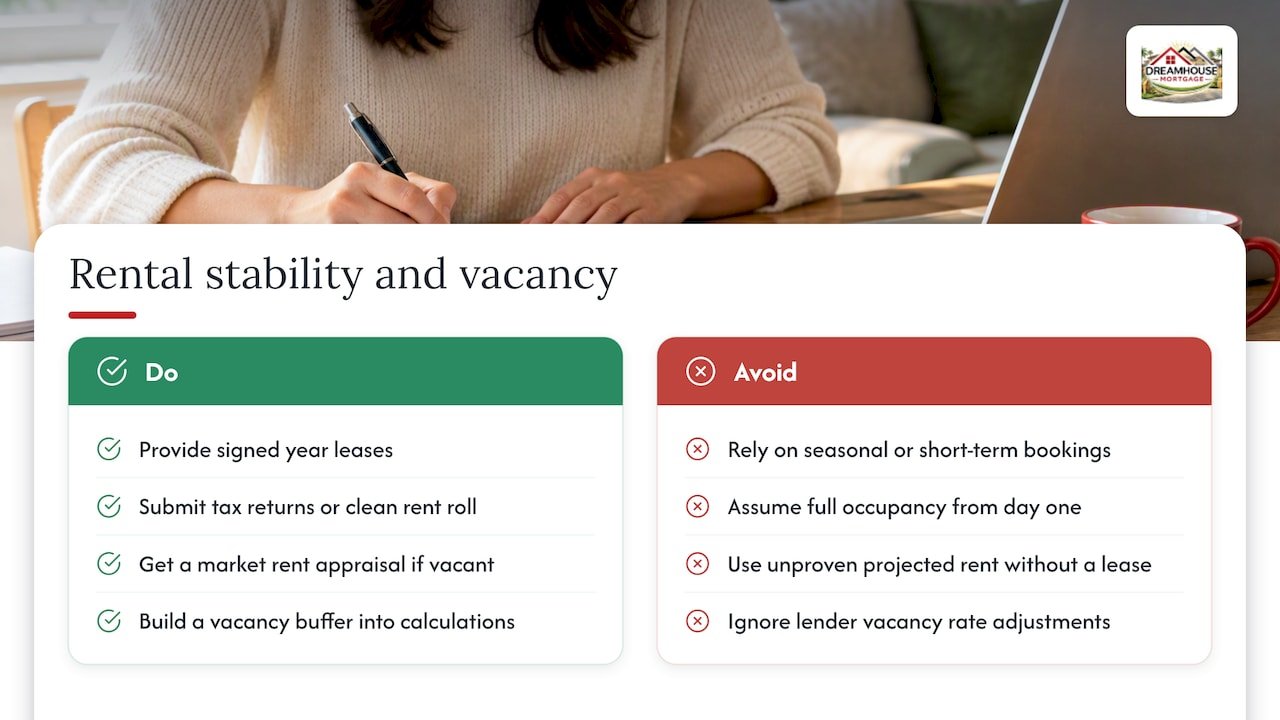
Lenders are not just asking how much rent a property generates. They want to know how reliably that rent will keep flowing. A long-term tenant on a signed year lease, with a documented payment history, reads very differently to an underwriter than a unit that has sat vacant for several months or that depends on short-term bookings through the summer season.
Vacancy risk shows up in several ways during underwriting. A lender may ask for a vacancy rate adjustment in markets where rental turnover is higher, reducing the rent figure used in your calculations even before any percentage haircut is applied. A property with a documented history of consistent occupancy, supported by lease renewals or a clean rent roll, tends to support a stronger case than a recently converted suite with no rental track record at all.
This is one reason projected rent on a property you have not yet closed on is treated more cautiously than rent you can prove through a tax return. If your plan depends on filling a currently vacant unit, expect your lender to ask for a market rent appraisal and possibly to apply a more conservative percentage until you have a lease in place. Building in a buffer for a vacancy period, rather than assuming full occupancy from day one, also helps you stress-test your own affordability before you commit to a purchase.
Self-managed versus professionally managed rental properties
Whether you manage a rental property yourself or pay a property management company to handle it rarely changes the core percentage a lender applies to your rent, but it can affect how confident an underwriter feels about the income figure.
A professionally managed property typically comes with a cleaner paper trail: monthly statements, a formal management agreement and consistent rent collection records that are easy to hand to a lender. That documentation can make verification faster, particularly for an out-of-province or multi-unit portfolio where a lender wants reassurance that the income is being tracked properly.
Self-managed properties are not disadvantaged in principle. Your T1 General and Notice of Assessment carry the same weight regardless of who collects the rent. Where self-management sometimes creates friction is in the supporting detail: a lender may ask more questions about how rent is collected, whether a formal lease exists, and how maintenance and vacancy are handled, especially if your rental history is new. Keeping your own records organized, signed leases, deposit records and a simple income and expense log, puts you on equal footing with a professionally managed file when your documentation reaches an underwriter.
How rental income affects your loan-to-value ratio and borrowing limits
Rental income primarily affects your qualifying income and debt ratios, but it also interacts with loan-to-value requirements in ways worth understanding before you shop for a property.
Your down payment requirement is driven by the property type and purchase price, not by how much rent it generates. A non-owner-occupied rental property generally requires a larger down payment than an owner-occupied purchase, which limits the loan-to-value lenders will extend regardless of how strong the rental income looks on paper. Rental income can raise the total mortgage amount you qualify for within that loan-to-value ceiling, but it does not let you reduce your down payment below what the property type requires.
For a 2 to 4 unit owner-occupied property insured through CMHC, the combination of strong rental add-back income and insured financing can meaningfully increase your approved loan amount compared with qualifying on your personal income alone. For a straight investment purchase with no insured financing available, your borrowing limit is shaped more heavily by the lender’s own loan-to-value policy for rental properties, and rental income works within that ceiling rather than raising it. Modeling your numbers with a broker before you shop helps you see where the real limit sits for your specific property type.
Tax implications to plan for alongside your mortgage qualification
Rental income has tax consequences that run on a separate track from your mortgage qualification, but the two intersect in ways that are worth planning for together.
Rental income you report to the Canada Revenue Agency becomes part of your taxable income for the year, and the same Notices of Assessment lenders want to see for mortgage qualification are the documents that reflect that reported income. You can generally deduct legitimate operating expenses against rental income on your tax return, mortgage interest, property taxes, insurance, maintenance and management fees among them, which reduces your net taxable rental income. A lower net income after deductions can help at tax time, but if a lender is using your net rental figure for qualification rather than gross rent, aggressive expense deductions can also lower the income figure they are willing to count.
That tradeoff is worth discussing with both your accountant and your mortgage broker before you file, particularly if you are planning a purchase in the near future and want your reported income to support your qualification goals. For specifics on how the CRA expects rental income and expenses to be reported, the CRA’s own guidance is the authoritative source, and a tax professional familiar with rental properties can help you apply it to your situation.
Calgary and Alberta perspective: what local buyers should watch for
Calgary, Airdrie and Cochrane each have their own rental demand patterns, and seasonal vacancy can shift your numbers more than buyers expect. Short-term rental rules vary by municipality, so confirm local bylaws before you count on Airbnb-style income. Build in a vacancy buffer and keep enough personal income headroom that your mortgage payment still works if the rental sits empty for a stretch. Reach out early for a Calgary-area pre-approval so your lender-matching happens before you are under a financing deadline.
We assist buyers who want rental income to count toward their mortgage, and our value is in matching your documentation to the lender most likely to accept it on good terms rather than leaving you to guess which bank’s policy fits your file.

Here is what we typically help with on a rental-income file:
- Comparing gross versus net rental income scenarios across multiple lenders before you write an offer.
- Sourcing a market rent appraisal when your unit is vacant or newly created.
- Matching your T1s and Notices of Assessment to a lender that accepts historical verified income on favorable terms.
Bring your last two years of tax returns and any lease agreements to your first conversation. Call Guriqbal Chahal, MBA, PMP, Mortgage Broker, at 403-966-6072, or start with our mortgage pre-approval process for Calgary buyers to get your rental-income scenario modeled properly. You can also find us on our Google Business Profile.
This article is general information, not a substitute for advice from a qualified financial advisor. Consult a qualified financial professional about your own circumstances before acting on anything here.
FAQ
Is rental income considered for a mortgage in Canada?
Yes, Canadian lenders can use rental income when you apply for a mortgage, though the percentage they count and the documentation they require differ by lender. CMHC outlines specific gross and net approaches for insured 2 to 4 unit properties, and conventional lenders set their own policies within OSFI’s underwriting framework.
What income do I need to qualify for a $400,000 mortgage in Canada?
The income you need depends on your interest rate, debt ratios, down payment and any other debts you carry, so there is no single figure that applies to every borrower. A mortgage broker can run your specific numbers, including any rental income from the property itself, to give you an accurate qualifying range for your situation.
What is the minimum down payment required for a rental property in Canada?
A non-owner-occupied rental property generally requires a larger down payment than a home you plan to live in, since most rental purchases do not qualify for standard mortgage loan insurance. An owner-occupied property with a rental suite, such as a duplex, may qualify for insured financing with a smaller down payment under CMHC’s rental income rules.
What is the mortgage stress test in Canada?
The mortgage stress test requires you to qualify at a rate higher than your actual contract rate, a standard set under OSFI’s Guideline B-20 to confirm you can handle future rate increases. Rental income is factored into your qualifying income before the stress test rate is applied, which is why the percentage of rent a lender counts has such a direct effect on your approval.
Does a mortgage broker help when I want to use rental income to qualify?
Yes. A broker compares how different banks, credit unions and monoline lenders treat rental income and matches your documentation, including tax returns and market rent appraisals, to the lender most likely to approve your file. We work with Calgary, Airdrie and Cochrane area buyers on exactly this kind of rental-income qualification.
Sources
- Rental income — CMHC
- Clarifying OSFI’s guidance on rental income and mortgage classification — OSFI
- Using rental income to qualify for a cottage mortgage: what lenders actually allow — WealthTrack
Recommended
- Why Calgary Buyers Overestimate Home Mortgage Affordability (And How to Fix It)
- Rent vs Buy Calgary 2026: Full Guide | Is It Worth It?
- Calgary Mortgage Calculators 2026: Avoid Costly Payment Mistakes & Estimate Your Monthly Mortgage Accurately
- First Time Home Buyer Calgary Alberta: How Much Income Do You Need to Buy a Home in 2026?