You can extend your mortgage amortization in Canada, but how depends on when you ask and how far you want to go. At renewal, a lender may reset your amortization toward the original period. Going beyond what you originally agreed to is a refinance, which means a new mortgage contract and fresh underwriting. Either way, a longer amortization lowers your monthly payment and raises the total interest you pay.
This guide is written for Calgary, Airdrie and Cochrane homeowners and buyers. It explains the rules, shows a worked example with real math, and covers the alternatives, so you can decide before you sign anything.
TL;DR
- Extending your amortization lowers your payment, but the Financial Consumer Agency of Canada (FCAC) warns it can add thousands or tens of thousands of dollars in interest.
- A permanent extension beyond your original amortization is a refinance and a new contract, so the Minimum Qualifying Rate (stress test) applies.
- For insured mortgages, the maximum is 25 years, or 30 years for first-time buyers and buyers of new builds. Uninsured mortgages follow the lender’s limit.
- Increasing payments, making lump sums or renegotiating can lower pressure without lengthening the amortization.
- A mortgage broker can compare lenders before you commit. Call Guriqbal Chahal at 403-966-6072.
Table of Contents
- What It Means to Extend a Mortgage Amortization
- Extending at Renewal vs Extending Mid-Term
- Maximum Amortization Rules in Canada
- What It Costs: A Worked Example
- Will You Pay Mortgage Insurance Again?
- Alternatives to Extending Your Amortization
- Who Should Consider Extending, and Who Should Wait
- Steps to Take Before You Change Your Amortization
- Our Perspective
- Work With a Calgary Mortgage Broker
- FAQ
- Sources
What It Means to Extend a Mortgage Amortization
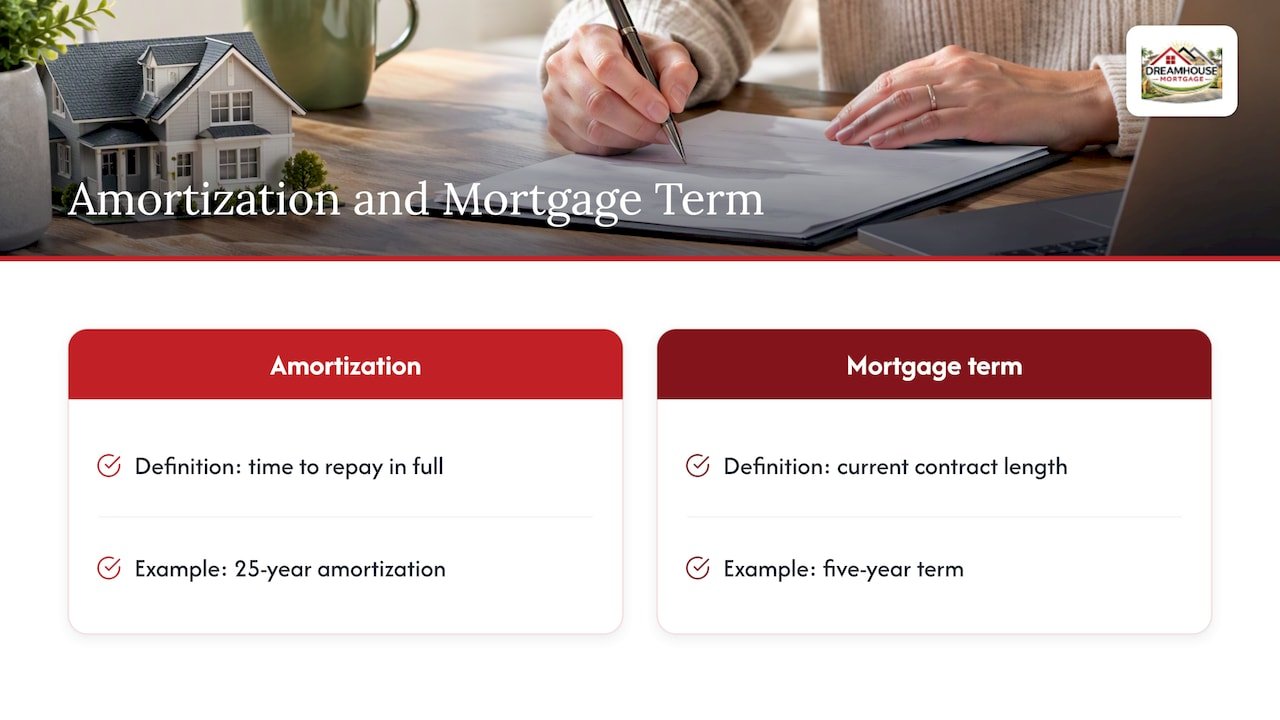
Amortization is the estimated time it takes to pay off your mortgage in full. Your mortgage term is different: it is the length of your current contract with the lender. According to the FCAC’s guide to terms and amortization, extending the amortization means spreading the same debt over more years to lower your regular payments.
The FCAC’s renewal guide explains that terms may range from a few months to five years or more, while the amortization is the full payoff horizon. A typical Calgary homeowner might have a 25-year amortization and a five-year term. When the term ends, you renew, and that is the natural moment to review the amortization.
If the difference still feels blurry, our page on amortization versus term for Calgary buyers walks through it with figures, and our mortgage glossary defines the other terms you will meet.
A Note on Variable Rate Statements
Some variable rate mortgages have fixed payments. When rates rise, a larger share of each payment goes to interest, and the statement can show a projected amortization of 70 years or more. The Office of the Superintendent of Financial Institutions (OSFI) says those hypothetical figures do not represent your actual repayment period. It also says that in most circumstances lenders are expected to restore borrowers to their contractual amortization. If your statement shows a number like this, ask your lender how it plans to bring you back on schedule.
Extending at Renewal vs Extending Mid-Term
You have two realistic moments to change your amortization.
At Renewal
Renewal is the easiest time to talk about amortization, because your contract is ending anyway. Federally regulated lenders must send you a renewal statement at least 21 days before the term ends, according to the FCAC. Use that window to compare the offer to the market rather than signing the first one.
Here is the line that matters. OSFI’s position is that extending beyond the previously agreed amortization is a refinance, and the B-20 underwriting expectations, including the Minimum Qualifying Rate, apply. A joint letter from OSFI, the FCAC and the Department of Finance states that a permanent extension past the original contractual amortization is a refinance and a new mortgage contract.
In practice, that means three scenarios:
- Staying within your original amortization. If you paid down faster than scheduled and want to return to the original schedule, ask your lender what it allows at renewal.
- Going beyond the original amortization. This is a refinance. You will need to qualify again, and the lender will review income, debts and the property.
- Switching lenders at renewal. A new lender will underwrite you fresh, and the amortization is part of that new contract.
If you are weighing a switch, read our broker tips for switching mortgage lenders in Calgary and our guide to negotiating a better renewal rate in Alberta.
Mid-Term
Changing amortization in the middle of a term generally means refinancing, which can bring prepayment charges or penalties if you break the contract. The FCAC explains how breaking a mortgage contract works. If cost is the issue, it is usually better to plan the change for the renewal date. Our refinancing guide for Calgary covers when a mid-term refinance makes sense.
Maximum Amortization Rules in Canada
How far you can extend depends on your down payment and your status as a buyer. The FCAC states the limits this way:
| Situation | Maximum amortization |
|---|---|
| Insured mortgage, down payment under 20% | 25 years |
| Insured mortgage, first-time buyer and/or buyer of a new build | 30 years |
| Down payment over 20% (uninsured) | Set by the lender |
The Government of Canada expanded 30-year insured amortizations to all first-time buyers and all buyers of new builds effective December 15, 2024. The same announcement raised the insured mortgage price cap from $1 million to $1.5 million.
Two practical points for Calgary buyers:
- A 30-year amortization is a purchase-stage option for qualifying first-time buyers. It is not automatic for a homeowner who bought years ago.
- Lenders set their own policies within these limits, so the maximum on paper is not always what a given lender offers.
If you are buying your first home, see our pages on the 30-year amortization mortgage for first-time buyers in Alberta, insured mortgage rules and the maximum insured mortgage home price. For the full picture of amortization choices, our amortization options explained for buyers is the next read.
What It Costs: A Worked Example
The payment drop is real, but so is the interest. The numbers below are our own illustration, not a quote. We assumed a fixed 4.5% rate with semi-annual compounding, the standard method for Canadian fixed-rate mortgages, and a $400,000 mortgage.
| Amortization | Monthly payment | Total interest over the full amortization |
|---|---|---|
| 20 years | $2,522 | $205,189 |
| 25 years | $2,214 | $264,168 |
| 30 years | $2,017 | $326,070 |
Moving from 25 to 30 years frees up about $197 a month. It also adds roughly $61,900 in interest, assuming the rate never changes. That is the trade-off the FCAC describes when it says the added interest may reach thousands or tens of thousands of dollars.
The Renewal Version
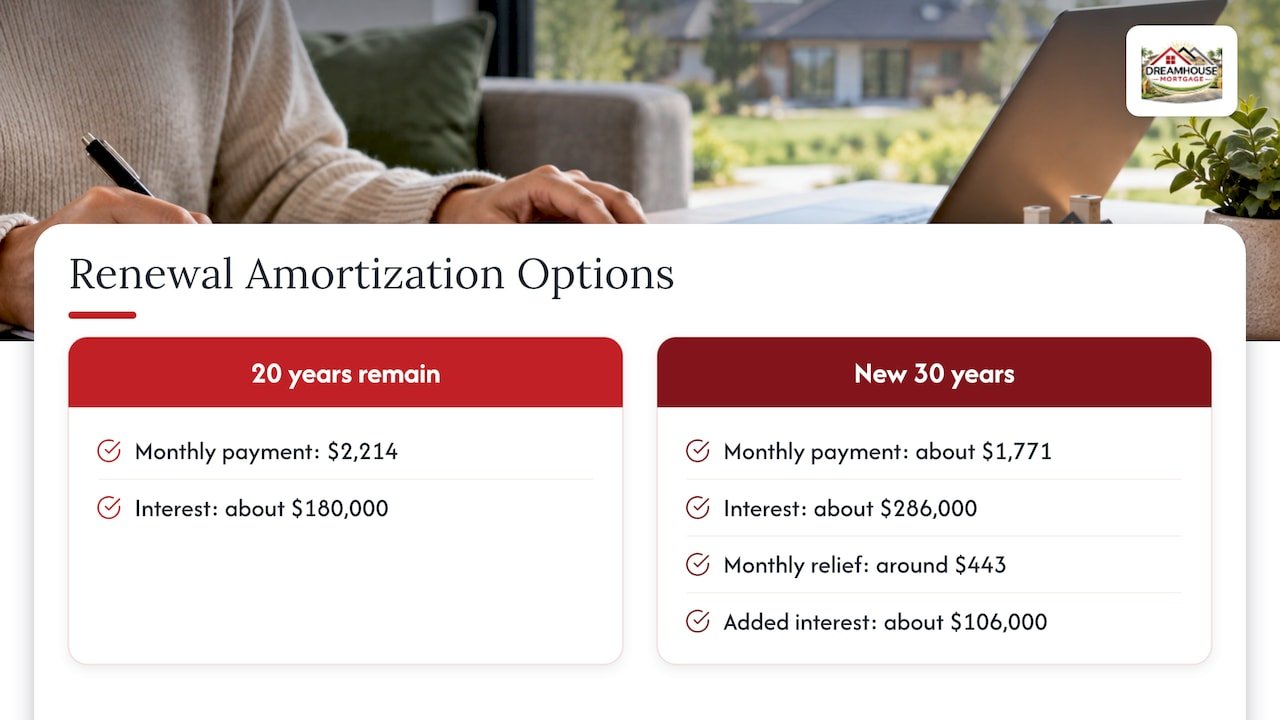
Now take the same $400,000 mortgage on a 25-year amortization at renewal after five years. The balance would be about $351,000. If you stay on the original schedule, 20 years remain and the payment stays at $2,214. If you were approved to re-amortize over a new 30 years, the payment would fall to about $1,771, a saving of around $443 a month. Over the new 30 years, you would pay about $286,000 in interest on that balance, against roughly $180,000 over the 20 remaining years. The difference is about $106,000.
That extra cost is why we treat a longer amortization as a tool with a purpose, not a default. Our mortgage amortization calculator guide lets you test 20, 25 and 30 years against your own figures.
Pro Tip: When you extend, ask the lender whether your regular payment can stay at the old amount. Keeping the higher payment while holding the longer amortization as a safety net lets you pay the balance down faster, as long as your contract allows prepayments.
Will You Pay Mortgage Insurance Again?
If your mortgage is insured, the answer can be yes. The FCAC notes that when you switch lenders, you may have to pay a new mortgage loan insurance premium if you extend the amortization or increase the loan amount. It advises you to tell the new lender that your existing mortgage has loan insurance, which may help you avoid paying premiums twice.
Before you commit to any change, ask for the premium in writing and check whether it is added to the mortgage balance. A premium on top of a longer amortization changes the numbers in the example above.
Alternatives to Extending Your Amortization
If the goal is simply a lower monthly burden, extending is one option among several. OSFI lists increasing payments, making lump-sum payments or renegotiating the mortgage as other routes. Here is how each might apply in Alberta.
- Renegotiate at renewal. A lower rate reduces the payment without touching the amortization. Brokers can request offers from several lenders at once.
- Blend and extend. The FCAC explains that this lengthens your term but does not change the amortization period.
- Consolidate debt. If high-interest balances are the real squeeze, rolling them into the mortgage can ease monthly cash flow. See our overview of debt consolidation and equity options.
- Switch lenders. A different lender may offer a better rate or product on the same balance.
If You Are in Financial Difficulty
If you are already struggling to pay, speak with your lender early. The FCAC’s mortgage relief page says federally regulated institutions are expected to develop a plan with borrowers at risk of default when extending amortization, and that the total period should be reasonable. It also notes that after a payment deferral, your amortization may end up longer because the deferred payments must be repaid. Contact your lender directly, and consider a free session with a credit counselling agency as well.
Who Should Consider Extending, and Who Should Wait
A longer amortization suits some situations better than others. Think about it through your own circumstances.
It may fit if:
- You are a first-time buyer in Calgary, Airdrie or Cochrane who qualifies for a 30-year insured amortization and wants a payment that leaves room for property taxes, utilities and a rainy-day fund.
- Your income is rising and you plan to make lump-sum payments or raise your regular payment later.
- You need short-term breathing room and intend to return to a shorter schedule at the next renewal.
Pause and compare first if:
- You are close to retirement. A longer amortization means carrying debt later in life.
- You can lower your payment with a better rate instead.
- You are not sure how a new insurance premium or refinance costs would change the total.
Self-employed borrowers have an extra layer to plan for, because income documentation affects which lenders will approve a refinance. Our team arranges self-employed mortgages with lenders that look at income differently, and we can pair that with an amortization strategy.
Steps to Take Before You Change Your Amortization
- Check your renewal date and the 21-day statement. Mark the date on your mortgage statement and ask your lender when it will send the renewal offer.
- Pull your numbers. Gather your current balance, rate, remaining amortization and the penalty for breaking the contract if you are mid-term.
- Model three scenarios. Compare staying put, a moderate extension and a full 30-year reset, looking at both payment and total interest.
- Ask about insurance and fees. Request written details on any premium, appraisal, legal and discharge costs.
- Compare lenders. Banks, credit unions, monoline lenders and alternative lenders each have different rules for refinance and amortization.
- Choose the shortest amortization you can comfortably carry. Then confirm your prepayment privileges so you can accelerate later.
Pro Tip: Do not sign a renewal letter just because it arrives. Lenders often send the first offer with a rate above what other lenders would give you.
Our Perspective
We see amortization as a lever, not a verdict. Many Calgary clients first ask us how to extend because the monthly payment feels heavy, and sometimes a longer amortization is the right answer, especially for a first-time buyer qualifying for 30 years on a new build or a condo.
Our advice is to treat the longer amortization as flexibility, not as the plan. When we work with a client, we compare the payment benefit with the interest cost, then look at whether a lower rate, a lender switch or a prepayment strategy would solve the same problem. Because we work with banks, credit unions, monoline lenders and alternative lenders, we can show you those options side by side before you commit.
Communicate early. If renewal is 90 to 120 days away, that is the time to talk, because it leaves room to shop the market and still meet each lender’s timelines.
Guriqbal Chahal, MBA, PMP
Work With a Calgary Mortgage Broker
DreamHouse Mortgage is a Calgary brokerage, founded in 2013, that serves homeowners and buyers in Calgary, Airdrie, Cochrane, Chestermere, Okotoks, High River, Edmonton, Red Deer and nearby communities. We help with first-time buyer mortgages, pre-approvals, renewals, refinancing and debt consolidation, and we compare lenders for you so you can see what each amortization option means before you commit. Start with our mortgage services page, or read our first-time homebuyer guide for Calgary.

If you are planning a renewal, a refinance or your first purchase, explore our Renew or Switch and refinancing services and call Guriqbal Chahal, MBA, PMP, Mortgage Broker, at 403-966-6072. You can also see client feedback on our Google Business Profile. If you are buying, a mortgage pre-approval in Calgary is the first step.
FAQ
Can I extend my mortgage amortization at renewal?
Often you can discuss it at renewal, but the limit matters. Extending beyond your original amortization is treated as a refinance and a new contract, so the stress test and full underwriting apply, according to OSFI, the FCAC and the Department of Finance. Ask your lender what it allows well before the renewal date.
What is the longest amortization I can get in Canada?
For an insured mortgage with less than 20% down, it is 25 years, or 30 years for first-time buyers and buyers of new builds. With more than 20% down, the lender sets the maximum, per the FCAC. Individual lenders may have tighter policies.
Does a longer amortization cost more?
Yes. Your payments fall, but you pay interest for more years. In our $400,000 example at 4.5%, going from 25 to 30 years adds about $61,900 in interest. The FCAC says the added cost may reach thousands or tens of thousands of dollars.
Will I pay mortgage insurance again if I extend?
Possibly. When you switch lenders, you may owe a new premium if you extend the amortization or increase the loan, according to the FCAC. Tell the new lender your mortgage is already insured, and get any premium in writing.
Is there a way to lower my payment without extending?
Yes. Options include renegotiating your rate, switching lenders, or adjusting payments and lump sums, as OSFI notes. A broker can compare these before you pick a longer amortization.
Sources
- Mortgage terms and amortization, Financial Consumer Agency of Canada
- Renewing your mortgage, Financial Consumer Agency of Canada
- Mortgage relief options, Financial Consumer Agency of Canada
- Breaking your mortgage contract, Financial Consumer Agency of Canada
- OSFI’s view on variable rate mortgages with fixed payments and extended amortizations
- Joint letter from OSFI, FCAC and the Department of Finance
- Government announces boldest mortgage reforms in decades, Department of Finance Canada