For most buyers with a down payment under 20%, CMHC and Sagen are two routes to the same result: an insured mortgage at the same standard premium rates. CMHC is a federal Crown corporation. Sagen is a private company. Your lender, not you, normally decides which one insures your file, so the better question is how to put together a file that either insurer will approve. Below, we explain how the two differ, what the insurance costs on a Calgary-priced home, and how a broker uses that knowledge for first-time buyers in Calgary, Airdrie and Cochrane.
TL;DR
- Mortgage default insurance is required in Canada when your down payment is under 20% of the purchase price, and it protects the lender, not you.
- CMHC is government-owned; Sagen is Canada’s largest private default insurer. Standard premiums for a typical owner-occupied purchase are the same, from 0.60% to 4.00% of the loan, depending on your loan-to-value ratio.
- Differences show up at the margins: program flexibility for self-employed buyers, newcomers, rental properties and unusual files.
- You generally cannot pick the insurer. Your lender does, which is why lender choice matters more than insurer choice.
- Call Guriqbal Chahal at 403-966-6072 and we will build the file so the insurer question never slows you down.
Table of Contents
- What CMHC and Sagen Actually Do
- CMHC vs Sagen Side by Side
- What Insurance Costs on a Calgary Home
- Down Payment Rules That Apply to Both Insurers
- Amortization: The 30-Year Option
- Where the Insurers Differ in Practice
- Can You Choose Between CMHC and Sagen?
- Default Insurance vs Mortgage Protection Insurance
- Our Perspective on CMHC vs Sagen
- Steps to Take Before You Compare Insurers
- Work With a Calgary Mortgage Broker
- FAQ
- Sources
What CMHC and Sagen Actually Do
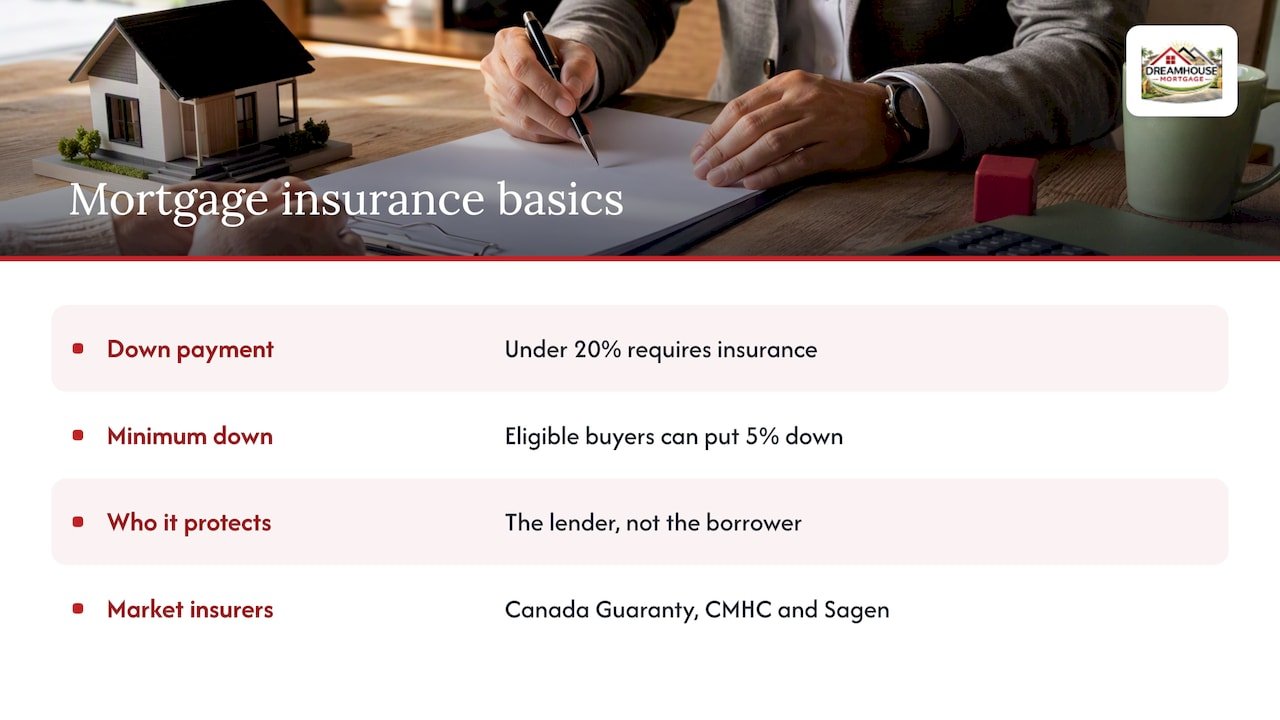
In Canada, mortgage default insurance is required when your down payment is less than 20% of the home’s purchase price. It lets eligible buyers purchase with as little as 5% down. It is also commonly called high-ratio mortgage insurance.
One point trips up many first-time buyers. This insurance protects the lender, not the borrower, if you stop making payments. It does not pay your mortgage if you lose your job, and it is not life or disability coverage. You pay the premium, but the lender is the one covered.
There are three insurers in the market. CMHC’s own first-time buyer materials list Canada Guaranty, CMHC and Sagen as the insurers an eligible first mortgage may use. This article focuses on CMHC and Sagen because that is the comparison most buyers search for, but Canada Guaranty is the third name you may see on your commitment letter.
CMHC
CMHC is the Canada Mortgage and Housing Corporation, a Crown corporation owned by the federal government. It insures homeowner and small-rental properties with 1 to 4 units, and multi-unit properties with 5 or more units, and it publishes research, tools and training for the housing sector.
Sagen
Sagen, formerly known as Genworth Canada, describes itself as Canada’s largest private default mortgage insurance provider, in business for over 35 years. On ownership, its investor page states that Brookfield Business Partners LP and its institutional partners hold 100% of Sagen MI Canada’s Class A common shares, with Sagen Mortgage Insurance Company Canada providing the insurance through a subsidiary.
Its product list includes Homebuyer 95, New to Canada, Business for Self, Purchase Plus Improvements, Progress Advance, portability, vacation homes, investment properties and second mortgages.
CMHC vs Sagen Side by Side
| Factor | CMHC | Sagen |
|---|---|---|
| Ownership | Federal Crown corporation | Private company, owned by Brookfield Business Partners and institutional partners |
| Down payment on a purchase | 5% of the first $500,000, 10% of the rest, up to $1.5 million | Same minimum structure |
| Standard premium range | 0.60% to 4.00% of the loan (4.50% for a non-traditional down payment at 90.01%-95% LTV) | Comparable standard rate chart published for lenders |
| Multi-unit (5+ units) | Insures these properties | Focused on the residential products listed on its site |
| Named programs | Homeowner and small-rental programs | Homebuyer 95, New to Canada, Business for Self and others |
| Who selects it | Your lender | Your lender |
The ownership difference is real, but it rarely changes what you pay or whether you close. Lenders generally treat the products as close substitutes. The practical differences are in how each insurer’s underwriting handles files that do not fit the standard mold: thin credit history, variable or self-employed income, a newcomer with limited Canadian credit, or a rental unit in the property.
Coverage terms are also set by the insurer’s policy and the lender’s compliance, not by the insurer’s name alone. OSFI’s guideline says a federally regulated mortgage insurer should describe its coverage and exclusions and place obligations on the lender for accurate information, documentation, property valuation and servicing. A clean, well-documented file protects everyone in the chain.
What Insurance Costs on a Calgary Home
The premium is a percentage of your mortgage amount, set by your loan-to-value (LTV) ratio. For an owner-occupied purchase of 1 to 4 units, CMHC’s schedule is:
| Loan-to-value | Premium (% of loan) |
|---|---|
| Up to 65% | 0.60% |
| 65.01% to 75% | 1.70% |
| 75.01% to 80% | 2.40% |
| 80.01% to 85% | 2.80% |
| 85.01% to 90% | 3.10% |
| 90.01% to 95% | 4.00% |
| 90.01% to 95%, non-traditional down payment | 4.50% |
Here is a worked example using a $500,000 home, a price that is realistic for a townhouse or condo in communities such as Saddle Ridge, Mahogany or Airdrie’s newer neighbourhoods. These figures are our own arithmetic from the schedule above.
- 5% down ($25,000): the mortgage is $475,000 at 95% LTV. At 4.00%, the premium is $19,000.
- 10% down ($50,000): the mortgage is $450,000 at 90% LTV. At 3.10%, the premium is $13,950.
- 15% down ($75,000): the mortgage is $425,000 at 85% LTV. At 2.80%, the premium is $11,900.
Going from 5% to 10% down saves $5,050 in premium on this home, and it also lowers the principal. Our page on CMHC mortgage insurance premiums in Alberta walks through more scenarios.
How the Premium Is Paid
Lenders arrange the insurance for you. You can pay the premium as a lump sum or add it to the total mortgage amount, in which case interest is charged on it at your mortgage rate. Most buyers add it to the mortgage, so it also affects your payment and your total interest.
Pro Tip: Provincial sales tax applies to premiums in Ontario, Manitoba and Quebec, and it must be paid at closing. That tax is a feature of those provinces. It does not apply to Alberta buyers, so do not budget for it in Calgary, Cochrane or Airdrie.
Down Payment Rules That Apply to Both Insurers
The insurer you land with does not change these rules for a purchase:
- Minimum down payment: 5% of the first $500,000 plus 10% of the portion above that, for homes priced between $500,000 and under $1.5 million.
- Price ceiling: insured purchases apply to properties priced under $1.5 million. At $1.5 million and above, you need 20% down.
- Owner occupancy: for CMHC’s 95% LTV purchase program on 1- or 2-unit homes, at least one unit must be owner-occupied, and non-permanent residents must be legally authorized to work in Canada.
For a $600,000 Calgary home, that means $25,000 on the first $500,000 plus $10,000 on the remaining $100,000: a minimum of $35,000 down. For a deeper look at what counts as a down payment, see our guide to mortgage down payment types in Canada.
Amortization: The 30-Year Option
Since December 15, 2024, 30-year amortization is available to all first-time homebuyers and all buyers of newly constructed homes when the LTV is above 80%. For a first-time buyer in a new build in Cochrane or Airdrie, that can lower the monthly payment noticeably, in exchange for more interest over the life of the loan.
There is a trade-off worth modelling before you commit. We cover it in 30-year amortization for first-time buyers in Alberta, and you can compare 20, 25 and 30 years with our amortization calculator.
Where the Insurers Differ in Practice
Industry commentary generally agrees that the core product and price are standardized, and that insurers differ in underwriting appetite. Here is how that tends to matter for different Alberta buyers. Each file is judged on its own facts, and none of this is a guarantee.
Self-Employed Buyers
If you own a business or work on commission, your income is documented differently than a salaried employee’s. Sagen offers a named Business for Self product, and CMHC also insures self-employed borrowers. The right insurer depends on how your income is documented and on the lender’s own policy. We explain approaches for self-employed income in Calgary on our site and in a direct conversation about your tax returns and notices of assessment.
Newcomers to Canada
Sagen lists a New to Canada program. CMHC requires that non-permanent residents be legally authorized to work in Canada. If you recently arrived and are buying in Calgary, the best path depends on your status, your documents and your lender, not only on the insurer’s brand.
Rental and Multi-Unit Properties
A basement suite in a Calgary home is a common situation. CMHC insures 1 to 4 unit properties and multi-unit buildings of 5 or more units, and Sagen lists investment property and secondary home products. If you plan to rent part of the home, tell us at the start so we match the file to the right lender and insurer.
Credit Profile
Insurers and lenders each have credit expectations. Read our breakdown of the minimum credit score for a CMHC-insured mortgage in Alberta before you apply, since a few points can change your options.
Can You Choose Between CMHC and Sagen?
Not directly. OSFI’s guidance indicates that federally regulated lenders generally choose the insurer, and some lenders have arrangements with more than one. In practice, the lender submits your application to the insurer it uses, and the insurer decides based on the file.
That is why a broker adds value. With access to banks, credit unions, monoline lenders and alternative lenders, we can steer a file toward a lender whose insurer relationships suit your situation. A single bank can only offer you its own arrangements.
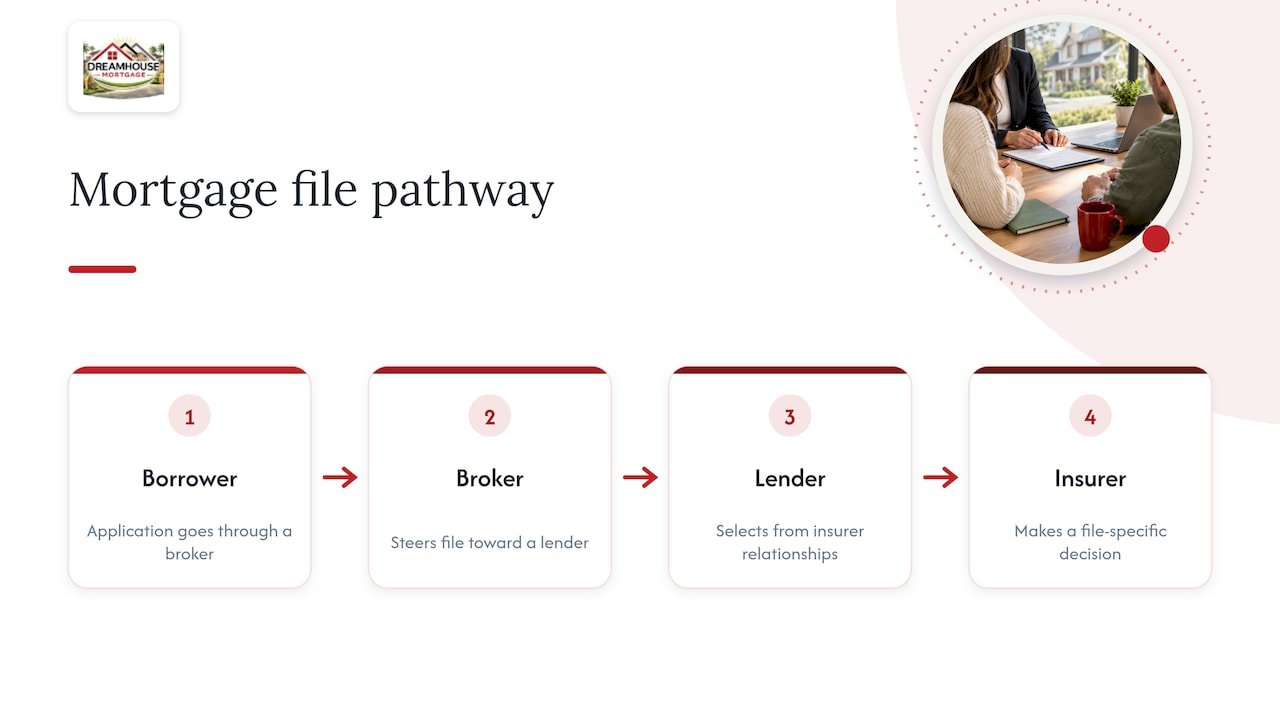
Also keep in mind that approval is file-specific. Sagen says its decisions are specific to each file, and following its published standards does not guarantee approval. Documentation and accuracy matter more than which logo is on the insurance certificate.
Default Insurance vs Mortgage Protection Insurance
Buyers often confuse two different products. Default insurance from CMHC or Sagen covers the lender. Mortgage protection insurance is a separate policy that is designed to help you or your family keep paying the mortgage if something happens to you, such as death, disability or critical illness. It is optional, and it is priced and underwritten independently. If you have dependants, speak with a licensed insurance advisor about it once your mortgage is approved.
Our Perspective on CMHC vs Sagen
We have been helping Alberta buyers since 2013, and the same pattern comes up with first-time buyers. They arrive worried about which insurer is better, when the stronger levers are elsewhere: a larger down payment where possible, clean credit, complete documents, and a lender whose policies fit their income.
Our advice is practical:
- Treat the insurer as a result of the lender you choose, not as a decision to agonize over.
- Compare the whole cost: the rate, the premium added to the mortgage, the amortization and the prepayment terms.
- Prepare your documents early. Gift letters, seasoning of funds, and proof of the source of your down payment are where files get delayed, especially for newcomers and for family gifts.
- Use a pre-approval before you shop in Calgary, Cochrane or Airdrie so your budget is real. A pre-approval is not a final approval, and the appraisal still has to support the purchase price.
Our aim is a calm, well-organized process where you understand each step before you sign it.
— Guriqbal Chahal, MBA, PMP
Steps to Take Before You Compare Insurers
- Set your price range. Use the 5% and 10% rule to work out your minimum down payment. Add closing costs, such as legal fees and an inspection.
- Check your credit. Review your reports and correct errors early.
- Gather documents. Typical items include identification, employment letter, pay stubs or tax documents, and down payment history.
- Get a pre-approval. See our mortgage pre-approval process for Alberta buyers and our guide to pre-approval versus approval, which explains how a Calgary appraisal can change a deal.
- Look at first-time buyer programs. The first-time home buyer benefits guide covers the FHSA, the GST rebate and the Home Buyers’ Plan.
- Let your broker select the lender. The insurer follows from that choice.
Work With a Calgary Mortgage Broker
Our First Time Buyer Mortgage and Mortgage Pre-Approval services are built for buyers in Calgary, Airdrie, Cochrane, Chestermere, Okotoks and across Alberta. We compare lenders, explain how insurance affects your numbers and coordinate the file through to funding. For a full walk-through of the process, read our first-time homebuyer mortgage guide for Calgary.
Call Guriqbal Chahal, MBA, PMP, Mortgage Broker, at 403-966-6072. You can also find us on our Google Business Profile.
FAQ
Is Sagen better than CMHC?
Neither is better across the board. Standard premiums are the same for a typical owner-occupied purchase, and your lender picks the insurer. The differences appear in program flexibility and underwriting for unusual files, so a broker’s lender selection matters more than the insurer’s name.
Who owns Sagen?
Sagen MI Canada’s investor page states that Brookfield Business Partners LP and its institutional partners hold 100% of its Class A common shares. It was formerly known as Genworth Canada. CMHC, by contrast, is owned by the federal government.
Is CMHC the same as mortgage insurance?
No. CMHC is a Crown corporation that provides mortgage loan insurance, among other housing activities. Mortgage default insurance is the product, and it is also offered by Sagen and Canada Guaranty. Either way, it is required when your down payment is under 20%.
Can I avoid paying mortgage default insurance?
If your down payment is 20% or more, default insurance is not required. At $1.5 million and above, you also need 20% down, so the insured route is not available. If you are under 20%, the premium is part of the cost of buying with a smaller down payment, and it can be added to your mortgage.
Sources
- CMHC Mortgage Loan Insurance Explained
- How much you need for a down payment, Canada.ca
- CMHC First-Time Home Buyer Incentive Fact Sheet
- CMHC Homeowner and Multi-Unit Mortgage Loan Insurance Products
- CMHC Purchase program
- Sagen
- Sagen MI Canada investor page
- Sagen Products and Services
- Sagen Lender Update on mortgage insurance rule changes
- Sagen UPS overview
- OSFI Residential Mortgage Insurance Underwriting Practices and Procedures Guideline
- OSFI Mortgage Insurance guidance