
A mortgage commitment letter is the lender’s written confirmation that it will lend you a specific amount on specific terms, as long as you meet the conditions listed in it. For a first-time buyer in Calgary, Airdrie or Cochrane, it is the document that turns a pre-approval estimate into a real financing offer on a real property. Reading it correctly, and clearing every condition on time, is what gets you to possession day. If you want a broker to review your letter line by line before you sign, call Guriqbal Chahal, MBA, PMP, Mortgage Broker at DreamHouse Mortgage at 403-966-6072.
TL;DR
- A commitment letter is the lender’s written approval of a set loan amount, rate and terms, issued after your full application and the property are reviewed. A pre-approval is only an estimate.
- The letter lists conditions (for example proof of down payment, income confirmation and an appraisal). Each one must be cleared before funds are released.
- Check the loan amount, rate, term, amortization, expiry date, fees and every condition against what you were told, before you sign.
- Aim to have every lender condition cleared well before closing. Provincial regulator guidance suggests at least two weeks.
- Your lender issues the letter, not your broker. A broker can help you read it and chase down the conditions.
Table of Contents
- What a mortgage commitment letter is
- When you receive it in the home-buying timeline
- Pre-approval vs commitment letter
- What a commitment letter typically contains
- The conditions: where deals get delayed
- Are you obligated once you sign?
- A checklist for reading your letter
- From letter to closing day
- Common mistakes first-time buyers make
- Why work through a broker for your commitment letter
- Our perspective
- Get your commitment letter reviewed in Calgary
- FAQ
- Sources
What a mortgage commitment letter is
Canada Mortgage and Housing Corporation (CMHC), the federal housing agency, describes a commitment letter, also called a mortgage approval, as written notification from a lender that a mortgage of a specific amount is approved under specific terms and conditions. The same guide makes the point that a pre-approval is not a guarantee of final approval, because the property still has to be evaluated.
That difference is the whole story. At pre-approval, the lender looks at you: income, credit, debts and down payment. At commitment stage, the lender has also looked at the home you chose, its value and, where relevant, mortgage default insurance. The letter is the result.
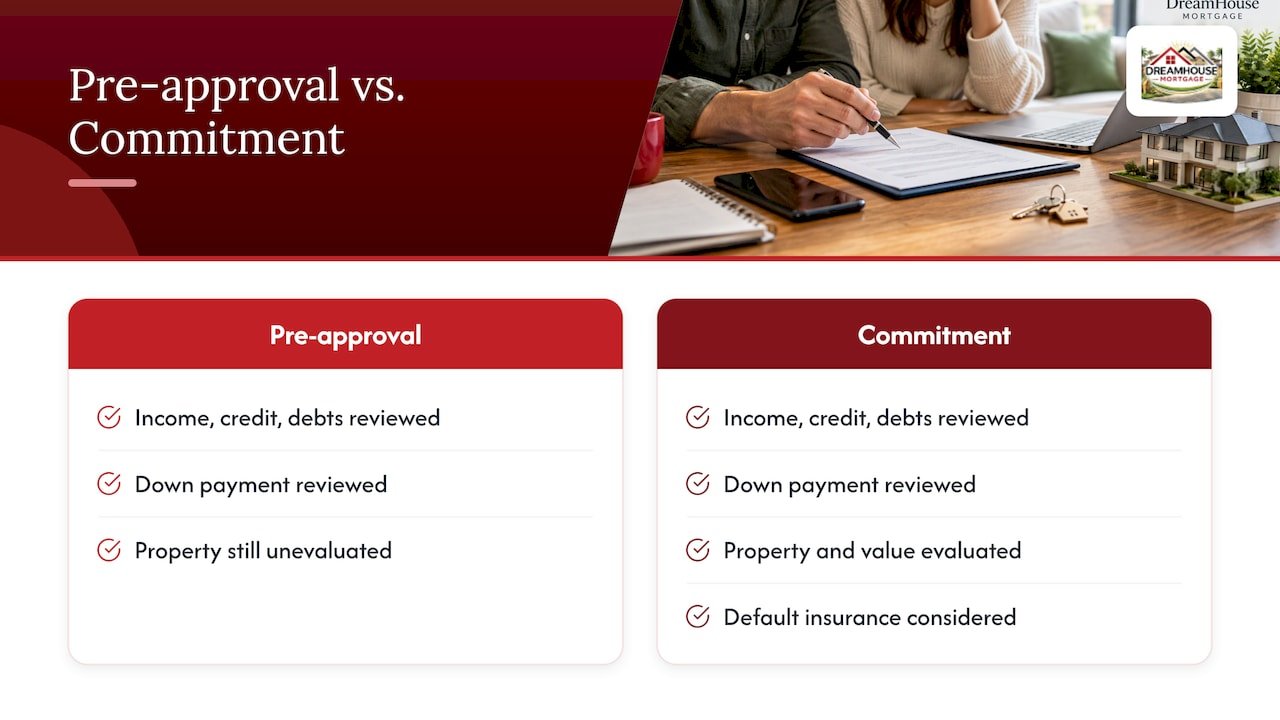
You may also see it called a letter of commitment, an approval letter or a mortgage approval. Lenders use these names loosely, so judge the document by what it says, not by its title. If it names a property, an amount, a rate and conditions, it is the commitment stage.
When you receive it in the home-buying timeline
For most buyers the sequence looks like this:
- You get a pre-approval and a rate hold, then shop with a clear budget.
- You make an offer, usually with a financing condition and a deadline.
- Your broker submits the full application with the signed purchase contract, and the lender underwrites the file and the property.
- The lender issues the commitment letter, usually with conditions.
- You satisfy the conditions and remove your financing condition in writing.
- Your lawyer receives the lender’s instructions, you sign the mortgage documents, and funds are released on the closing date.
A Calgary legal checklist notes that once a lender has approved your full application, as opposed to the pre-approval, it issues a formal commitment letter showing the loan amount, rate, terms and conditions. The same checklist warns that buyers must remove offer conditions in writing by the agreed deadline, or the contract can be voided. So the timing of your commitment letter and the deadline on your financing condition need to be planned together with your realtor.
If you are still before step 3, our guide to preapproval vs approval in Calgary explains why an appraisal can change the deal.
Pre-approval vs commitment letter
The Financial Services Regulatory Authority of Ontario (FSRA) is Ontario’s mortgage regulator, and its consumer guidance draws the same line Albertans should know: a pre-approval is not a guarantee that the lender will enter a mortgage contract, while a commitment letter signifies that financing has been officially approved. Alberta’s rules differ from Ontario’s in places, but the distinction between an estimate and an approval is how lenders work across Canada.
| Pre-approval | Commitment letter | |
|---|---|---|
| Based on | Your income, credit, debts, down payment | Your file plus the specific property |
| Property named | No | Yes |
| Amount | A maximum you may qualify for | A specific loan amount |
| Rate | Often held for a period | Stated in the letter |
| Conditions | General | Specific, with deadlines |
| Use | Shopping with a budget | Waiving financing and closing |
A pre-approval does not become a commitment on its own. If you want to see the early part of the process in detail, read our mortgage pre-approval process explained and the pre-approval requirements for Alberta.
What a commitment letter typically contains
FSRA lists the usual contents: loan amount, interest rate, repayment terms and period, collateral, fees incurred in the transaction, and fees and charges payable by the borrower. In practice, you will find these items:
- Borrower and property details. Names, the property address and the lender’s file number.
- Loan amount. Including any default insurance premium if the mortgage is high-ratio, meaning your down payment is under 20%.
- Interest rate and rate type. Fixed or variable, and how the rate is set.
- Term and amortization. The term is the length of the contract (commonly five years), and the amortization is the total repayment period.
- Payment amount and frequency. Monthly, bi-weekly or accelerated.
- Closing and advance date. The day funds are expected to be released.
- Expiry date. The date by which the letter must be accepted and conditions satisfied.
- Conditions. The list of items the lender needs before funding.
- Fees. Appraisal, commitment or other charges, if any.
The Law Society of British Columbia’s checklist for lawyers, a useful picture of what professionals look for, tells them to review conditions that must be met before funds advance, a clause allowing the lender to withdraw if circumstances change, any deposit required on acceptance, and who prepares the documents. It is written for British Columbia lawyers, but those are the same pressure points for a buyer to read in any Canadian province.
The conditions: where deals get delayed
Most commitment letters are conditional. The lender is saying yes, provided certain things are confirmed. Typical conditions for Calgary-area buyers include:
- Proof of down payment. Bank statements showing the funds have been in your account, or documentation for an RRSP withdrawal under the Home Buyers’ Plan, a First Home Savings Account withdrawal, or a gift. Our guide to Alberta gift letter requirements covers what a lender expects, and mortgage down payment types in Canada lists the accepted sources.
- Income and employment confirmation. Recent pay stubs, an employment letter, or for self-employed buyers, tax documents such as Notices of Assessment.
- Appraisal. The lender confirms the home is worth what you agreed to pay. In a fast-moving Calgary market, a low appraisal can reduce the amount the lender will advance.
- Mortgage default insurance. For high-ratio mortgages, the insurer’s approval must be in place.
- Property insurance and a status certificate or condo documents. Relevant if you are buying a condo in Beltline, Mission or a townhome community in Airdrie or Cochrane.
- Legal conditions. Your lawyer confirms clear title and that the mortgage is registered in the first position, as the lender requires.
- Credit conditions. An updated credit check, or explanations for new inquiries or balances. See how the credit bureau factors into a mortgage application.
Our article on conditional mortgage approval in Alberta explains the difference between conditional and unconditional approval in more detail.
Pro Tip: Do not open new credit, finance a vehicle or move large sums between accounts between your commitment letter and closing. Lenders can re-check your file before funding, and new debt or unexplained deposits create new conditions.
Are you obligated once you sign?
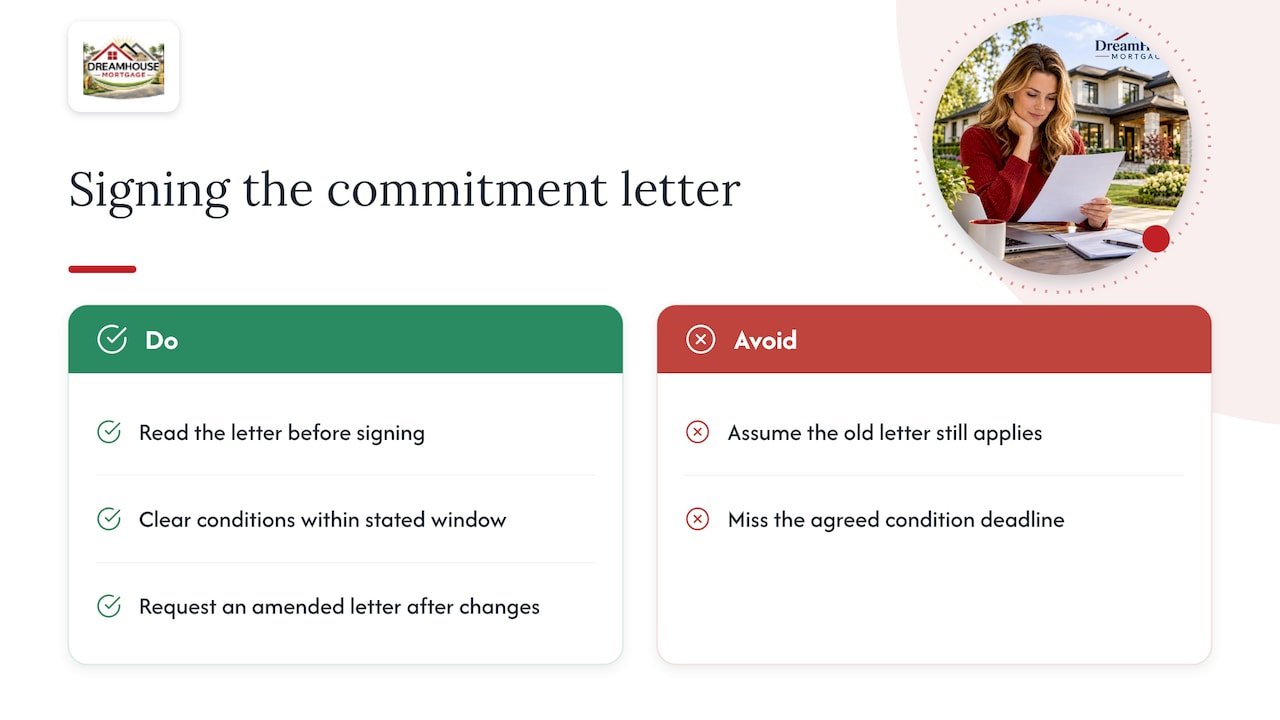
This is the question buyers ask most, and the answer needs care. FSRA states that a commitment letter is a formal, binding contract between the buyer and the lender once signed. Treat your signature as a real commitment, and read the document before you sign it, not after.
The lender is also bound to the terms it wrote, provided you meet the conditions within the stated window. If a condition is not cleared by the deadline, the lender’s offer can lapse under its own terms. If you renegotiate the purchase price or change the loan amount, ask for an amended letter instead of assuming the old one still applies.
FSRA also notes that a brokerage must give written disclosure of material risks at least two business days before you enter into a mortgage agreement, such as a commitment letter, and that you may choose to shorten or waive that time but do not have to. That rule belongs to Ontario’s regulator. Whatever province you are in, take the time you need.
A checklist for reading your letter
When the letter arrives, sit down with it and your purchase contract side by side.
- Names and address. They must match your contract exactly.
- Loan amount. Does it match what you expected after your down payment and any insurance premium?
- Rate and type. Does it match the rate you were quoted or the rate hold you secured? Our page on a mortgage rate hold in Calgary explains how holds work.
- Term, amortization and payment. Confirm the payment fits your monthly budget. A mortgage affordability calculator for Canada can help you test the payment against your income and other debts.
- Expiry date. When must you sign and return it? When do conditions need to be cleared?
- Each condition. Write down every item, who supplies it and the deadline.
- Fees and deposits. Anything payable to the lender, and whether it is refundable.
- Prepayment and portability terms. Know your options if you sell before the term ends.
- Closing date. It must line up with your purchase contract.
A worked example: you are buying a home in Cranston with a purchase price that includes a 5% down payment. Your commitment letter shows a loan amount that includes the default insurance premium, which is added to the mortgage. If you mistakenly budgeted only the base amount, the payment on the letter will look higher than you expected. Catching this before you sign lets you correct the budget, not scramble at closing.
From letter to closing day
FSRA advises that everything should typically be in place at least two weeks before the closing date, including all lender conditions cleared, otherwise delays in closing are to be expected. Build your own schedule backward from your possession date:
- Day the letter arrives. Review it, flag questions, and list conditions.
- Within days. Send documents to your broker for submission. Slow replies are the most common cause of delay.
- When conditions clear. Confirm in writing that the lender has accepted each item.
- Before closing. Book a time with your lawyer to sign the mortgage documents, and confirm the lender’s funding instructions with them directly.
- Closing day. Your lawyer registers the transfer and mortgage, and funds are released.
FSRA’s fraud guidance says you should receive an official approval or letter of commitment stamped or signed by the lender, not the broker, with all terms and conditions clearly outlined. If you have not received one, you do not yet have a mortgage. Never remove your financing condition on the strength of an email or a verbal assurance.
Common mistakes first-time buyers make
- Waiving the financing condition too early. Remove it only after the lender’s written commitment and your own review.
- Treating a pre-approval as a commitment. The pre-approval did not include the property, and a low appraisal can change your numbers.
- Missing the expiry date. The letter is time-limited. Put the date and each condition deadline in your calendar.
- Forgetting that gifts and savings need paper trails. Unexplained deposits are the typical reason a down payment condition stays open.
- Changing jobs or taking on debt. Even a vehicle loan after approval can reopen the file.
- Ignoring the lawyer’s role. Your lawyer confirms title and handles the lender’s instructions. Send them the letter as soon as you have it.
Our mortgage checklist for Calgary gathers the documents so you are not hunting for them under a deadline.
Why work through a broker for your commitment letter
A lender’s letter will tell you what that lender needs. A mortgage broker works with banks, credit unions, monoline lenders, alternative lenders and private lenders, so the approval you receive comes from the lender best matched to your situation. At DreamHouse Mortgage, our team assists with mortgage qualification, lender selection, document collection, approvals, rate comparisons and funding coordination. That matters at commitment stage, when the work is collecting documents against deadlines and making sure each condition lands with the lender in the form it expects.
If you are a first-time buyer, a self-employed buyer or new to Canada, the conditions in your letter will often be more detailed, and being prepared before the offer pays off. We help clients throughout Calgary, Airdrie, Cochrane, Chestermere, Okotoks, High River and Rocky View County.
Our perspective
The commitment letter is where first-time buyers feel the most pressure, and it is also where good preparation shows. Most of the stress comes from conditions that arrive with short deadlines.
Our approach is to treat the letter as a checklist from the very first meeting. When we prepare a pre-approval, we gather the same documents a lender will ask for later: down payment history, income records, identification and credit information. That way, when the commitment letter arrives, the conditions are familiar and the answers are ready.
We also believe in explaining the letter, not just delivering it. We walk you through the rate, term, amortization, payment, expiry date and each condition, so you sign knowing what you are agreeing to. Our focus is transparent communication and educating borrowers, because a buyer who understands the paperwork closes with confidence.
If you are buying in Calgary, Airdrie or Cochrane, bring your letter to us and we will go through it together.
Guriqbal Chahal, MBA, PMP
Get your commitment letter reviewed in Calgary
Whether you are still shopping or already holding an offer, we can help you reach a clean commitment letter and close on time. Our team handles first-time buyer mortgages, pre-approvals, refinancing and renewals across Alberta. Start with our first-time home buyer mortgage services or see everything on DreamHouse Mortgage.

Call Guriqbal Chahal, MBA, PMP, Mortgage Broker at 403-966-6072, and find us on our Google Business Profile.
FAQ
What is a mortgage commitment letter?
It is a written notice from your lender that a mortgage of a specific amount is approved under stated terms and conditions, as defined by CMHC. It names your rate, term, payment and conditions. Once those conditions are cleared, the lender funds the mortgage on closing day.
What comes after a commitment letter?
You clear each condition, remove your financing condition in writing by the deadline in your purchase contract, and send the letter to your lawyer. The lawyer then handles title and the lender’s instructions, and you sign the mortgage documents before closing. Funds are released on the closing date.
Is a commitment letter the same as a pre-approval?
No. A pre-approval is based on your finances and is not a guarantee of final approval. A commitment letter comes after the lender reviews your full application and the property itself, and it states a specific loan amount and terms.
Can the lender still change anything after I receive the letter?
The lender’s offer depends on your meeting the conditions within the stated window. If a condition is not met, or the purchase price or loan amount changes, the letter may need to be amended or may lapse under its own terms. Share any change with your broker right away.
Who should I show my commitment letter to?
Show it to your mortgage broker, your realtor for the financing deadline, and your lawyer, who handles the closing. If you would like us to review it, call Guriqbal Chahal at 403-966-6072.
Sources
- CMHC: Homebuying Step by Step guide
- FSRA: Signing a Mortgage Contract
- FSRA: Watch Out for Mortgage Fraud
- Law Society of British Columbia: Mortgage Practice Checklist
- Calgary Real Estate Legal Checklist
Recommended
- Mortgage Checklist Calgary: The Ultimate Proven Guide — Everything You Need Before Applying (2026)
- Mortgage Pre-Approval Requirements in Alberta: Your Checklist
- Mortgage Terms Explained Alberta Mortgage Glossary: 60 Essential Terms Every Calgary Buyer Must Know (2026)
- Completion Mortgage in Alberta: How It Works for Calgary Buyers