Yes, you can get a mortgage for a second home in Canada. If the property will be owner-occupied, you may qualify for insured financing with a minimum down payment as low as 5%, through programs overseen by the Canada Mortgage and Housing Corporation (CMHC).
TL;DR:
- Insured financing for a second home is available with as little as 5% to 10% down for owner-occupied properties, but only for two properties per borrower.
- Qualifying depends heavily on stress tests, GDS and TDS ratios, and thorough documentation, including proof of income and down payment sources.
- Borrowers should focus on qualification first through pre-approval, as paperwork and ratios are the main hurdles rather than interest rates.
- Rates are similar to primary residences if the property is owner-occupied but can be higher for rental or investment properties due to added risks.
- Costs like land registration fees, appraisal, and legal expenses should be considered alongside down payments when budgeting for a second home purchase.
Table of Contents
- CMHC Second-Home Eligibility and Down Payment Rules
- How Lenders Qualify You for a Second Home
- Financing Routes, Insurance Premiums, and Amortization
- Step-by-Step: Applying for a Second Home Mortgage in Alberta
- How DreamHouse Mortgage Supports Alberta Buyers
- What a Second Mortgage Does to Your Debt Load and Credit
- Tax Rules That Come With a Second Home
- Interest Rates on Second Homes Versus Your Primary Residence
- The Real Barrier Isn’t the Rate, It’s the Paperwork
- Book a Second-Home Mortgage Consultation
- FAQ
- Sources
CMHC Second-Home Eligibility and Down Payment Rules
CMHC treats a second home differently depending on who will actually live there. To qualify for insured second-home financing, you or a qualifying relative must occupy the property, and it needs to be suitable for year-round living with year-round vehicular access, according to CMHC’s second-home program. A cottage you only visit in summer with no winter road access will not meet that bar.
CMHC caps insured homeowner financing at two properties per borrower or co-borrower. Once you are financing a third property for personal use, insured treatment is off the table and you move into conventional or investment territory.
The down payment bands work the same way they do for a primary residence:
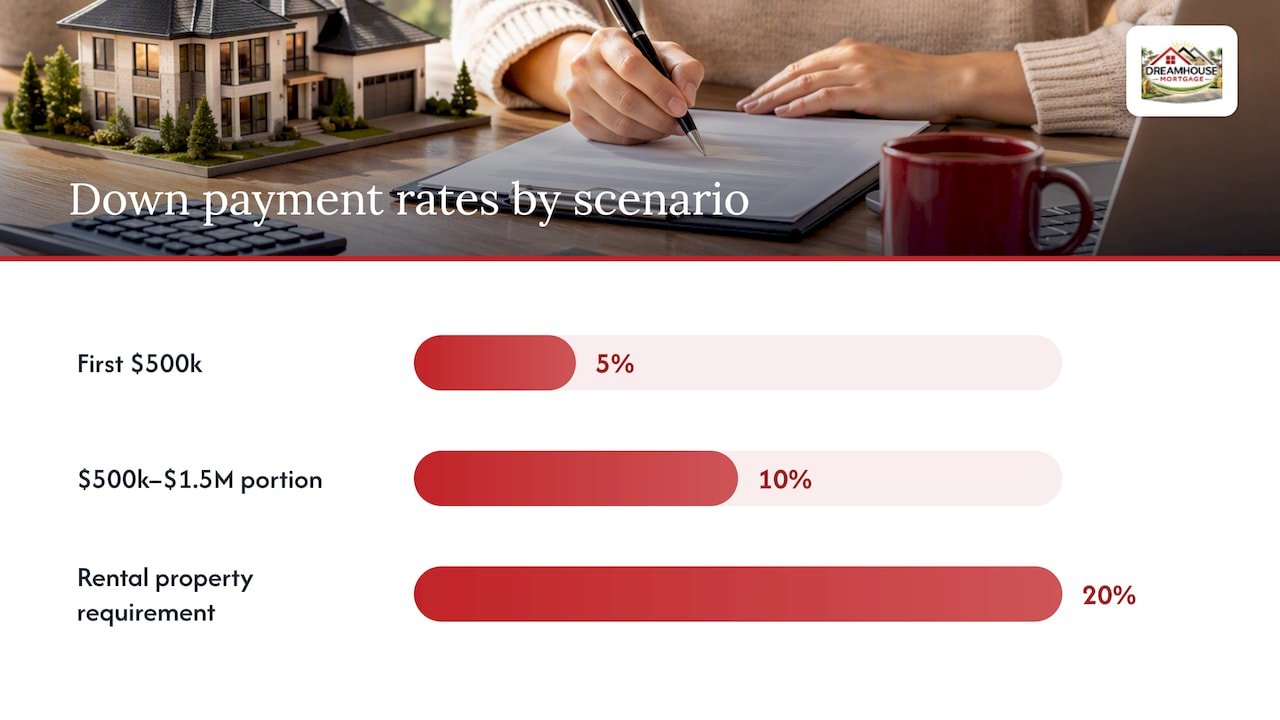
- 5% of the first $500,000 of the purchase price.
- 10% on the portion between $500,000 and the $1.5 million insured mortgage cap set in the 2024 federal mortgage reforms.
- No insured financing above a $1.5 million purchase price, and insured loans typically carry a 25-year amortization.
A second home priced near the $1.5 million insured mortgage cap qualifies for insured financing with a relatively low down payment compared to a rental property (CMHC), far less cash upfront than the 20% a rental property would demand. That gap is often the single biggest factor in whether a vacation property makes financial sense this year.
For a fuller breakdown of how these bands apply across different purchase prices, our guide to mortgage down payment types in Canada walks through the math in detail.
How Lenders Qualify You for a Second Home
Qualifying for a second mortgage is not just about the down payment. Lenders need to confirm you can carry two properties at once, and the rules that govern that calculation are strict.
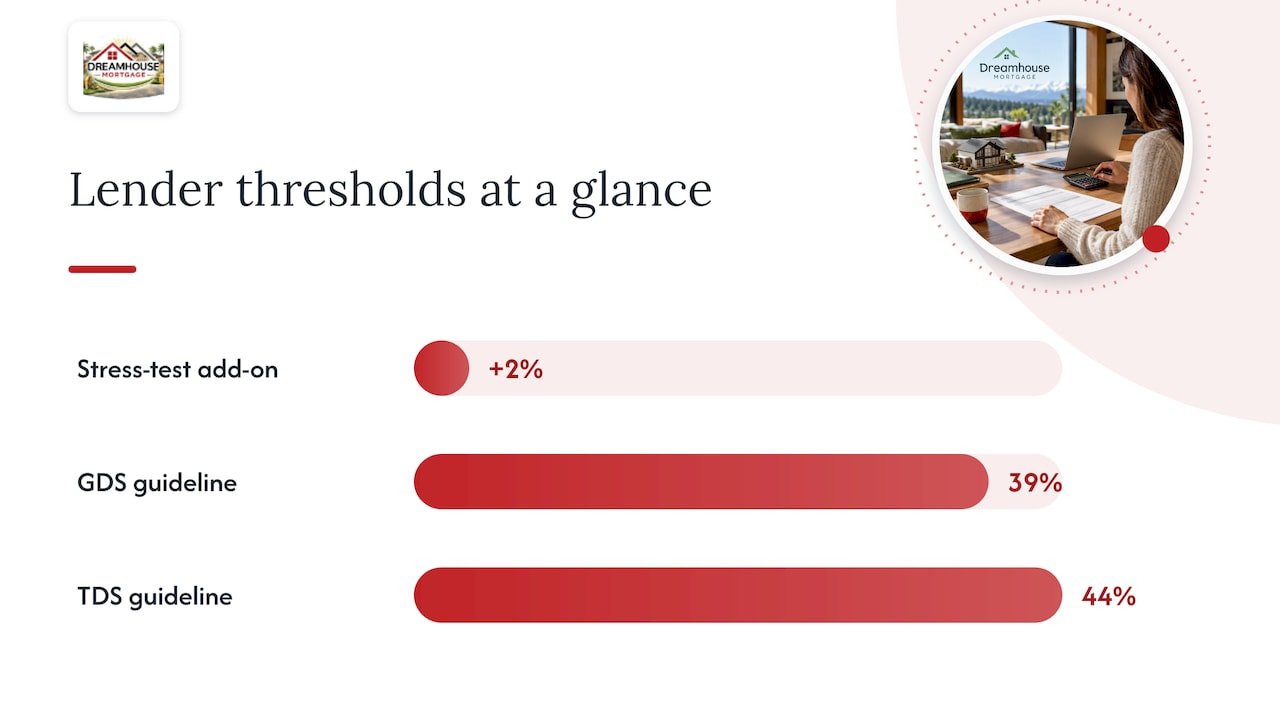
- The stress test applies. Every new uninsured mortgage in Canada must qualify at the greater of the contract rate plus 2%, or the OSFI minimum qualifying rate. This affects second-home purchases just as much as a primary residence.
- GDS and TDS ratios get tighter. Lenders use a Gross Debt Service guideline of 39% and a Total Debt Service guideline of 44%, per the FCAC mortgage qualifier. Your existing mortgage payment counts in both ratios, so carrying one home already reduces how much a second property you can add.
- Documentation expands. Expect to provide income verification for both properties, proof of down payment source for the new one, and existing mortgage statements for your current home.
- Self-employed and rental-income buyers face extra scrutiny. Lenders may average two years of business income or request a net rental calculation if part of the second home will generate income, and some situations call for an alternative lender.
Our GDS/TDS ratio guide for Calgary buyers shows worked examples of how these ratios play out with a local mortgage, income, and tax load.
Pro Tip: Run your numbers before you shop for a second property. A pre-approval that accounts for your existing mortgage payment tells you your real ceiling, not just what a calculator suggests before debt service is applied.
Financing Routes, Insurance Premiums, and Amortization
Three practical paths exist for financing a second property in Canada, and which one applies depends almost entirely on occupancy.
- CMHC-insured owner-occupied second home: lowest down payment (5% to 10%), but limited to two insured properties and a 25-year amortization in most cases.
- Conventional uninsured mortgage: used when the purchase price exceeds $1.5 million or when you prefer not to pay mortgage insurance; typically requires at least 20% down.
- Investment or income-property financing: required when the home will be a rental, generally needing 20% or more down under CMHC’s income property program.
CMHC’s premium schedule for insured homeowner loans ranges from low single-digit percentages to over four percent of the loan amount depending on loan-to-value (CMHC). That premium gets added to your mortgage balance, so a higher-ratio loan costs more over the life of the term even though it lets you buy with less cash down.
Amortization matters just as much as the rate. The federal reforms from September 2024 expanded eligibility for 30-year amortizations in specific cases, which lowers the monthly payment but stretches total interest paid. Lender type also shapes your options: banks and credit unions tend to offer the most competitive rates for straightforward insured deals, while monoline and private lenders often step in for self-employed income, rental-heavy applications, or properties that do not fit standard criteria.
Step-by-Step: Applying for a Second Home Mortgage in Alberta
Buying a second home in Calgary, Cochrane, or Airdrie follows a predictable sequence once you know what lenders expect.
- Run the numbers first. Use the FCAC mortgage qualifier and gather proof of income and down payment source, including gift letters if family is contributing.
- Get pre-approved. A broker or lender will confirm your stress-test rate and walk through amortization options before you start house hunting. Our mortgage pre-approval process outlines exactly what documents to prepare.
- Confirm occupancy intent. If you plan to rent the property short-term, check municipal rules in your target community. Occupancy intent also determines whether insured financing is even available to you.
- Budget for closing costs. Legal fees, appraisal and inspection costs, and Alberta’s land titles registration fees all come due at closing, on top of your down payment.
Our vacation home mortgage qualifying guide covers Alberta-specific occupancy and qualifying rules in more depth.
How DreamHouse Mortgage Supports Alberta Buyers
Our team has experience working with Alberta buyers on second-home and investment financing. Our team is led by a mortgage broker experienced in financial analysis and disciplined application processing.
For second-home financing specifically, we assist with lender matching, income structuring, accessing various lender types, and coordinating the mortgage process. We assist clients throughout Alberta communities.
What a Second Mortgage Does to Your Debt Load and Credit
Adding a second mortgage increases your total debt service, and lenders will recalculate your GDS and TDS ratios to include it before approving anything new. Even if your existing home is paid down significantly, the new mortgage payment, property taxes, and heating costs on the second property all flow into the TDS guideline of 44% set out by the FCAC mortgage qualifier.
Your credit score plays a role too, though differently than people expect. A hard inquiry from a mortgage application has a modest, short-term effect. The bigger risk is utilization and payment history across both properties going forward: carrying two mortgages means two fixed obligations that show up in your debt service calculations every time you apply for new credit, whether that is a car loan or a line of credit. Lenders reviewing a future application will treat the second mortgage as a permanent fixture of your finances, not a temporary blip. Keeping both mortgages current and avoiding new revolving debt in the months after closing protects your ability to refinance or qualify for additional credit later.
Tax Rules That Come With a Second Home
Owning a second property in Canada carries tax consequences that differ depending on how you use it. A second home you use personally, like a cabin near Rocky View County, does not generate rental income, so there is nothing to report annually beyond any capital gains when you eventually sell it.
The principal residence exemption only shelters one property per family per year, so if you already claim it on your primary home, gains on the second property are generally taxable when sold. If you rent the property out, even part-time, the rental income is taxable, but you can generally deduct related expenses such as mortgage interest, property taxes, insurance, and maintenance against that income. Mixed-use properties, part personal and part rental, require prorating expenses based on the time or space used for each purpose.
Because these rules depend heavily on your specific use pattern and timing of ownership, this is an area where working with an accountant alongside your mortgage broker pays off, especially if you plan to eventually convert the property from personal use to a rental or vice versa.
Interest Rates on Second Homes Versus Your Primary Residence
Rate differences between a second home and a primary residence come down almost entirely to how the property is classified, not the property itself. An owner-occupied second home financed through CMHC-insured programs typically qualifies for rates close to what you would see on a primary residence, since the lender’s risk profile is similar: insured financing, full underwriting, and a borrower who will live there.
Rates shift meaningfully once a property is classified as a rental or income property. Lenders price in the added risk of vacancy, tenant turnover, and reliance on rental income to support debt service, which often means a modest rate premium compared to an owner-occupied file. The size of that premium depends on the lender and your overall file strength, including your down payment, credit history, and whether the rental income is documented through a lease or projected.
Amortization length also factors into your effective borrowing cost. A longer amortization lowers your monthly payment but increases total interest paid, so comparing two second-home offers only on the posted rate without checking amortization terms can be misleading.
The Real Barrier Isn’t the Rate, It’s the Paperwork
Most Alberta buyers researching second-home mortgages fixate on the interest rate when the actual bottleneck is almost always documentation and ratio qualification. A difference of a quarter point on your rate matters far less than whether your GDS and TDS ratios can absorb a second property at all, especially once the stress test is applied on top of your existing mortgage.
The conventional advice to “shop around for the best rate” skips the harder, earlier question: can you qualify in the first place, and under which occupancy classification? A cabin near Cochrane that you plan to occupy seasonally but also rent out on weekends is not a simple insured second home anymore, it is a hybrid file that needs careful structuring before you ever compare rates.
Our view is that the first move should always be a real pre-approval that tests your file against current stress-test rules, not a rate comparison. Get the qualification question answered first. Everything else, the rate, the lender, the amortization, becomes a much easier decision once you know your actual ceiling.
— Guriqbal Chahal, MBA, PMP
Book a Second-Home Mortgage Consultation
A short call with our team usually answers the three questions that matter most before you make an offer: whether your file qualifies as owner-occupied or investment financing, which lenders fit your income structure, and what documents to gather first.

What we typically cover in a first consultation:
- Pre-approval direction based on your actual GDS/TDS ratios, not a generic calculator estimate.
- Lender-fit guidance, including whether a bank, credit union, monoline, or alternative lender suits your file.
- A documentation checklist tailored to your income type and down payment source.
| What you get | Why it matters |
|---|---|
| Stress-test pre-approval | Confirms your real borrowing ceiling before you shop |
| Lender matching | Avoids wasted applications with lenders unlikely to approve your file |
| Document checklist | Speeds up closing once you have an accepted offer |
There is no obligation attached to this call, and our focus stays on buyers across Calgary and the surrounding Alberta communities. Call our mortgage broker at 403-966-6072, or find us on our Google Business Profile. You can also start with our mortgage pre-approval page or explore our full range of mortgage services.
This article is general information, not a substitute for advice from a qualified financial advisor. Consult a qualified financial professional about your own circumstances before acting on anything here.
FAQ
How much down payment do I need for a second home in Canada?
An owner-occupied second home can qualify for insured financing with as little as 5% down on the first $500,000 and 10% on the portion up to $1.5 million, under CMHC’s second-home program.
What’s the difference between a second home mortgage and an investment property mortgage?
A second home mortgage applies when you or a qualifying relative will occupy the property, which opens the door to CMHC-insured financing with a lower down payment. An investment or income property mortgage applies when the home is a rental, requiring at least 20% down under CMHC’s income property rules.
Does the mortgage stress test apply to second homes?
Yes, every new uninsured mortgage application in Canada, including second homes, must qualify at the OSFI minimum qualifying rate, which is the greater of your contract rate plus 2% or a set floor rate.
How long does it take to close on a second home mortgage?
Timelines vary by lender and file complexity, but pre-approval typically happens within days once your documents are in order, while full approval and closing depend on appraisal scheduling and your purchase contract’s conditions. Working with a broker who gathers documentation upfront, as outlined in our mortgage pre-approval process guide, helps avoid delays.
Can self-employed buyers qualify for a second home mortgage?
Yes, self-employed buyers can qualify, though lenders typically average two years of business income and may require additional documentation to verify earnings. Alternative lenders are often used when standard bank criteria do not fit a self-employed income structure.
Sources
- CMHC — Second home (premium schedule and eligibility)
- FCAC — Mortgage qualifier tool
- Government of Canada — The boldest mortgage reforms in decades