
Most Alberta refinances take roughly two to four weeks from the first conversation to the day funds reach your lawyer’s trust account. The legal closing stage alone often runs five to ten business days once the lender’s instructions are complete. The rest of the time goes to gathering documents, the appraisal and the lender’s approval, and that is where most delays start. This guide walks through each stage for homeowners in Calgary, Airdrie, Cochrane and across Alberta, with the costs and the rules that affect your dates.
TL;DR
- A typical refinance runs about two to four weeks end to end. Legal closing is usually five to ten business days of that, once the lender’s instructions are complete.
- Missing documents, a slow appraisal and unresolved title or credit issues cause most delays. Complete files fund fastest.
- You can refinance at any time, but breaking a closed term early usually triggers a prepayment penalty. Timing a refinance to your renewal date can remove it.
- Budget for legal fees, an appraisal, Land Titles registration and possibly a penalty. Ask your broker for a written estimate before you sign.
- Call Guriqbal Chahal at 403-966-6072 before you give notice or sign anything, so the timeline is built around your term end and your goal.
Table of Contents
- What a refinance is, and how it differs from a renewal or switch
- The refinance timeline, stage by stage
- What slows an Alberta refinance down
- How long do you have to wait to refinance?
- Mortgage-break penalties and your timeline
- What an Alberta refinance costs
- Refinancing for renovations or debt consolidation
- Our perspective: plan backward from your term end
- Work with a Calgary mortgage broker on your refinance
- A practical checklist for a four-week refinance
- FAQ
- Sources
What a refinance is, and how it differs from a renewal or switch
The timeline depends on which of three things you are actually doing, so it is worth being precise.
- Renewal: you continue the same mortgage with new terms when your term ends. The Financial Consumer Agency of Canada (FCAC) explains that federally regulated lenders must generally send a renewal statement at least 21 days before the term ends.
- Switch: you move the existing mortgage to another lender for the same amount. The same FCAC page notes the new lender must approve you, and discharge, registration, transfer, appraisal or administration fees may apply.
- Refinance: you replace the current mortgage with a new, larger one and take the difference in cash, or change other terms. BMO describes refinancing as borrowing more against your home equity, potentially up to 80% of the home’s value.
A refinance takes longer than a renewal because you are being underwritten again as a new borrower: income, credit, property value and legal title are all reviewed. A straight renewal with your current lender can be done in a day. A refinance cannot, and you should not plan it that way.
If you are comparing options, our page on renewing or refinancing your mortgage in Calgary lays out the choice, and our guide to second mortgage vs. refinance covers the alternative of leaving your first mortgage untouched.
The refinance timeline, stage by stage
The ranges below are planning figures for a straightforward file. A self-employed borrower, a rental property or a title issue can add time at any stage.
| Stage | What happens | Typical time |
|---|---|---|
| 1. Goal and numbers | Review your current mortgage, term end date, penalty and target amount | 1 to 3 days |
| 2. Application and documents | Application, income proof, property tax bill, mortgage statement | 2 to 7 days, mostly up to you |
| 3. Lender selection and submission | Broker compares lenders and submits the file | 1 to 2 days |
| 4. Appraisal and approval | Lender orders or accepts a valuation and issues conditions | 3 to 10 days |
| 5. Legal work | Lawyer receives instructions, you sign, old mortgage is discharged | 5 to 10 business days |
| 6. Funding | New mortgage registered, old lender paid, balance released | Same day as closing |
The legal stage is the best documented. One Calgary real estate law firm says that from complete lender instructions most refinances fund within five to ten business days, and Deeded, an Alberta closing company, reports a 5 to 7 business day timeline for its own process, adding that document complexity and prompt submission affect timing. Both are individual firms’ figures, not a provincial average, so treat them as a reasonable range rather than a promise.
Stage 1: Set the goal and check your term
Before any application, answer three questions:
- What do you need the money or change for: a lower payment, debt consolidation, a renovation, a buyout of a partner?
- When does your current term end?
- What would it cost to leave early?
The third question drives the whole calendar. If you are six months from term end, waiting may save more than any rate improvement. If you are two years out, the penalty may be worth paying, or a second mortgage or home equity line may suit better.
Pro Tip: Ask your current lender for a written penalty quote with the calculation shown. Penalty figures move with the month, so get the number close to when you will actually act.
Stage 2: Application and documents
This stage is the one you control. A lender will usually want:
- Government photo ID and your Social Insurance Number
- Proof of income: recent pay stubs, a letter of employment and T4s, or for self-employed borrowers, Notices of Assessment and financial statements
- Your most recent mortgage statement
- The current property tax assessment or bill
- Home insurance confirmation
- A list of debts you plan to consolidate, with balances
Send everything at once and in a readable format. Many Calgary files lose a week because a statement was missing a page or a Notice of Assessment did not match the stated income. If you are self-employed, our self-employed mortgage guide for Calgary explains the documents lenders ask for and how income is calculated.
Stage 3: Choosing the lender
A bank only offers its own products. A broker can compare banks, credit unions, monoline lenders and, when the file needs it, alternative lenders. The right lender is not always the one with the lowest advertised rate: a lender with a gentler penalty formula, portable terms or a faster legal process may serve you better over the term. This stage is short when your file is organized, because the broker already knows which lender fits which profile.
Stage 4: Appraisal and approval
Refinancing lenders need to know what your home is worth. Some order their own appraisal, some accept an automated valuation for lower loan amounts and some require a full inspection by an appraiser. Expect a few days for scheduling and a report. Appraisers in busy Calgary quadrants and growing communities such as Airdrie and Cochrane may have booking queues, so ask early.
The value matters because of the lending limit. Refinancing a conventional mortgage generally caps out at 80% of appraised value, so a value lower than you expected can shrink the amount you can borrow. If you need to plan around that, ask what number the lender is using before you commit to renovation contracts or debt payouts.
Approval then arrives with conditions, such as a final document, proof of a debt payout or an updated tax bill. Clearing those conditions quickly is how you keep the timeline short.
Stage 5: Legal work and signing
In Alberta, a lawyer or notary handles the legal side: reviewing the lender’s instructions, confirming title, registering the new mortgage, arranging payout and discharge of the old one and releasing funds. Usually one signing appointment covers it, and many firms can complete it virtually where the lender allows. The law firm cited above notes that out-of-town refinances can close without anyone driving to Calgary, which helps homeowners in Cochrane, Okotoks or Rocky View County.

Stage 6: Funding
On the funding date, the lawyer pays out the old mortgage and any debts you listed, and you receive the balance. Some lenders also impose a short waiting period on certain files, so ask your broker whether your lender has one before you plan to spend the money.
What slows an Alberta refinance down
Most delays are predictable:
- Incomplete or inconsistent documents. A Notice of Assessment that disagrees with your stated income triggers questions that add days.
- Appraisal shortfalls. A valuation below the number you expected can mean restructuring the file or choosing a different lender.
- Credit surprises. A collection you did not know about or recent late payments can change the lender options. Our team can help you improve your credit score before a mortgage when timing allows.
- Title and legal issues. Unregistered easements, an old lien or a name mismatch between the title and your ID need clearing by your lawyer.
- Rate holds expiring. If you have a rate hold, tell everyone the deadline at the start. A good legal team can often move faster for an expiring hold, but it is not guaranteed.
- The qualifying test. Borrowers at federally regulated lenders must qualify at the greater of their contract rate plus 2% or 5.25%, so a payment that looks affordable at your new rate may still fail at the qualifying rate.
Pro Tip: Do not open new credit cards, finance a vehicle or change jobs between application and funding. Lenders often re-check before releasing funds.
How long do you have to wait to refinance?
There is no mandatory waiting period set by law for a standard refinance. BMO states that you can refinance at any time, but doing so before term end may come with a prepayment penalty. The practical limits are different:
- Equity. You need enough room under the 80% limit after the new loan. A recent purchase with a small down payment usually leaves little.
- Lender policies. Some lenders ask for a seasoning period on recent purchases or recent title changes.
- Credit. TD points out that frequent refinancing involves repeated credit checks that can affect your credit score. Refinancing a few months after buying, for example, rarely works unless value has risen substantially.
If you recently bought, our page on refinancing after you buy a home explains when it works and when waiting is smarter. First-time buyers in Calgary who want to understand the starting point can read our first-time homebuyer mortgage guide for Calgary.
Mortgage-break penalties and your timeline
The single largest timing factor is whether you are inside a closed term. The FCAC says that breaking a closed mortgage before the term ends normally triggers a prepayment penalty, and it may also involve administration, appraisal, reinvestment and discharge fees. Its advice is to compare the costs and benefits of breaking the mortgage with your other options.
Here is how the penalty generally works, according to Ratehub’s explanation of refinancing costs:
- Fixed rate: generally the greater of three months’ interest or the interest rate differential (IRD).
- Variable rate: typically three months’ interest.
- Refinancing at renewal: no penalty applies when the mortgage is refinanced exactly at the time of renewal.
That last point is the key timing lever. If your term ends in a few months, you can begin the process early, line up the appraisal and approval and have the refinance fund on the renewal date. Lenders also hold rate offers for a period, which is why starting 90 to 120 days before term end is common practice. Banks that belong to the Canadian Bankers Association have also agreed to give clear information on prepayment charges, including examples of how they are calculated, so ask your lender for the example before you decide.
Our mortgage renewal service in Alberta and the article on renewal during rate changes show how to plan a renewal or a switch if a refinance is not needed.
What an Alberta refinance costs
The keyword people pair with the timeline is cost, and the two connect: unexpected fees are another reason files stall. BMO lists the common fees as prepayment penalties, discharge fees, registration fees, appraisal fees and legal expenses, and advises weighing them before you proceed.
| Cost | What to expect |
|---|---|
| Prepayment penalty | Depends on rate type and lender; zero at renewal if refinanced exactly then |
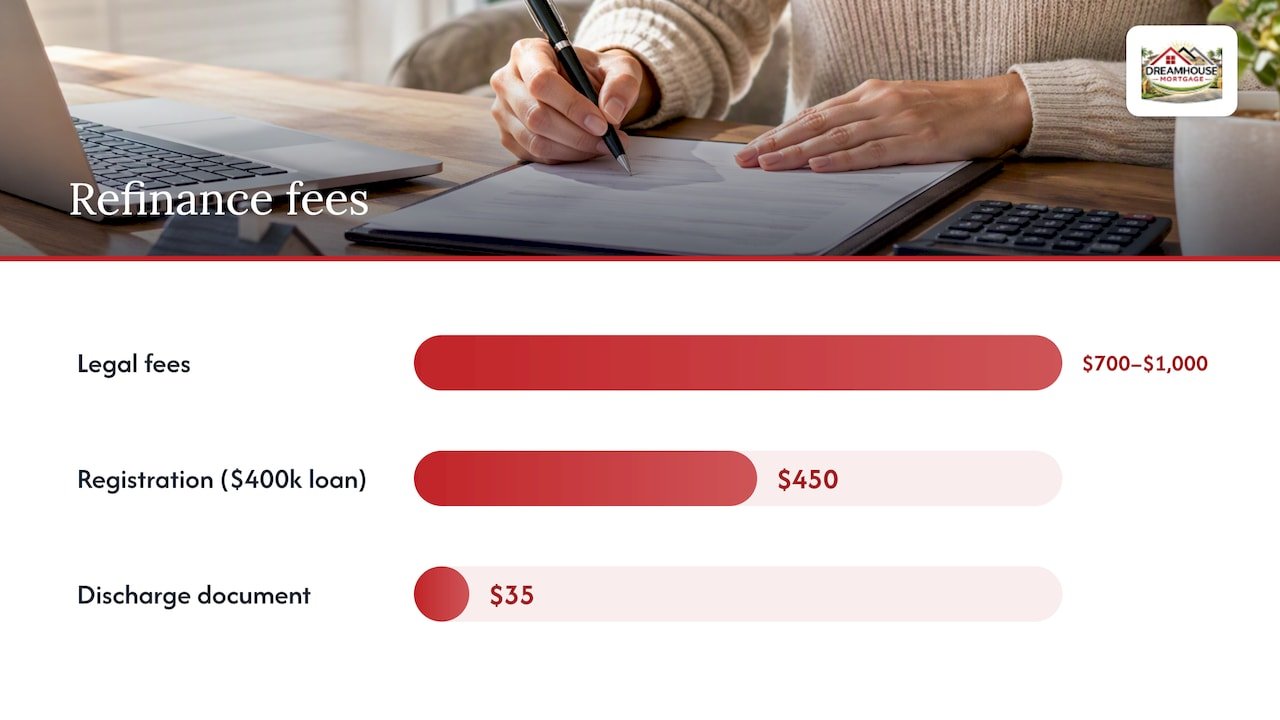
| Legal fees | Ratehub reports typically $700 to $1,000 (published March 2022), and some lenders cover legal costs on balances above $200,000 |
| Land Titles mortgage registration | $50 plus $5 per $5,000 of principal |
| Discharge document | $35 for any other discharging document |
| Appraisal | Varies by lender and property; ask whether the lender pays |
The registration and discharge amounts come from the Alberta Land Titles common document fee schedule, which shows an October 1, 2026 effective date. On a new $400,000 mortgage, the registration works out to $50 plus $5 for each of 80 increments of $5,000, which is $450. Your lawyer will confirm the final figure on your reporting letter.
For a deeper breakdown, including why a flat estimate can fall short on Calgary files, read our refinance closing costs guide. Buyers and owners should also see how Alberta closing costs are changing.
Pro Tip: Add up total costs and divide by your monthly savings. If a refinance saves $250 a month and costs $5,000 all in, you reach break-even in 20 months. Compare that with how long you will keep the mortgage.
Refinancing for renovations or debt consolidation
Two goals account for many Alberta refinances: consolidating high-interest debt and funding a renovation. Both follow the timeline above, but each adds a detail.
- Debt consolidation. The lawyer pays your credit cards or loans directly at funding, so you need current balances and account numbers early. See our debt consolidation mortgage guide for Calgary.
- Renovations. Some lenders advance funds up front, others release money in stages against the work completed. If you are planning a larger project, this overview of renovation financing options helps you compare ways to pay for the work before you pick a mortgage structure. When your renovation is the reason for the refinance, ask whether the appraisal will use today’s value or the value after completion, as it changes how much you can borrow. Our home equity renovation mortgage for Calgary page explains the options.
CMHC also allows refinancing up to 90% loan-to-value for properties with up to four units when building secondary suites, provided credit and debt service ratio requirements are met. That can matter for owners in Calgary neighbourhoods such as Bridgeland, Killarney or Forest Lawn considering a basement suite.
Our perspective: plan backward from your term end
We see the same pattern again and again with Calgary, Airdrie and Cochrane homeowners: the people who feel stressed about a refinance are the ones who started when they needed the money. The ones who feel calm started with a date. Our approach is to put your term end, your penalty estimate and your goal on one page first, then work backward to the application date.
We also look at the refinance as one tool among several. Sometimes a switch at renewal, a second mortgage or a home equity line does the job at lower cost and with a shorter timeline. Because we work with banks, credit unions, monoline lenders, alternative lenders and private lenders, we can show you those alternatives side by side instead of defaulting to a single product. A lender that funds quickly but has a harsh penalty formula may not be the right fit for you, and we say so.
Our view on documents is simple: the complete file is the fast file. We will tell you exactly what to send and in what order, and we keep you updated at each stage so that you are never guessing where your file is.
— Guriqbal Chahal, MBA, PMP
Work with a Calgary mortgage broker on your refinance
DreamHouse Mortgage is a Calgary-based brokerage, founded in 2013, serving homeowners in Calgary, Airdrie, Cochrane, Chestermere, Okotoks, High River, Rocky View County, Edmonton, Red Deer and surrounding Alberta communities. We handle mortgage refinancing, renewals and switches, compare lenders for you, collect your documents and coordinate the file through to funding.

If you already know your term end date, start your application here and we will come back to you with a timeline built around your date. You can also explore all of our mortgage services.
Call Guriqbal Chahal, MBA, PMP, Mortgage Broker, at 403-966-6072, or find us on our Google Business Profile.
A practical checklist for a four-week refinance
Use this as a working schedule if you want funding in about a month:
- Week 0: get your penalty quote and your term end date. Talk to your broker about the goal and the amount.
- Week 1: submit the full document package. Pull your credit report and fix anything incorrect.
- Week 2: appraisal is booked and completed, the lender issues approval with conditions.
- Week 3: clear every condition, choose your lawyer and book the signing.
- Week 4: sign, the lawyer registers the new mortgage and pays out the old one, and funds arrive.
If your term is ending sooner than four weeks, say so at the first call. Some steps can run in parallel, and some lenders move faster than others. If your term is ending later, you may be able to start earlier and avoid a penalty altogether.
FAQ
How long does a mortgage refinance take in Alberta?
Plan on roughly two to four weeks from application to funding for a straightforward file. The legal stage alone is often five to ten business days once the lender’s instructions are complete. Self-employed income, a rental property or a title issue can add time.
Can I refinance my mortgage right after buying a home?
There is no legal waiting period, but it rarely works soon after a purchase. You need enough equity under the 80% limit, and some lenders apply their own seasoning rules. A prepayment penalty may also apply if you break a closed term early.
What is the difference between renewing and refinancing in Canada?
Renewing continues your existing mortgage with new terms when your term ends. Refinancing replaces it with a new mortgage, often for a larger amount, after a full re-qualification and appraisal. Switching moves the same balance to a different lender at renewal.
What does it cost to refinance in Alberta?
Expect legal fees, Land Titles registration, a possible appraisal fee and, if you leave your term early, a prepayment penalty. Registration is $50 plus $5 per $5,000 of principal. Ask for a written estimate before you sign.
Sources
- Renewing your mortgage, Financial Consumer Agency of Canada
- Preparing to get a mortgage, Financial Consumer Agency of Canada
- Breaking your mortgage contract, Financial Consumer Agency of Canada
- Mortgage prepayment: know your rights, Financial Consumer Agency of Canada
- Mortgage Renewal vs Refinance, BMO
- Mortgage Refinancing, BMO
- What is refinancing, TD Canada Trust
- Costs of Refinancing in Canada, Ratehub
- Land Titles and Surveys Common Document Fee Schedule, Alberta.ca
- CMHC Refinance for Building Secondary Suites
- Mortgage Refinancing Lawyer in Alberta, Spectre Law
- Five tips for a quick closing to your mortgage refinance, Deeded
- Renovation financing options guide for homeowners, House A-Z
- DreamHouse Mortgage on Google Business Profile