In Canada, the difference between a second home and an investment property comes down to who uses it. If you will live in it or use it personally, such as a vacation home, lenders treat it as a second home. If it will be rented out to tenants and you will not occupy it, it is an investment property. That one distinction changes your minimum down payment, the insurance available, how lenders count rental income, and how the Canada Revenue Agency (CRA) taxes you.
This guide is written for Calgary, Airdrie, Cochrane and Chestermere buyers who already own a home, or who are about to buy their first one and are thinking ahead. We cover the numbers, the tax treatment, and the questions to settle before you make an offer.
TL;DR
- An owner-occupied second home can qualify for CMHC-insured financing with 5% down on the first $500,000 and 10% on the rest, while a non-owner-occupied rental needs at least 20% down.
- Interest on a second home is deductible only when the property is used to earn rental income. A personal-use vacation home gets no interest deduction.
- Selling either property can trigger capital gains tax, because the principal residence exemption covers only the home you designate as your principal residence.
- A pre-approval is not a final approval. The appraisal and the property itself decide whether the loan funds.
- Call Guriqbal Chahal, MBA, PMP, at 403-966-6072 before you write an offer, so the structure is settled first.
Table of Contents
- How lenders define a second home and an investment property
- Down payment: 5% versus 20%
- How lenders count the income
- Tax: where the two paths really diverge
- Side-by-side: which fits your goal?
- Buying while you still have a home to sell
- Pre-approval is not approval
- Steps to choose and finance the right property
- Thinking about first-time purchase now and a second property later?
- Our perspective
- How DreamHouse Mortgage can help
- FAQ
- Sources
How lenders define a second home and an investment property
Canadian lenders do not care what you call the property. They care how it will be used and who will occupy it.
Second home (owner-occupied): a property you use personally, such as a cabin, a lake or mountain property, or a condo you keep for part of the year or for a family member’s personal use. You are not relying on tenants to pay the mortgage.
Investment property (non-owner-occupied): a property purchased to earn rental income. A basement-suite house in Airdrie rented to a tenant, a townhouse in Calgary’s northwest, or a duplex in Cochrane all fit here when you will not live in them.
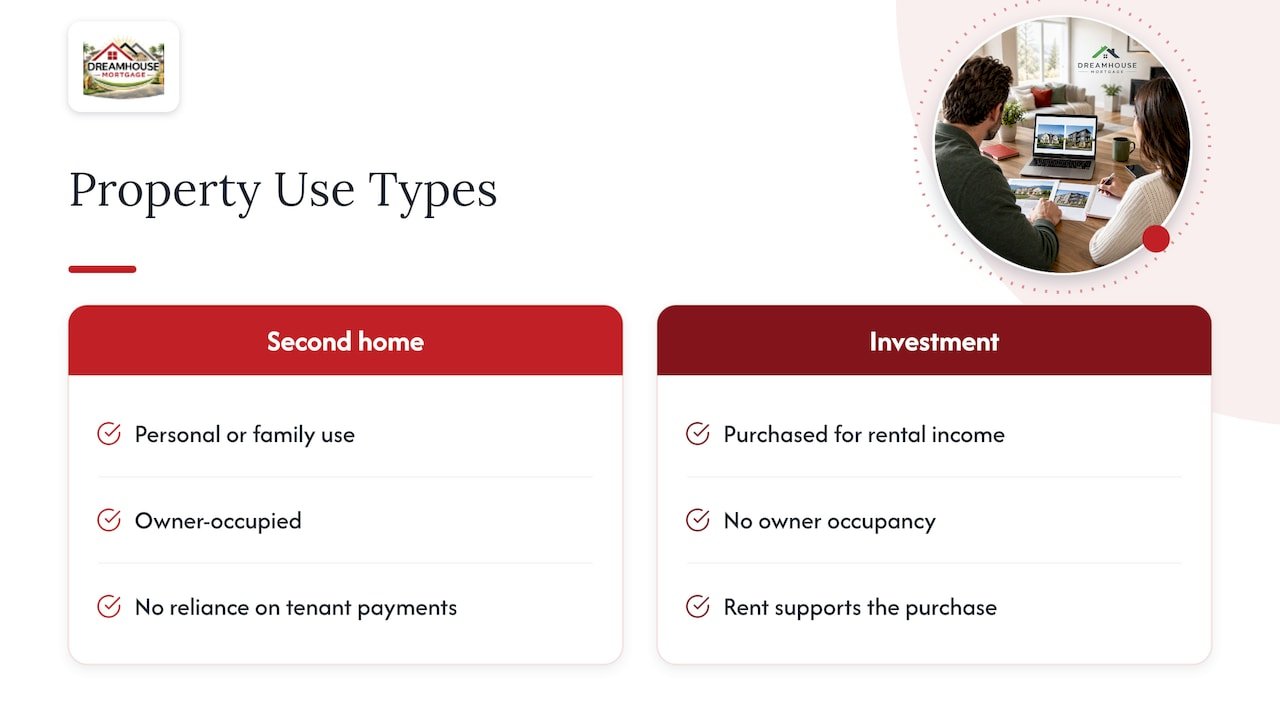
The label matters because it determines the product you can use. Mixed situations, such as a property you use for part of the year and rent out for the rest, need a conversation with a broker before you apply, because the lender needs a clear answer on intended use. Our own second home mortgage page for Alberta and our vacation home qualifying guide walk through how those cases are presented.
Down payment: 5% versus 20%
This is where most buyers get caught. Many assume the same down payment strategy works for both property types. It does not.
| Second home (owner-occupied) | Investment rental (non-owner-occupied) | |
|---|---|---|
| Minimum down payment | 5% on the first $500,000, 10% on the remainder | 20% |
| Maximum loan-to-value | 95% | 80% |
| Purchase price limit for the CMHC product | Below $1,500,000 | Below $1,000,000 (2-to-4 units) |
| Maximum amortization on insured product | See lender and CMHC guidance | 25 years |
| Limit on insured properties | Two CMHC-insured properties per borrower at a time | Not applicable |
The figures for the second home come from CMHC’s Second Home program, which covers a 1-unit owner-occupied property and is limited to Canadian citizens and permanent residents. The rental figures come from CMHC Income Property, the insurance product for 2-to-4-unit rental properties. Rules and thresholds can change, so we confirm the current version of each program before we build your plan.
A worked example
Suppose you find a $450,000 townhouse in Cochrane.
- As an owner-occupied second home: the minimum down payment at 5% is $22,500, and the insured mortgage would be $427,500.
- As a rental you will not occupy: the minimum at 20% is $90,000, and the mortgage would be $360,000.
The $67,500 gap is the real cost of choosing the wrong label, or of wanting a rental while assuming vacation-home rules apply. It is also the reason lenders ask for evidence of intended use. If you plan to rent, tell us at the start. A mismatch discovered late can sink an approval.
Pro Tip: Where does the 20% come from? Lenders look at the source of the funds. Savings, a gift, or equity from another property can all work, but each has documentation rules. Our guide to mortgage down payment types in Canada explains what counts, and our page on when a 20% investment down payment fails covers the traps.
How lenders count the income
For a second home, lenders qualify you on your total income against all your debts, including the carrying costs of the new property. Rental income is not usually the thing that makes the deal work.
For an investment property, the question is how much of the expected rent a lender will let you count. Lenders handle rental income in different ways: some add a portion of the rent to your income, and others subtract the property’s costs from the rent and treat the result as an offset. Policies vary by lender, which is one reason a broker with access to banks, credit unions, monoline lenders and alternative lenders is useful here. A property that one lender treats conservatively may suit another’s rules better.
Two of our pages cover this in detail:
- How a rental offset mortgage counts rental income
- Debt service coverage ratio explained for Canadian investors, relevant when you are qualifying on the property’s performance rather than only on your own income
Self-employed buyers, including many business owners across Calgary and Airdrie, have an extra layer: lenders look at how income is documented. Our add-back income guide for self-employed borrowers explains how some lenders treat it.
Tax: where the two paths really diverge
Mortgage rules decide whether you can buy. Tax rules decide what the property costs you over time. Speak to an accountant before you commit, because your situation (other income, how you use the property, how long you hold it) changes the answer. The points below show where the two property types differ.
Mortgage interest
It is a common misconception that interest on a second home is always deductible. According to the CRA’s rental income guide (T4036), interest on money borrowed to buy a property is generally deductible only when the property is used to earn rental income. If you use it as a personal vacation home, the interest is a personal expense. The same guide explains that expenses are not deductible when a property sits vacant and earns no income.
Mortgage fees on a rental
If you buy a rental, the fees to arrange the financing, such as application fees, appraisal costs and finder’s or brokerage fees, are generally not deductible all at once. The CRA guide above says these are spread over five years, at 20% per year. Build that into your first-year cash flow projection so you are not surprised at tax time.
Selling: capital gains and the principal residence exemption
The home you live in as your principal residence is generally not taxed on sale. A second property, whether vacation or rental, does not receive that treatment automatically. The principal residence exemption applies only to a property designated as your principal residence for the years you owned it, and the CRA explains the basics in its page on the tax effects of buying real estate to sell for a profit.
The CRA also separates two kinds of profit:
- Capital gain: typical when you buy a rental to hold and later sell.
- Business income: applies when the main intention at purchase was to resell for profit. In that case you lose the more favourable capital gains treatment and the principal residence exemption, even if you lived in the property during renovations.
There is also a separate rule for residential properties that are sold within a short period after purchase. Ask your accountant how it applies if you may sell quickly. Your original intention at the time of purchase matters, so keep a written record of why you bought.
Pro Tip: Do not decide between a second home and an investment property on tax assumptions you picked up from a friend. Ask an accountant to run both scenarios with your real numbers.
Side-by-side: which fits your goal?
| Question | Second home | Investment property |
|---|---|---|
| Who uses it? | You and your family | Tenants |
| Cash needed up front | Lower (down payment can start at 5%) | Higher (20% minimum) |
| Can the mortgage interest be deducted? | Not when used personally | Generally yes, when it earns rental income |
| Rental income role | Not relied on to qualify | Central to the plan |
| Ongoing effort | Maintenance, seasonal use | Tenant management, vacancy risk, reporting rental income |
| Tax on a future sale | Capital gain possible, no automatic exemption | Capital gain possible, no automatic exemption |
Neither is better in the abstract. A second home buys you use and flexibility. An investment property buys you income and a taxable activity with more paperwork. The right choice follows from why you want the property and how much cash you can comfortably commit without stretching your main residence.
Buying while you still have a home to sell
Many Calgary owners want to upgrade, move to Cochrane or Airdrie, and keep the old house as a rental. Others plan to sell first. The timing creates a financing gap.
Bridge loans can cover it. Per RECA’s guidance on bridge loan financing, these are short-term loans that bridge the gap between buying a new property and selling the existing one, and they carry risks as well as benefits. In practice they run for a limited period, so they should be part of an overall plan, not a last-minute fix. Our page on bridge financing in Canada explains why Calgary buyers generally need a firm sale to close.
If you are selling a property to fund the next one, preparation affects the price you net. Even simple work such as painting before selling can shape how buyers see a home, and the sale proceeds feed directly into the down payment on your next purchase.
Pre-approval is not approval
When you buy a second or investment property, the pre-approval is the start of the process. RECA reminds mortgage brokers and real estate licensees to be clear that a pre-approval does not guarantee the final loan will be approved.
The appraisal is the usual pressure point. If an offer is made above what the appraiser supports, the lender lends against the lower value, and you must cover the difference. This is a real risk for investors and for buyers who waive financing conditions. Our page on preapproval versus approval explains how Calgary appraisals can change the deal, and our pre-approval process guide for Alberta buyers lists the documents lenders request.
Pro Tip: Get your pre-approval structured for the property type you intend to buy. A pre-approval for an owner-occupied purchase does not automatically fit a rental.
Steps to choose and finance the right property
- Write down the purpose. Personal use, rental income, or a mix. Be honest, because the lender will ask.
- Set your cash limit. Compare 5% and 10% scenarios for a second home against a 20% minimum for a rental, and keep reserves for closing costs and maintenance.
- Check your current mortgage. Find out whether you can port it, refinance, or tap equity. Our refinancing after purchase guide explains when that works.
- Get a structured pre-approval. Share income documents, down payment sources and your plan for the property.
- Speak with an accountant. Confirm tax treatment before you sign.
- Write the offer with the appraisal risk in mind. Know your fallback if the value comes in lower.
- Fund and plan ahead. Keep an eye on your renewal date and rate options.
Thinking about first-time purchase now and a second property later?
If you are still a first-time buyer in Calgary, the order of purchases matters. Your first home is usually the property you will designate as your principal residence, and a later second property is a separate decision with its own rules. Our first-time homebuyer mortgage guide for Calgary covers the starting point, and the CRA’s guide to taxes and housing benefits lists federal programs, including the First Home Savings Account.
Our perspective
We see the same pattern across Calgary, Airdrie and Cochrane. A buyer finds a property they like, calls it a vacation home or a rental based on how they feel about it, and only afterwards learns that the lender, the insurer and the CRA each look at it differently. The cost of that surprise is usually thousands of dollars of down payment, or a deal that falls apart close to possession.
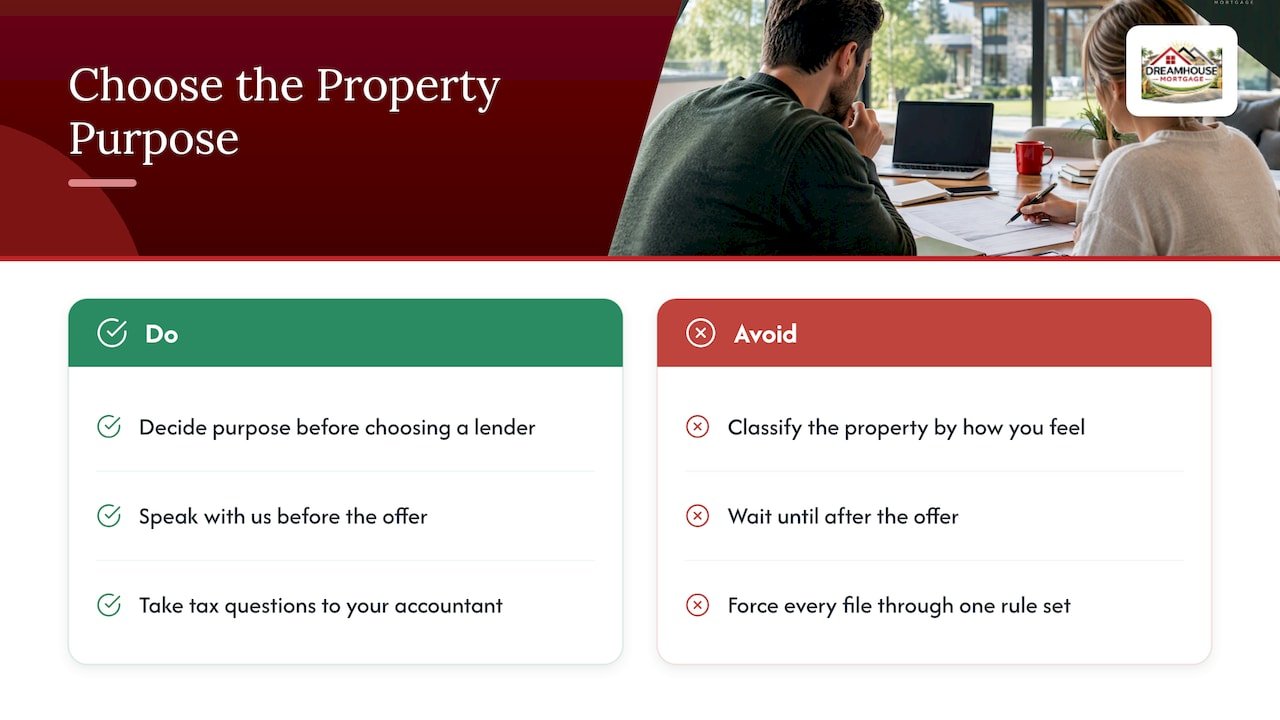
Our approach is to decide the property’s purpose first, then choose the lender. Because we work with banks, credit unions, monoline lenders, alternative lenders and private lenders, we can match a property type and an income profile to a lender whose policy fits, instead of forcing every file through one set of rules. We also explain the tax questions you should take to your accountant, so the mortgage and the tax plan agree with each other.
One habit we recommend: speak with us before the offer, not after. Structure, appraisal risk and the source of your down payment are all easier to fix early.
— Guriqbal Chahal, MBA, PMP
How DreamHouse Mortgage can help
We are a Calgary-based mortgage brokerage, founded in 2013, serving Calgary, Airdrie, Cochrane, Chestermere, Okotoks, High River, Rocky View County, Edmonton, Red Deer and surrounding Alberta communities. Our services include vacation home mortgages, investment and rental property mortgages, refinancing, renewals and mortgage portability, along with first-time buyer mortgages and pre-approvals.
Call Guriqbal Chahal, MBA, PMP, Mortgage Broker, at 403-966-6072 to talk through whether a second home or an investment property fits your plan. You can also find us on our Google Business Profile.
FAQ
Can I buy a second home with 5% down in Canada?
Possibly, if the property is owner-occupied and meets CMHC’s Second Home criteria. The minimum is 5% on the first $500,000 and 10% on the remainder, for a price below $1,500,000, and a borrower can have two CMHC-insured properties at a time. It does not apply to a property you will rent out and not occupy.
How much down payment do I need for an investment property in Calgary?
A non-owner-occupied rental generally needs at least 20% down, which means a maximum loan-to-value of 80%. CMHC Income Property insurance for 2-to-4-unit rentals also sets a price limit below $1,000,000 and a 25-year maximum amortization. Lender policy can add its own requirements, so confirm before you shop.
Is mortgage interest on a vacation home tax deductible in Canada?
Not when the property is for personal use. The CRA states that interest is generally deductible only when the borrowed money is used to earn rental income. Talk to an accountant about how that applies if you rent the property part of the year.
How are capital gains taxed on a second property in Canada?
The principal residence exemption applies only to the property you designate as your principal residence for the years you owned it. A vacation home or rental can produce a taxable capital gain on sale, and if you bought it mainly to resell, the profit may be treated as business income instead. Your accountant can model the result for your situation.
Sources
- CMHC: Second Home mortgage loan insurance
- CMHC: Income Property mortgage loan insurance
- CRA: Rental income (T4036)
- CRA: Tax effects of buying real estate to sell for a profit
- CRA: Your guide to taxes and housing benefits