
An IRD penalty is the interest rate differential charge a lender applies when you break a closed fixed-rate mortgage before the term ends. It is usually the higher of two numbers: three months’ interest on your balance, or the interest the lender loses because rates have fallen since you signed. Two lenders can charge very different amounts for the same balance and the same timing, which is why you should read the penalty clause before you choose a mortgage, not when you need to sell.
This guide explains the mechanics in plain terms, walks through a worked example, shows where the calculation differs between lenders, and lists the practical ways to keep a penalty small or avoid it. It is written for Calgary, Airdrie and Cochrane buyers, with first-time buyers in mind.
TL;DR
- On a closed fixed-rate mortgage, the penalty is generally the greater of three months’ interest or the interest rate differential (IRD). On a variable rate it is generally three months’ interest.
- The IRD depends on the comparison rate your lender uses. That method is written in your mortgage contract and can change the bill by thousands of dollars.
- Ways to reduce exposure: choose a term you can realistically keep, use prepayment privileges, port the mortgage when you move, and ask for the penalty method in writing before you sign.
- Before you commit to a lender, ask a broker to show you the penalty clause side by side with the rate. Call Guriqbal Chahal at 403-966-6072.
Table of Contents
- What an IRD penalty actually is
- When you might trigger a penalty
- Three months’ interest versus IRD
- Why the same mortgage can cost very different amounts to break
- The five-year rule for long terms
- How to estimate your own penalty
- Ways to avoid or reduce an IRD penalty
- When paying the penalty is the right decision
- Calgary, Airdrie and Cochrane: local situations
- Questions to ask before you sign
- Our perspective on penalties
- Work through your options with a Calgary broker
- FAQ
- Sources
What an IRD penalty actually is
A closed mortgage is a contract. You agree to a rate and a term, commonly five years, and the lender agrees to fund the mortgage at that rate for the whole term. The lender raised that money expecting to earn your interest until the end of the term. If you pay the mortgage off early, the lender has to re-lend that money at today’s rates. If today’s rates are lower than yours, the lender earns less than planned, and the IRD charge is how it recovers the difference.
That is the logic behind the name. The “differential” is the gap between your rate and a comparison rate. The “interest” is that gap applied to what you still owe, over the time left in your term.
A few points follow from this:
- The penalty grows when rates fall. If rates have risen since you signed, the differential is small or zero, and the three-months’-interest figure usually wins.
- The penalty grows with the balance and the time left. A large balance with three years remaining costs far more than the same balance with six months remaining.
- It applies to more than selling. A penalty can also apply when you refinance, switch to another lender before maturity, or prepay more than your privileges allow. An open mortgage can generally be repaid at any time without one.
When you might trigger a penalty
Most people think of selling, but life produces several other triggers. In the Calgary region, these are the situations we see most often:
- Selling and moving up or down. A first-time buyer in a condo in Beltline or a townhouse in Airdrie outgrows the space within a few years. Selling mid-term can trigger a penalty unless the mortgage is portable.
- Relocating for work. Moves between Calgary and Edmonton, or out of province, are common in an energy-linked economy.
- Refinancing for equity. Pulling equity out for a renovation or to consolidate debt means replacing the existing mortgage, which can bring the penalty into play.
- Separation or a change in household income. These events often force a sale or a buyout of a partner’s share.
- Switching lenders for a better rate. Switching before maturity is only worthwhile if the savings clearly exceed the penalty.
- Large lump-sum payments. An inheritance or a bonus put toward the mortgage can exceed your annual prepayment limit.
Three months’ interest versus IRD
Both methods apply to a closed fixed-rate mortgage, and you generally pay the higher one. Variable-rate mortgages generally carry the three-months’-interest penalty alone, though the wording in each contract controls.
Three months’ interest
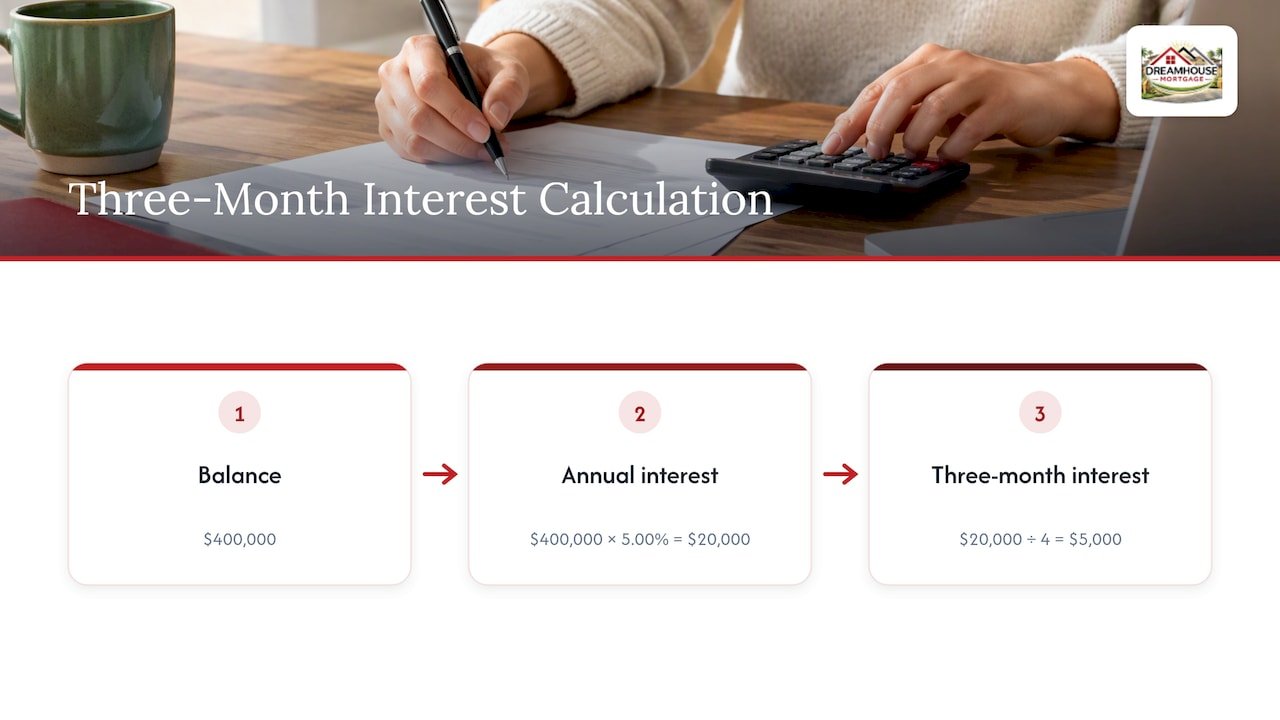
This one is simple: take your current balance, multiply by your annual rate, divide by four.
Example (illustration only): a $400,000 balance at 5.00% earns the lender $20,000 in interest per year. A quarter of that is $5,000.
The interest rate differential
The simplified version is:
IRD = balance × (your rate − comparison rate) × months remaining ÷ 12
The comparison rate is the lender’s rate for a term close to the time you have left. If you have 24 months left, the lender looks at its rate for a two-year term, or the nearest available term.
Example (illustration only): same $400,000 balance at 5.00%, with 24 months left. Today the lender’s comparison rate is 3.50%.
- Rate gap: 5.00% − 3.50% = 1.50%
- $400,000 × 1.50% = $6,000 per year
- Over two years: $12,000
Because $12,000 is higher than the $5,000 three-months’-interest figure, the IRD applies. Real lender formulas can be more detailed, for example using the present value of the remaining interest, and some lenders add an administration fee. Treat the numbers above as a way to understand the structure, not as a quote.
Why the same mortgage can cost very different amounts to break
The formula looks the same everywhere. The difference sits in the comparison rate and in how your original rate is treated.
Some lenders compare your contract rate to their current rate for the remaining term. Others reduce the comparison by the discount you were given when you signed. A third approach starts from the lender’s posted rate at the time you signed rather than the discounted rate you actually received. Each method produces a different gap, so each produces a different penalty.
Here is the same borrower, with the same balance, rate and time remaining, under two hypothetical comparison rates:
| Scenario | Balance | Your rate | Comparison rate | Months left | IRD |
|---|---|---|---|---|---|
| Lender X | $400,000 | 5.00% | 4.00% | 24 | $8,000 |
| Lender Y | $400,000 | 5.00% | 3.00% | 24 | $16,000 |
Nothing about the borrower changed. Only the lender’s method did. This is the strongest reason to look at the penalty clause when you compare mortgages, not just the headline rate. A rate that is 0.10% lower can easily be outweighed by a penalty clause that costs thousands more if your plans change.
Canadian lenders also differ by type. Banks, credit unions, monoline lenders and alternative lenders each write their own contract language. A mortgage broker can compare the penalty terms across several of them at the same time, which is one practical advantage of working with a brokerage instead of a single branch.
The five-year rule for long terms
Under the federal Interest Act, there is a limit on how long a lender can charge a large prepayment penalty on a residential mortgage. The commonly cited rule is that after five years, the borrower can prepay with a maximum penalty of three months’ interest. This matters mainly for mortgages with terms longer than five years, such as seven or ten years, where the IRD portion can only apply during the first five years. Confirm how the rule applies to your own contract with your broker or a real estate lawyer before you rely on it.
How to estimate your own penalty
You do not need to guess. A federally regulated lender must disclose how it calculates the penalty, and most will give you a figure on request. Here is a practical sequence:
- Find the clause. Look in your mortgage commitment or contract for the sections titled prepayment, penalty or early repayment.
- Gather the inputs. You need your current balance, your contract rate, your maturity date and the original discount from posted rate, if the contract mentions one.
- Run both calculations. Work out three months’ interest, then the IRD using the lender’s stated comparison rate.
- Ask for a written payout statement. Request one from the lender with a date. Rates change, and so does the number.
- Add the other costs. Include legal fees, discharge fees and any administration charge. A new mortgage can carry its own costs too.
- Compare the total to the savings. If you are switching for a lower rate, the interest you save over the remaining term must exceed the penalty plus costs.
Pro Tip: Ask for the payout figure for two dates, today and your intended closing date. If the figures differ, you will see how much the timing matters.
Ways to avoid or reduce an IRD penalty
Choose a term you can keep
A five-year fixed term is popular in Canada, but only keep it if your life is likely to be stable for five years. Some first-time buyers in Calgary are buying a starter home they expect to leave in three to four years. A shorter fixed term, or a variable rate where the penalty is typically three months’ interest, can cost less to break, even if the headline rate is different. Our guide on first-time homebuyer mortgages in Calgary covers how term choice fits the rest of the plan.
Port the mortgage when you move
Many lenders allow you to move the existing mortgage, with its rate and remaining term, to the next property. A portable mortgage can avoid the penalty when the new purchase completes in the time window the lender allows. Portability has conditions: you must qualify again for the new amount, and if you borrow more, the extra is typically at current rates, often blended with your existing rate. Ask about the porting window and any limits before signing, because not every product has the same terms. Mortgage portability is one of the services we handle for clients.
Use your prepayment privileges
Most closed mortgages allow you to prepay a set percentage of the original principal each year, and to raise regular payments, without penalty. The limits vary by lender. Using them reduces the balance, which reduces any future penalty, because both methods work off what you still owe. Our article on paying down your mortgage faster explains how Alberta homeowners can use these options.
Consider the amortization you choose
A longer amortization lowers payments but keeps the balance higher for longer, which increases the base for any penalty. A shorter one pays the balance down faster. See mortgage amortization options in Canada for how the trade-off works.
Time your renewal or switch
At maturity, you can renew or switch lenders without an IRD penalty. Early renewal, before maturity, is a different matter: some lenders offer it, often by blending your old rate with a new one, and may charge a penalty or fee. If your term ends in the coming months, wait for the renewal offers, compare them with a broker’s options, and decide at maturity. Our renew or switch service handles that comparison.
Ask whether an open or short-term product fits
If you expect to sell within a year, an open mortgage or a very short term can make sense even at a higher rate, because you can repay it with no penalty. Run the numbers: the premium you pay in interest should be less than the penalty you would otherwise risk.
When paying the penalty is the right decision
A penalty is not always a mistake. Sometimes it is the cheaper path. Consider paying it in these cases:
- A large rate saving. If rates have fallen far below your contract rate, the savings from a refinance may exceed the penalty over the remaining term. Compare the total interest saved against the penalty and fees.
- High-interest debt. Rolling credit card balances or other consumer debt into the mortgage can reduce your monthly outflow. Weigh the penalty against what you currently pay in interest. We explain this strategy on our Calgary debt consolidation page.
- A life event that cannot wait. Relocation, separation or a job change can make timing more valuable than the penalty.
The key is to calculate before you act. A broker can model the penalty, the new rate, legal and lender fees, and the break-even point in months.
Calgary, Airdrie and Cochrane: local situations
The penalty works the same way across Canada, but local patterns shape who runs into it.
- Calgary condo and townhouse buyers. Entry-level buyers in communities such as Beltline, Mahogany or Seton often upgrade within a few years as families grow. A term and a portability clause that fit that plan matter more than a small rate difference.
- Airdrie and Cochrane move-up buyers. Many households move out from Calgary for space, then move again for school, work or acreage. If you may sell inside your term, ask about portability and your prepayment limits at the start.
- Self-employed and variable-income owners. If your income changes, you may need to refinance or restructure in the middle of a term. Understanding the penalty gives you options.
- Investors. Rental property owners who sell or refinance to buy another property should confirm how the penalty applies to their product, as terms can differ from owner-occupied mortgages.
Questions to ask before you sign
Bring this list to your broker or lender before you accept any mortgage commitment:
- How is the penalty calculated on this exact product: three months’ interest, IRD, or the greater of both?
- What is the comparison rate, and does it use the discount I received?
- Is there an administration or discharge fee on top of the penalty?
- What are my annual prepayment limits for lump sums and payment increases?
- Is the mortgage portable, for how long after a sale, and under what conditions?
- Can I see a sample penalty calculation based on my balance and term?
- Is the mortgage assumable by a buyer, and under what conditions?
- What happens at the end of the term if I want to switch lenders?
Pro Tip: Save the lender’s answers in an email. A written explanation is easier to compare later than a verbal one.
Our perspective on penalties
We talk to first-time buyers every week who ask about rate first and the penalty clause last. We believe the order should often be reversed, or at least balanced. The rate is what you see every month. The penalty is what you see once, at the moment when you have the least flexibility.
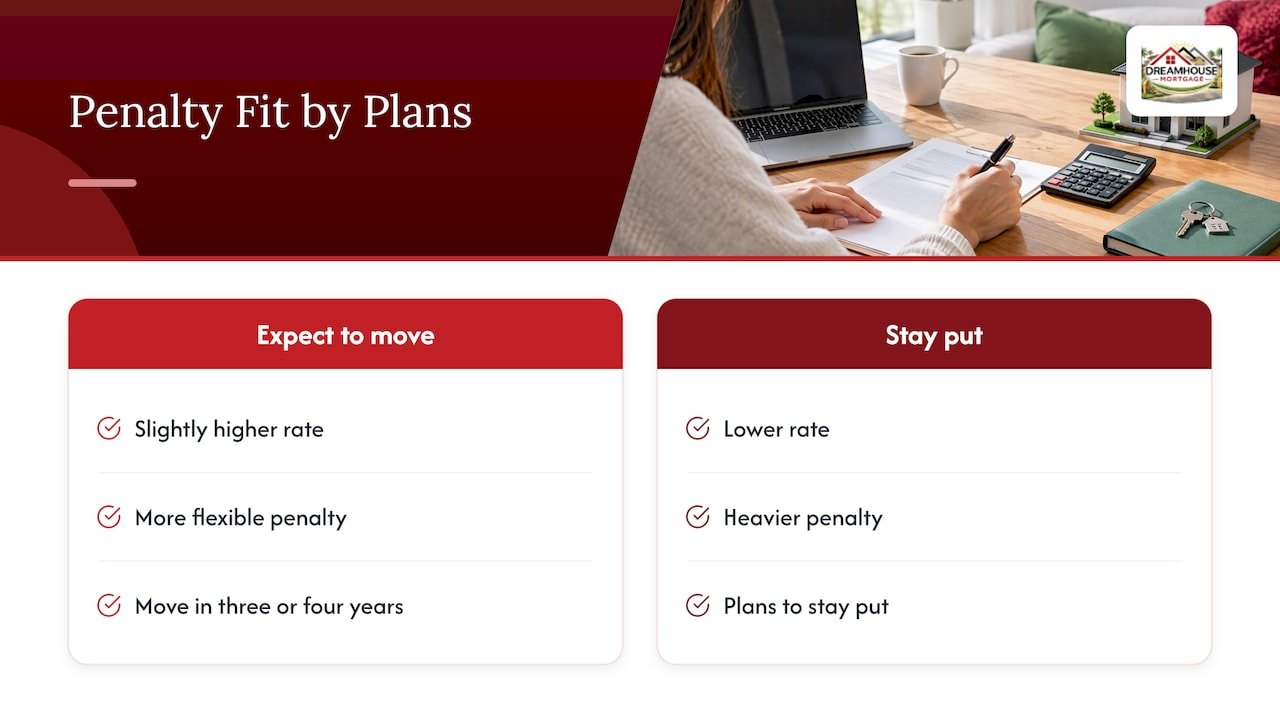
As a Calgary brokerage that works with banks, credit unions, monoline lenders, alternative lenders and private lenders, we can lay out how different products treat early repayment next to the rate, the prepayment limits and the portability terms. That comparison is part of the advice. A slightly higher rate with a clearer, more flexible penalty can be the better fit for a buyer who expects to move in three or four years. A lower rate with a heavier penalty can be the better fit for someone who plans to stay put.
Our job is to match the product to the plan you actually have, explain it in plain language, and make sure you know the exact cost of changing course before you commit. If your plans change, we run the numbers with you, including whether to wait for renewal, port, refinance or pay the penalty.
— Guriqbal Chahal, MBA, PMP
Work through your options with a Calgary broker
If you are buying your first home in Calgary, Airdrie, Cochrane or the surrounding area, we can help you compare lenders on rate, penalty method, prepayment privileges and portability before you choose. If you already have a mortgage and are thinking about selling, refinancing or switching, we can estimate what leaving early would cost and whether it pays off. Explore our first-time buyer mortgage and pre-approval services, or read about the pre-approval process in Calgary.
Call Guriqbal Chahal, MBA, PMP, Mortgage Broker at 403-966-6072. You can also find us on our Google Business Profile.
FAQ
Is the IRD penalty always higher than three months’ interest?
No. On a fixed-rate mortgage the lender generally charges whichever of the two is greater. If rates are higher now than when you signed, the IRD may be small or zero, and the three-months’-interest amount applies. The IRD tends to be the larger number when rates have fallen and you have a long time left in your term.
Do variable-rate mortgages have an IRD penalty?
Variable-rate mortgages typically carry a penalty of three months’ interest instead of an IRD. That is one reason some buyers who expect to move or refinance choose variable. The exact wording is in your contract, so confirm it before you sign, and weigh the rate risk that comes with variable.
Can I avoid the penalty by selling my home?
Not automatically. Selling usually ends the mortgage, so a penalty can apply. You may avoid it by porting the mortgage to your next home within the lender’s time limit, or by waiting until your term matures. Ask your lender about portability before you list the property.
Can the penalty be added to a new mortgage?
Often, yes. When you refinance, the payout, including the penalty, is typically paid from the new mortgage proceeds, so it increases the new balance. That means you pay interest on it over time. Ask a broker to model the new payment and the break-even point before you decide.
How can I find out my exact penalty?
Contact your lender and ask for a written payout statement showing the penalty calculation and the date it is valid. Compare it with the method written in your mortgage contract. A broker can also help you read the clause and test whether switching or refinancing makes sense.
Sources
This guide describes how Canadian closed mortgage penalties generally work, based on the disclosure rules and consumer guidance for federally regulated lenders, and the federal Interest Act’s treatment of prepayment on residential mortgages. All dollar figures and rates in the examples are hypothetical illustrations, not quotes. Your mortgage contract and lender statement are the authoritative source for your own penalty.
- Your own mortgage contract and commitment letter
- Your lender’s written payout statement
- Financial Consumer Agency of Canada consumer guidance on mortgage prepayment