
Student loans do affect a mortgage application in Canada, but they rarely end it. Lenders count your monthly student loan payment as a debt when they work out how much you can borrow, so the real question is how large that payment is next to your income, your other debts and the stress-tested mortgage payment. If you are buying your first home in Calgary, Airdrie or Cochrane, the sections below show how the math works, what to fix before you apply and when to speak with a broker.
TL;DR
- Student loan payments are included in your Total Debt Service (TDS) ratio, which the Government of Canada says generally should not exceed 44% of gross income.
- A student loan is not an automatic refusal. The payment, your income, your credit and the stress-tested mortgage payment decide the result.
- If your loan is not yet in repayment, some lenders still assign a payment to it. One published lender practice uses the greater of the credit report payment or 1% of the balance.
- Check your credit report, list every payment and get a pre-approval before you make offers on a Calgary home.
- Call Guriqbal Chahal, MBA, PMP, at 403-966-6072 to see how your student loans fit your first-time buyer plan.
Table of Contents
- How Canadian lenders treat student loans
- GDS, TDS and where student loans land
- What if your student loan is deferred or not yet in repayment?
- The stress test and your student loan
- Credit score, payment history and student loans
- Steps to take before you apply
- Our perspective: student loans are a planning problem, not a barrier
- What this looks like in Calgary, Airdrie and Cochrane
- Work with a Calgary mortgage broker who looks at the full picture
- FAQ
- Sources
How Canadian lenders treat student loans
When you apply for a mortgage, a lender reviews your income, expenses, the amount you want to borrow, your debts, your credit report and score, and the amortization. The Financial Consumer Agency of Canada (FCAC) lists student loans among the debts that go into this assessment.
A student loan is treated like any other installment debt. It is a fixed monthly obligation that reduces the room left for a mortgage payment. It is not treated as a character flaw, and a loan that is being repaid on time shows lenders a payment history.
Two points surprise many first-time buyers:
- The payment matters more than the balance. A $40,000 balance on a long repayment schedule can weigh less than a $15,000 balance on an aggressive one.
- The loan is counted even if you are not paying it yet. More on this below.
Pro Tip: Bring your most recent National Student Loans Service Centre statement, or your provincial loan statement, to your first meeting. A broker can only calculate precisely if the payment and balance are documented.
GDS, TDS and where student loans land
Canadian lenders use two debt-service ratios.
- Gross Debt Service (GDS): your housing costs as a share of gross household income. FCAC says this generally should not exceed 39%, and housing costs include the mortgage payment, property taxes, heating and 50% of applicable condominium fees.
- Total Debt Service (TDS): housing costs plus all other debt payments, including student loans, as a share of gross income. FCAC says this generally should not exceed 44%.
CMHC publishes the same 39% and 44% maximums for its mortgage loan insurance framework, and the Eligible Mortgage Loan Regulations set the same limits for eligible high-ratio loans, subject to the conditions in the regulation. High-ratio means your down payment is under 20%, which describes most first-time buyers in Calgary.
Student loans never enter GDS, because GDS only measures housing costs. They enter TDS, and that is where they can become the limiting factor. If you want a step-by-step walk through the formulas, this guide on how to calculate GDS and TDS ratios shows how housing costs and debt payments are added. Our own explainer on the GDS and TDS ratio in Calgary applies the same idea to local property taxes and condo fees.
A worked example (illustrative numbers)
The figures below are a simple illustration, not a quote or an approval. Real lenders also apply the stress test, and limits vary by lender and product.
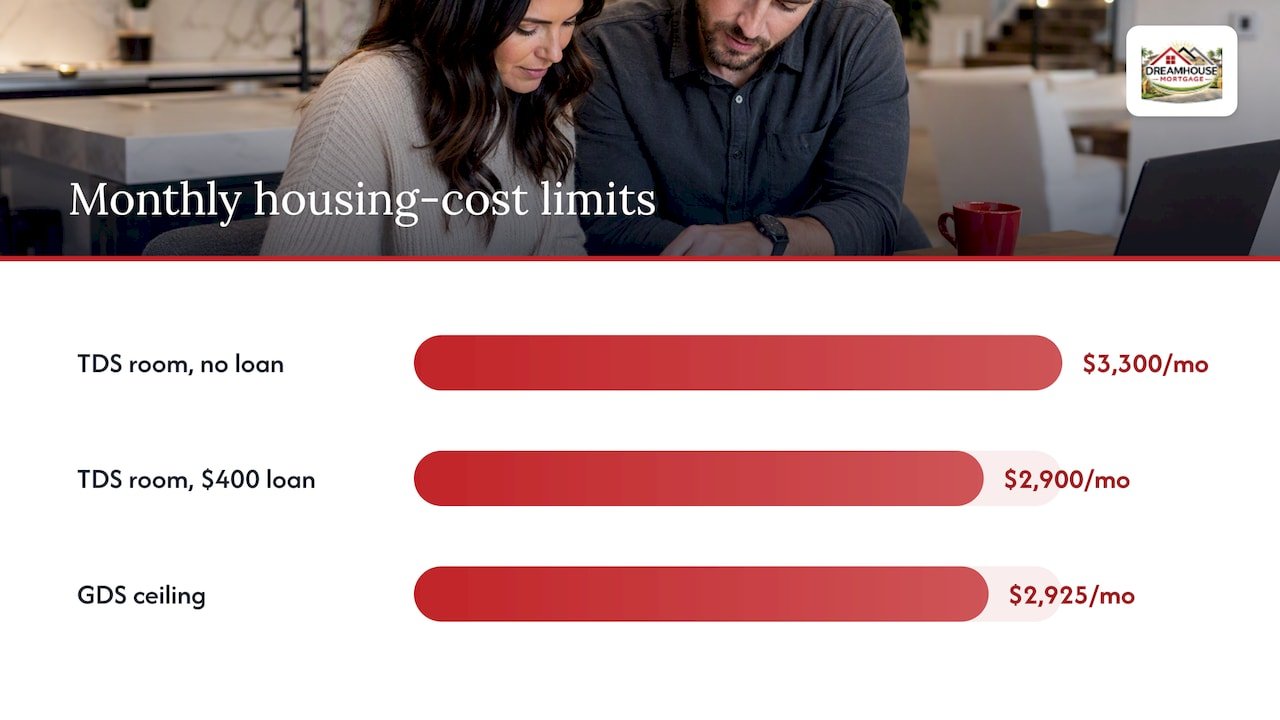
Suppose a household earns $90,000 a year, or $7,500 a month before tax.
| Item | No student loan | With a $400 monthly student loan payment |
|---|---|---|
| Monthly gross income | $7,500 | $7,500 |
| 44% TDS ceiling | $3,300 | $3,300 |
| Student loan payment | $0 | $400 |
| Room left for housing costs under TDS | $3,300 | $2,900 |
| 39% GDS ceiling on housing | $2,925 | $2,925 |
| Housing budget the lender can use | $2,925 | $2,900 |
In this example the student loan barely changes the housing budget, because GDS was already close to the limit. Add a $450 car loan and a credit card payment, and TDS becomes the tighter ratio, so the housing budget drops further. That is the pattern we see: a student loan alone is usually manageable, and the combination of several debts is what shrinks the approval.
The ceilings above are the maximum housing costs your income can carry, which is not the same as the mortgage payment you should take. Those housing costs also include property tax and heat, so the mortgage payment itself is smaller. Our Calgary mortgage affordability calculator guide and our piece on Calgary property tax and your mortgage explain how to separate those pieces.
What if your student loan is deferred or not yet in repayment?
This is the most common question from recent graduates in Calgary. Federal student loan repayment normally begins six months after your studies end, following a six-month period with no payments. During that window your statement may show a zero payment.
A zero payment on the statement does not always mean a zero payment in the lender’s calculation. One published broker resource from a Canadian lender, CMLS, states that for student loans not yet in repayment it uses the greater of the credit report payment or 1% of the outstanding balance in TDS. On a $30,000 balance, 1% is $300 a month. That is one lender’s practice, and others may differ, which is a good reason to compare several lenders rather than rely on one bank’s answer.
The same resource says installment loan payments must be verified, for example through the credit bureau, the cost-of-borrowing document, an approval letter, or a bank or loan statement. Have at least one of those ready.
Repayment Assistance Plan (RAP)
If you cannot afford your regular payment, the federal Repayment Assistance Plan can lower it. According to the RAP application, approved borrowers receive an altered monthly payment that may be reduced to zero, RAP is granted in six-month periods and must be renewed, and borrowers generally need to be in repayment status to apply.
For mortgage purposes, treat RAP carefully. A reduced payment may help your ratios, but a lender may ask for documents showing the payment and how long it lasts, and may still look at the balance. Do not assume a temporary reduction will be counted as your long-term payment. Ask your broker before you apply for RAP just to improve a mortgage file, and speak with the student loan service provider about what is right for your finances.
Pro Tip: Never stop paying a student loan to improve your cash flow before a mortgage application. Missed payments appear on your credit report, and the report is one of the first things a lender reviews.
The stress test and your student loan
Lenders do not qualify you at your actual rate. FCAC says banks use the greater of 5.25% or your negotiated rate plus 2% to test whether you could still afford the payment if rates rose. The Eligible Mortgage Loan Regulations apply the same greater-of test, the contract rate plus 2 percentage points or 5.25%, to high-ratio debt-service calculations.
The stress test raises the mortgage payment used in your ratios, and your student loan payment sits on top of it. A buyer with no other debts may absorb the test easily. A buyer with a student loan payment feels the combined effect: a higher qualifying mortgage payment, plus a fixed monthly debt.
For a deeper look, read our guides on the mortgage stress test in Alberta and the mortgage stress test for first-time buyers.
Credit score, payment history and student loans
Student loans that are paid on time can help your credit profile, and late or missed payments can hurt it. FCAC advises prospective borrowers to obtain and check their credit report before mortgage shopping, because lenders review it and may refuse a mortgage or ask for a co-signer if credit is not sufficient.
For an eligible high-ratio loan, the federal regulations generally require at least one borrower or guarantor to have a credit score of 600 or higher, subject to a portfolio exception. Individual lenders often set their own, higher minimums for their best rates.
When you review your report, look for:
- Student loans listed twice, or with the wrong balance.
- Payments marked late that you made on time.
- Accounts you do not recognize.
- Old balances on closed credit cards.
If your credit needs repair first, our team can help you plan that step; see our Repair Your Credit and mortgage services. If you have gone through a consumer proposal, our guide to a mortgage after a consumer proposal explains the timeline.
Steps to take before you apply
Here is the order we recommend to first-time buyers carrying student loans.
- List every debt. Write down the monthly payment on each: student loans (federal and provincial), car loans, credit cards, lines of credit. CMHC’s home-buying guide names student loans as an expense to include when you prepare your budget.
- Pull your credit report. Check it for errors and confirm the student loan payment shown is accurate.
- Run a quick estimate. FCAC offers a Mortgage Qualifier Tool to see whether you may qualify. Then use our Calgary affordability calculator guide to avoid the common mistakes.
- Reduce other debts first. Paying off a credit card or car loan lowers TDS more efficiently than paying extra on a student loan, because those balances often carry higher payments relative to the debt.
- Keep student loan payments consistent. Zoocasa’s Canadian guide on buying with student debt recommends paying other debt down, making student loan payments consistently, restructuring where appropriate to lower monthly payments, and seeking a pre-approval to check affordability.
- Plan your down payment. A larger down payment reduces the mortgage and the payment in your ratios. See our guide to mortgage down payment types in Canada and the first-time home buyer benefits such as the FHSA and Home Buyers’ Plan.
- Get pre-approved. A pre-approval tests your numbers with real lender rules before you fall in love with a house. Read our Calgary pre-approval step-by-step guide and why preapproval is not the same as approval.
Pro Tip: Do not open new credit, finance a vehicle or co-sign a loan between pre-approval and closing. A new payment can change your TDS and weaken the approval.
Should you pay off the student loan before buying?
Not necessarily. Many borrowers do better keeping their savings for the down payment and closing costs, and letting the student loan payment stay in the ratios. Others find that clearing a small remaining balance frees the monthly payment completely. The answer depends on the balance, the interest rate, your down payment target and the price range you want in Calgary. A broker can model both versions with the same lender rules.
Student loans are not a reason to wait if you are otherwise ready. Waiting has its own cost, including changes in prices, rates and your rent. Run the numbers rather than guess.
Our perspective: student loans are a planning problem, not a barrier
We meet many buyers who assume that a student loan means a bank will say no. In practice, the file that struggles is rarely the one with a student loan alone. It is the file with a student loan, a financed vehicle, two credit cards near their limits and a small down payment, all assembled without anyone looking at the ratios together.
Because we work with banks, credit unions, monoline lenders and alternative lenders, we can place the same student loan in front of several sets of rules. Lenders treat deferred loans, new-graduate income and variable pay differently, and that difference can change the approval amount. Our approach is to calculate first, then advise: which debt to clear, whether to wait a few months for a payment history to show, and which lender’s policy suits your file.
We also encourage buyers to think past the approval. A mortgage you qualify for is not always a mortgage you should take, especially if the student loan is still being repaid. Leave room in the monthly budget for property tax, utilities, maintenance and the rest of life in Calgary, Airdrie or Cochrane.
— Guriqbal Chahal, MBA, PMP
What this looks like in Calgary, Airdrie and Cochrane
The student loan math is national, but the housing costs it sits beside are local. Your TDS includes property taxes, heat and condo fees, so the type of home you target changes how much room is left.
- Calgary condos in areas such as the Beltline or Mission: condo fees are partly counted in GDS (FCAC says 50% of applicable fees), so a lower purchase price can still carry a higher housing cost than expected.
- Calgary townhomes and detached homes in communities such as Cranston, Mahogany or Seton: property tax and heating are counted, and larger mortgages raise the stress-tested payment.
- Airdrie and Cochrane: many first-time buyers look here for more space per dollar. The ratios work the same way, and you should still price in property tax, utilities and the commute.
Our local pages go deeper: first-time home buyer mortgage in Calgary, first-time buyers across Alberta, and the Calgary mortgage affordability guide. If you are also thinking about amortization to lower the payment, read about mortgage amortization options in Canada. If a high-interest student or consumer debt is weighing on you after you own a home, a debt consolidation mortgage in Calgary may be worth reviewing later.
Work with a Calgary mortgage broker who looks at the full picture
At DreamHouse Mortgage, we help first-time buyers across Calgary, Airdrie, Cochrane and the surrounding Alberta communities with mortgage pre-approvals and first-time buyer mortgages. We collect your student loan statements, credit report and income documents, compare lenders and explain your options in plain steps. Our brokerage was founded in 2013 and is led by Guriqbal Chahal, Broker of Record.
Call Guriqbal Chahal, MBA, PMP, Mortgage Broker, at 403-966-6072 to review your student loans and your buying budget. You can also find us on our Google Business Profile.
FAQ
Can I get a mortgage in Canada with student loans?
Yes. Lenders include student loan payments in your TDS ratio, which the Government of Canada says generally should not exceed 44% of gross income. If your income, credit and down payment support the stress-tested mortgage payment plus your debts, you can qualify. A broker can compare how different lenders treat your loan.
Do student loans reduce how much mortgage I can afford?
They can, because the monthly payment uses part of the 44% TDS allowance that would otherwise go toward housing. The effect depends on your income and on your other debts. A modest payment often changes the approval less than people expect, while several debts together can change it a lot.
Do deferred student loans count against my mortgage application?
Often yes. Some lenders apply a payment even when your statement shows none. One published lender practice uses the greater of the credit report payment or 1% of the balance, and other lenders may follow different rules, so ask before assuming a deferral helps.
Should I pay off my student loan before applying for a mortgage?
Not always. Compare using your savings on the down payment against clearing the loan to remove the payment from your ratios. Paying off higher-payment debts, such as credit cards or a car loan, often improves TDS more. A pre-approval or a quick broker calculation will show which route works for your numbers.
Can I get pre-approved in Calgary if I am a recent graduate?
Yes, in many cases. Lenders look at your income documents, job history, credit report and student loan payment. Having a signed offer or contract, a clean credit report and a clear down payment source makes the file stronger, and a broker can match you to a lender whose policy fits a new graduate.
Sources
- Preparing to get a mortgage, Financial Consumer Agency of Canada
- Calculating GDS / TDS, CMHC
- Eligible Mortgage Loan Regulations, Justice Laws Website
- Canada Student Loans Program Annual Report 2016 to 2017
- Repayment Assistance Plan Application
- CMLS broker resource
- Homebuying Step by Step, CMHC
- How to Buy a Home When You Have Student Loan Debt, Zoocasa
- How to Calculate GDS and TDS Ratios for a Canadian Mortgage