BRRRR financing in Canada works in two loans, not one. You first fund the purchase and renovation with a mortgage, a private loan or your own cash. Then, once the property is improved and rented, you refinance it with a long-term mortgage that returns part of your capital so you can repeat the process. The second loan is where most Canadian BRRRR plans succeed or fail, because it has to pass the stress test, the lender’s rental income policy and the appraisal, all after you have already spent your money.
This guide walks through each stage the way we do it with investors in Calgary, Airdrie and Cochrane: what Canadian rules apply, what lenders look at, where deals stall and how to plan the numbers before you make an offer.
TL;DR
- BRRRR (Buy, Rehab, Rent, Refinance, Repeat) needs two financing plans: short-term money for the purchase and renovation, and a long-term refinance that must qualify on its own.
- Lenders apply the stress test to the refinance: the greater of your contract rate plus 2 per cent or 5.25 per cent, according to CMHC.
- Rental income is not treated the same everywhere. OSFI guidance leaves room for each lender’s own policy, so the lender you choose matters as much as the rate.
- Run your after-repair rent, appraisal and payment through a broker before you buy, not after the renovation is finished.
- Call Guriqbal Chahal, MBA, PMP, at 403-966-6072 to pressure-test a BRRRR plan in Calgary, Airdrie or Cochrane.
Table of Contents
- What BRRRR means in a Canadian context
- Stage 1: Buy, and decide how you will fund the purchase
- Stage 2: Rehab, and keep the paper trail clean
- Stage 3: Rent, and understand how lenders count it
- Stage 4: Refinance and pull your capital out
- Stage 5: Repeat, and watch your total debt
- Tax points that affect your BRRRR numbers
- BRRRR in Calgary, Airdrie and Cochrane
- A pre-purchase checklist for BRRRR financing
- Our perspective: plan the refinance first
- Planning a BRRRR purchase with DreamHouse Mortgage
- Frequently asked questions
- Sources
What BRRRR means in a Canadian context
BRRRR stands for Buy, Rehab, Rent, Refinance, Repeat. You purchase a property that needs work, improve it, place a tenant, refinance at the higher value and use the money you pull out to buy the next one.
Much of what ranks online for this strategy is written for the United States, where the vocabulary and the loan products differ. In Canada the same idea runs through different machinery:
- Mortgage insurance. CMHC, Sagen and Canada Guaranty insure some purchases and refinances. Rental properties have their own insured product and its own limits.
- The federal stress test. Qualifying is done at a higher rate than the one you will actually pay.
- Regulated lenders versus alternative lenders. Banks and credit unions follow OSFI’s underwriting guidance. Alternative and private lenders set their own terms, usually at higher cost.
- Tax treatment. The Canada Revenue Agency has specific rules for financing fees and for interest on refinanced funds, which we cover below.
BRRRR is a strategy, not a guarantee. It depends entirely on the deal: the purchase price, the renovation cost, the rent the property will command and the appraised value at the end. A good financing structure can support a good deal. It cannot rescue a poor one.
Stage 1: Buy, and decide how you will fund the purchase
You have three realistic ways to fund the purchase of a property that needs work.
Conventional investment mortgage
If the property is livable and a lender will finance it as it stands, a standard investment property mortgage is the cheapest option. For a non-owner-occupied 2 to 4 unit property, CMHC Income Property insurance allows a loan-to-value ratio of up to 80 per cent, which means a minimum 20 per cent down payment. CMHC lists these conditions:
- Borrowers must be Canadian citizens or permanent residents.
- At least one borrower must have a credit score of 600 or higher.
- Maximum amortization is 25 years.
- The purchase or lending value must be under $1,000,000.
Many Calgary BRRRR candidates, such as older bungalows in established communities or duplexes needing cosmetic work, fit comfortably under that ceiling. Our Calgary investment property mortgage guide covers down payments and qualification in more detail.
Purchase plus improvements
Some lenders will advance renovation funds on top of the purchase price and release them against completed work. This keeps your cost of money low, but the renovation scope, contractor quotes and the after-improvement value must be documented up front. Ask early which lenders in our panel offer this on your property type, because availability differs by lender.
Private or alternative financing
When a property is not financeable by a bank in its current condition (a kitchen torn out, an unfinished basement, a property with deficiencies), investors often use a short-term private or alternative loan. These carry higher rates and fees, and the term is short, so your exit has to be realistic. The refinance into a conventional mortgage is the exit, which brings us to the part people underestimate.
Pro Tip: Whichever route you choose, write down your exit before you buy. If the plan is to refinance with a bank in 6 to 12 months, confirm now what that bank will require in terms of ownership time, documentation and rental history.
Stage 2: Rehab, and keep the paper trail clean
Renovation is where the budget moves. Three habits protect your refinance.
- Keep every invoice and permit. Appraisers and lenders want evidence of what was done. In Calgary, work such as a new secondary suite requires proper permits, and a suite that is not legal may not count toward value or income for many lenders. Our article on legal basement suite mortgages in Calgary explains how lenders approve or reject suite income.
- Renovate for the rent, not for taste. Durable flooring, neutral paint, efficient fixtures and reliable appliances support rent and limit turnover costs. For tenant-friendly finishing touches that do not damage walls, some owners look at removable wall panels for rentals, which suit a property you will not be living in.
- Track capital versus expense. The Canada Revenue Agency treats repairs and capital improvements differently, and your accountant will need clean records. See the tax section below.
The renovation also affects your cash flow. Every month the property sits empty, you carry the mortgage, taxes, utilities and insurance. Build a vacancy cushion into your plan, because a schedule that slips by two months can erase the margin on a thin deal.
Stage 3: Rent, and understand how lenders count it
The rent you collect becomes the income that supports your refinance, but lenders do not simply add it up. CMHC’s rental income guidance shows that, for 2 to 4 unit rental properties, lenders can use different approaches, including:
- Gross rental income method: counting up to 50 per cent of gross rent.
- Net rental income method: gross rents minus operating expenses.
For the subject property, lenders may also exclude property taxes and heat from the debt service calculations. CMHC’s published thresholds for insured small rental loans are a 39 per cent gross debt service (GDS) ratio and a 44 per cent total debt service (TDS) ratio.
This is why a property that looks profitable on a spreadsheet can still be declined or limited at refinance. A lender that offsets only part of the rent will approve a smaller mortgage than one that uses net rental income. Our piece on how rental income counts toward your mortgage shows how a $2,000 rent can count for much less than $2,000 in qualification.
Why the lender you pick changes the answer
OSFI’s Guideline B-20 remains the standard for residential mortgage underwriting at federally regulated lenders. Within it, OSFI has clarified that institutions apply their own risk-based judgment to rental income, and lenders are expected to do rigorous due diligence when they rely on it. Mortgages that depend heavily on rental cash flow can be treated as higher-risk income-producing residential real estate, which may come with different internal requirements than an owner-occupied mortgage.
In practice, two banks can look at the same duplex and reach different loan amounts. That is the strongest argument for using a broker for the refinance: you are matching the property to the policy before the application, not discovering the policy after a decline.
Stage 4: Refinance and pull your capital out
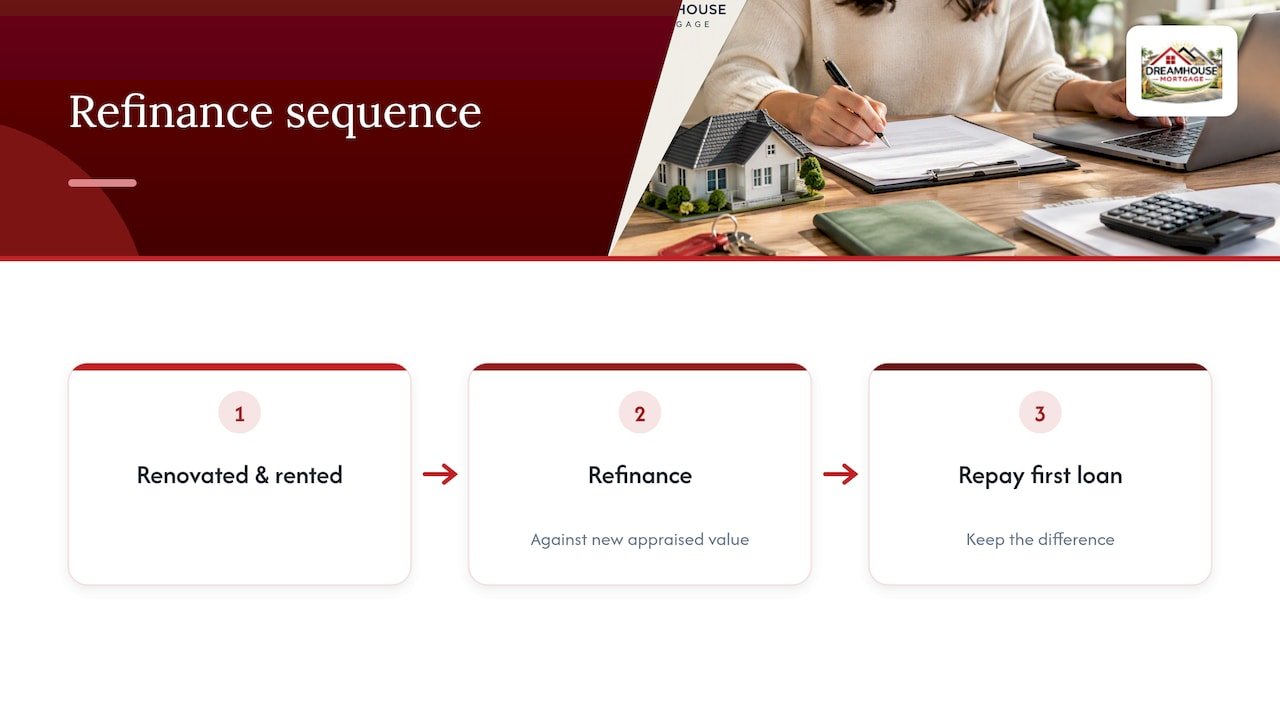
This is the step that defines BRRRR. Once the property is renovated and rented, you refinance against its new appraised value, repay the first loan and keep the difference.
The stress test applies
According to CMHC, lenders calculate debt service ratios using the greater of the contract rate plus 2 per cent or 5.25 per cent. If your actual rate is 4.5 per cent, you qualify at 6.5 per cent. Investors often discover their ratios are tighter than expected for exactly this reason. Your other debts, including your own home mortgage, count in the same calculation.
A worked example
The figures below are a simplified illustration, not a quote, and they ignore legal fees, appraisal costs, interest during renovation and other closing costs, which all reduce what you recover.
| Step | Illustrative figure |
|---|---|
| Purchase price of a Calgary duplex needing work | $380,000 |
| Down payment at 20% | $76,000 |
| First mortgage | $304,000 |
| Renovation budget paid in cash | $60,000 |
| Your cash in the deal so far | $136,000 |
| Appraised value after renovation | $520,000 |
| Refinance at 80% of appraised value | $416,000 |
| Less payoff of the first mortgage | $304,000 |
| Cash released before costs | $112,000 |
| Cash left in the deal before costs | $24,000 |
The example shows why the appraisal matters so much. If the property appraises at $470,000 instead, the 80 per cent figure drops to $376,000 and the cash released falls to $72,000. Your refinance amount also has to pass the stress test on the new payment. Many lenders cap rental refinances at 80 per cent of appraised value, but limits vary by lender and property type, so confirm the maximum for your specific file.
Seasoning: how long before you can refinance
Investors often ask about the seasoning period for a refinance. There is no single national rule. Each lender sets its own minimum time between your purchase and a refinance that uses the higher appraised value, and some lenders will rely on the purchase price for a period of time rather than a new appraisal. Alternative lenders are generally more flexible than banks on this point. Because the timeline decides how long your capital is tied up, ask about seasoning at the planning stage and build the answer into your carrying costs.
Seasoning also has a second meaning in Canadian lending. Lenders and the regulator expect you to document the source of your down payment and your funds, and money that has sat in your account for a period is easier to verify than a large recent deposit. Keep statements that show where your funds came from.
Insured options for secondary suites
If your BRRRR project includes adding a legal secondary suite to a home you live in, a newer product may help. The Government of Canada announced that, effective January 15, 2025, insured refinancing for homeowners building secondary suites became available. CMHC’s published summary describes up to 90 per cent loan-to-value on properties valued up to $2 million. This is aimed at owner-occupants, so it is a different path from a pure investment property refinance. If this is your situation, ask about it directly.
Stage 5: Repeat, and watch your total debt
Each cycle adds a mortgage, a payment and a larger debt load. Before you repeat, check these points with your broker:
- Whether the next purchase still qualifies after the new refinance payment is counted.
- How the same lender will treat several rental properties at once, since policies often tighten as your portfolio grows.
- Whether you should keep the property on a conventional term or look at options such as interest-only investment property mortgages to improve cash flow.
- Whether your rate and renewal dates are staggered so that you are not renewing everything at once.
For a broader view of how investors sequence their financing, see our overview of mortgage strategies for Alberta real estate investors.
Tax points that affect your BRRRR numbers
This is general information based on Canada Revenue Agency guidance, not tax advice. Speak with a Canadian accountant about your own file.
- Financing fees are spread out. Under CRA’s rental income guide, fees such as mortgage brokerage, appraisal and legal fees tied to financing are generally deducted over five years, at 20 per cent a year. If you sell or repay the loan earlier, you can deduct the remaining balance at that time.
- Interest follows the use of the money. CRA allows you to deduct interest on money borrowed to buy or improve a rental property. The same logic means that if you refinance a rental and use the cash for personal purposes, such as a down payment on the home you live in, the interest on that portion is not deductible against rental income.
- Keep business and personal debt separate. Put refinance proceeds into a clearly labelled account and record how each dollar was used.
This last point matters in BRRRR, because the cash you pull out is often used as a down payment on the next rental, which is a different use from spending it on a personal purchase. The paper trail is what shows the difference.
BRRRR in Calgary, Airdrie and Cochrane
BRRRR financing in Alberta follows the same federal rules as anywhere in Canada, but the local market shapes the deal.
- Calgary. Established inner-city communities offer older houses and duplexes where renovation can lift value, while suburban communities offer newer stock with less rehab upside. Rent levels and legal suite rules differ by neighbourhood, so run your numbers on actual comparables.
- Airdrie. Often considered by investors who want lower entry prices than Calgary and a steady rental pool of commuters.
- Cochrane. Popular with families, which can support rental demand, but price points are higher for some property types, so the margin must be checked closely.
Across all three, your appraiser’s comparables decide the after-repair value, not your estimate. Ask your broker which lenders have been comfortable with appraisals in the specific community you are buying in. For an Alberta-specific walkthrough, read our BRRRR strategy guide for Calgary.
A pre-purchase checklist for BRRRR financing
Before you submit an offer, work through these steps:
- Pre-qualify the refinance, not just the purchase. Have a broker run your income, debts and the projected after-repair rent through the stress test, using the projected mortgage payment.
- Set the budget with a margin. Add a contingency to the renovation and a vacancy allowance to the rental period.
- Confirm the exit lender’s policies. Ask about seasoning, maximum loan-to-value, the rental income method and whether the property type (single-family, duplex, up to four units) is treated differently.
- Gather documents. Notice of assessments, T1 Generals, pay stubs or business financials, bank statements showing the source of funds, renovation invoices and the lease.
- Plan for the appraisal. Know the comparable sales that support your target value.
- Check your credit score. CMHC’s insured rental product requires at least one borrower with a 600 score, and a stronger score widens your lender options.
Pro Tip: Do not wait for the renovation to end to find out whether you qualify. Disqualification at the refinance stage is the costliest surprise in this strategy, and it is largely avoidable.
Our perspective: plan the refinance first
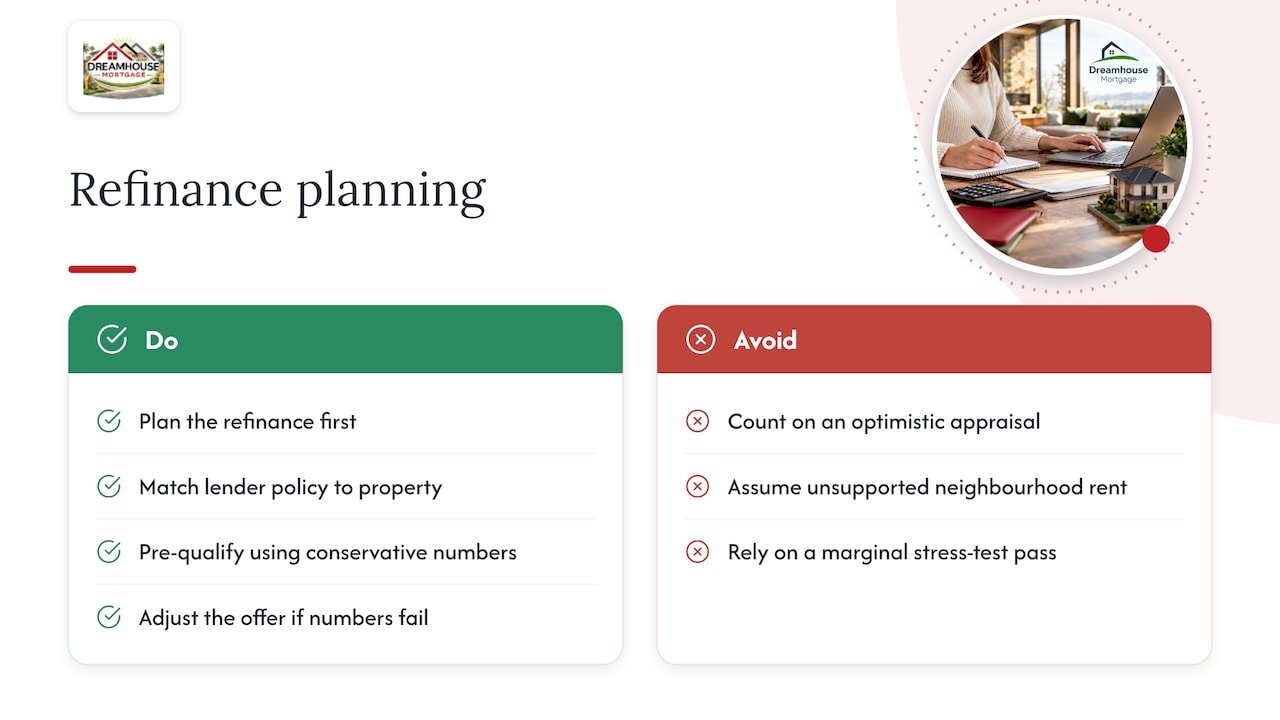
We approach BRRRR from the end of the process. When an investor calls us about a property, the first question is not which rate we can get on the purchase. It is what the refinance will look like twelve months from now and which lender’s rental income policy fits that property.
We work with banks, credit unions, monoline lenders, alternative lenders and private lenders, so we can match a file to the lender whose rules suit it, rather than fitting a file into one institution’s policy. For BRRRR, that matters at both ends: a short-term private or alternative loan to get the project started, and a long-term mortgage to take it out.
We also tell investors when a deal does not work. A BRRRR plan that relies on an optimistic appraisal, a rent that is higher than the neighbourhood supports or a refinance that barely passes the stress test carries too much risk. We would rather you adjust the offer price than discover the gap after the renovation. The best BRRRR files we see are the ones that were pre-qualified on conservative numbers and still worked.
— Guriqbal Chahal, MBA, PMP
Planning a BRRRR purchase with DreamHouse Mortgage
If you are planning a purchase in Calgary, Airdrie, Cochrane or elsewhere in Alberta, we can map your financing from purchase through refinance. Our services include investment and rental property mortgages, refinancing, renovation financing and mortgage pre-approval, and our investment property mortgage page for Calgary explains how we structure rental files.
If you are also buying your first home and want to build toward rental investing, start with our first-time homebuyer mortgage guide for Calgary.
Call Guriqbal Chahal, MBA, PMP, Mortgage Broker, at 403-966-6072, or find us on our Google Business Profile.
Frequently asked questions
Can I use a cash-out refinance on a rental property in Canada?
Yes. In Canada this is usually called an equity take-out refinance. You borrow against the property’s appraised value, repay your existing mortgage and receive the difference as cash. The maximum amount depends on the lender’s loan-to-value limit for rentals, your income and debts, and the stress test. If you use the funds to buy another rental, the interest is generally deductible, but confirm with your accountant.
How long do I have to wait before I refinance a BRRRR property?
There is no single national rule. Each lender sets its own minimum ownership period before it will refinance at a new appraised value, and alternative lenders tend to be more flexible than banks. Ask about this before you buy, so your carrying costs and your private loan term match the lender’s requirements.
Does the stress test apply to a BRRRR refinance?
Yes, for regulated lenders. Per CMHC, qualification is calculated at the greater of your contract rate plus 2 per cent or 5.25 per cent. Rental income is counted under the lender’s own method, so the result can differ between lenders.
Can I borrow my down payment for a BRRRR purchase?
Lenders expect the down payment to come from your own resources, such as savings, a gift from an eligible family member or equity from another property. Borrowed funds are treated differently and need to be disclosed and counted in your debt ratios. Speak with a broker about your specific source of funds before you make an offer.
Is BRRRR financing different in Alberta than in the rest of Canada?
The federal rules, including CMHC insurance and OSFI guidance, are the same across Canada. What changes in Alberta is the local market: prices, rents, appraisals and the lenders comfortable with particular communities and property types. A broker with Alberta experience can match your property to the right lender.
Sources
- CMHC Income Property
- CMHC Rental Income
- OSFI: Clarifying guidance on rental income and mortgage classification
- Government of Canada: Mortgage insurance rule changes for secondary suites
- Canada Revenue Agency: Rental Income (T4036)
- Canada Revenue Agency: Rental expenses you can deduct